News and Announcements
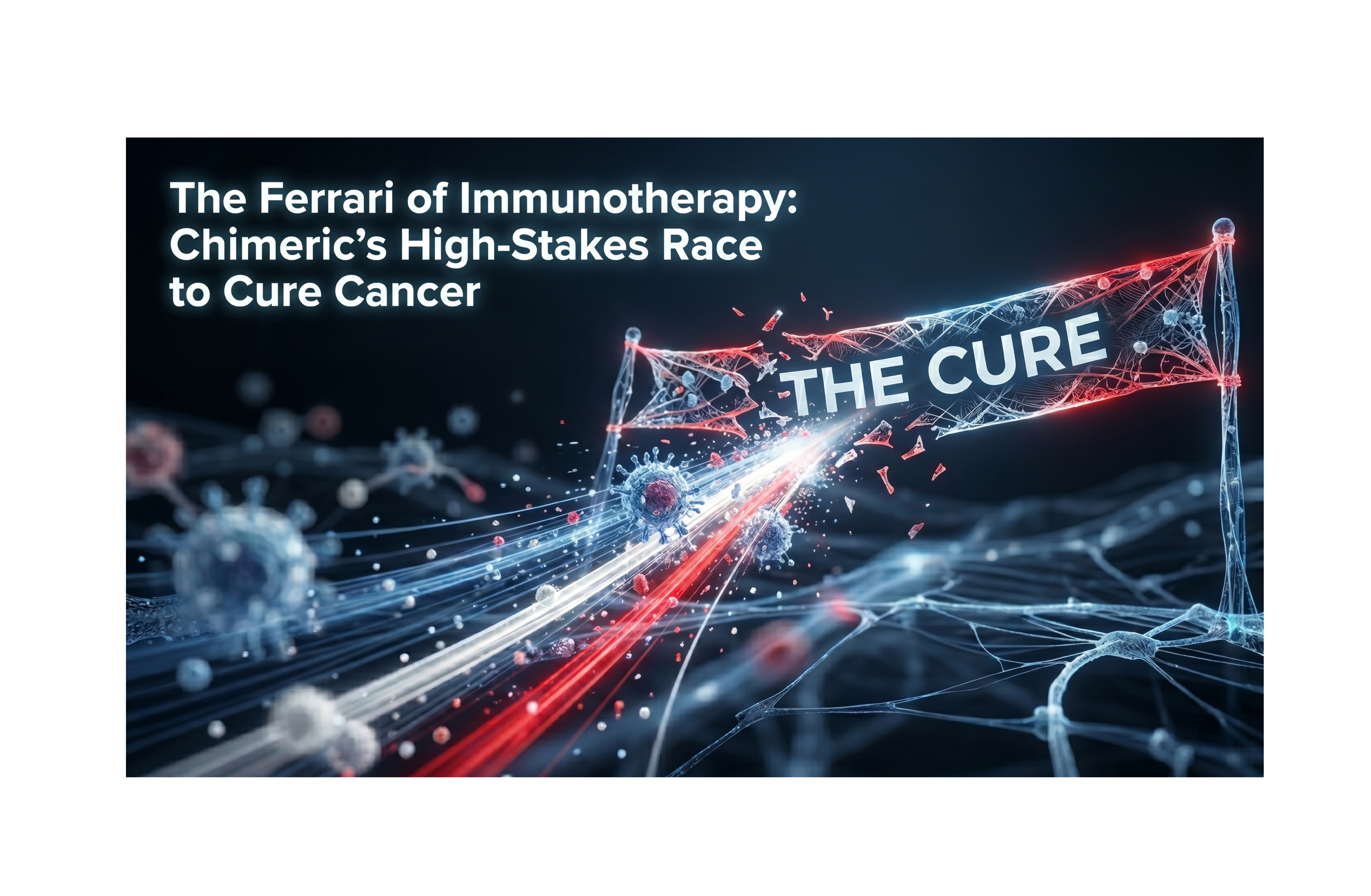
The Ferrari of Immunotherapy: Chimeric’s High-Stakes Race to Cure Cancer
- Published April 30, 2026 4:40AM UTC
- Publisher Jade Miguel
- Categories Capital Insights, Executive Interviews, Landing, Life Science Hub, Trending
In the high-stakes world of biotechnology, the most sophisticated weapon against cancer isn’t a new chemical compound but the patient’s own immune system, re-engineered with the precision of a high-performance engine.
“This particular CAR T is like a Ferrari,” says Dr. Rebecca McQualter, CEO of Chimeric Therapeutics (ASX: CHM). “It’s got two big engines on the back that can really push into the solid tumor and start the attack.”
McQualter, a Monash University PhD in cell therapy who cut her teeth in big pharma acquisitions, didn’t join Chimeric for the corporate title. She was headhunted for a specific reason: she understands both the “bench and the boardroom.” Leading a lean, “special forces” unit of US-based cell therapy experts, McQualter is now steering the company toward a critical value inflection point as they move from first-in-human safety trials into the high-growth territory of Phase 2.

The “Ferrari” vs. The Fortress
For decades, the standard of care for cancers like colon or pancreatic tumors has relied on the “scorched earth” approach of chemotherapy—a 70-year-old systemic treatment that kills healthy cells alongside cancerous ones.
Chimeric is taking a different path. Their lead program, CHM CDH17, utilises CAR T (Chimeric Antigen Receptor T-cell) technology licensed from the University of Pennsylvania—the same birthplace as the world’s first FDA-approved CAR T therapy, Kymriah.
The process is deeply personal:
- Engineering: A patient’s blood is collected and their T-cells are “engineered” in a lab.
- The “Cars”: Scientists attach specific receptors (the “Ferraris”) to these cells, training them to identify and hunt a specific protein called CDH17.
- Reinfusion: The supercharged cells are returned to the patient in a single dose to begin their search-and-destroy mission.
“We give the cells back, and the patient’s body starts to fire up,” McQualter explains. “It uses their own immune system to highlight that the cancer is foreign and it’s time to kill it.”
Solving the “Off-Target” Blind Spot
The challenge with many modern cancer drugs is “off-target effects”—where the drug attacks healthy tissue, leading to severe toxicities. In the 11 patients treated to date across Chimeric’s trials, the results have shown a formidable safety profile.
“We haven’t seen any issues with off-target effects,” McQualter notes. “That is a really big concern as we move through first-in-human trials.”
Beyond safety, the clinical signals are emerging. At the lowest dose level (just 50 million cells), one patient with stage four metastatic disease achieved stable disease for 13 months.
“She hasn’t had any other nasty therapies,” McQualter says. “She told me we’ve given her 13 months where she doesn’t have to go to hospital all the time. Her hair’s grown back; she’s spending time with her teenage children. That patient value is equally as important as the shareholder value.”
Global Pedigree, Sovereign Strength
Chimeric’s credibility is anchored by a “Who’s Who” of global oncology. Their partnerships include:
- University of Pennsylvania: Collaborating with the pioneers of the entire CAR T field.
- MD Anderson Cancer Center: The world’s top-ranked cancer hospital is currently funding an investigator-initiated trial for Chimeric’s second asset, CHM Core-NK, in AML (blood cancer).
- Sovereign Manufacturing: McQualter has strategically partnered with Cell Therapies in Melbourne and the Viral Vector Manufacturing Facility in NSW to ensure the “backbone” of their technology can be produced on Australian soil.
The 2026 Value Inflection Point
For investors, the timeline is tightening. Chimeric is currently closing out its Phase 1 dose-escalation study and is fully funded to reach this milestone by mid-2026.
The company has already secured FDA Fast Track Designation and Orphan Drug Designation for gastric cancer. These aren’t just bureaucratic badges; they represent a “dedicated team” at the FDA helping to map a faster route to market.
“All cell therapies currently on the market have been registered after Phase 2. We may not even need a Phase 3,” McQualter suggests, highlighting the potential for a significantly truncated and less expensive development path.
The Investor Takeaway
As Chimeric prepares to move into Phase 2, the company is operating with a reduced headcount and a “nimble” cost structure. With the FDA already providing a clear regulatory runway and early clinical data showing both safety and stability in terminal patients, McQualter believes the current valuation represents a rare entry point.
“We are just about to hit a very big inflection point,” she concludes. “For an investor who finds this space compelling, now is the right time to look at the story. We are moving at a rapid pace now.”
At a Glance: Chimeric Therapeutics (ASX: CHM)
Regulatory Status: FDA Fast Track & Orphan Drug Designations secured.
Lead Asset: CHM CDH17 (Solid Tumors)
Key Partners: UPenn, MD Anderson, Mayo Clinic (via Lindo collaboration)
Next Milestone: Completion of Phase 1 / Initiation of Phase 2 (Mid-2026)
Trending

Dogs First to Reduce Risk: QBiotics’ Smarter Path to Oncology Markets
QBiotics took a compound derived from a north Queensland rainforest tree all the way to veterinary registration before pursuing human oncology to de-risk its human cancer programme. Interim CEO Ebru Davidson argues that sequence – now backed by early responses across several human cancers – is the company’s real asset. The story that pulled Wholesale […]

Built on discipline, not complexity: inside an ASX equities income strategy
Haydn Froggatt and Zac Brabin have decades of derivatives experience between them and access to almost any strategy in the market. They use two of the simplest structures available, and wrote 202 positions with them last year. Published by Fairway Capital Management. Based on an interview with co-founders Haydn Froggatt and Zac Brabin. Two traders, […]
BlackRock has named the next Economy. What this latest paper means for Private Market Investors.
BlackRock has put a name on something the smart money has been circling for two years. Its digital assets research team calls it the machine-native economy. The thesis fits in one line. AI is machine-native intelligence. Digital assets are machine-native money. Both are built on the same architecture, and they are converging into a single […]
Backed By Leading Investment Groups and Family Offices