
News and Announcements
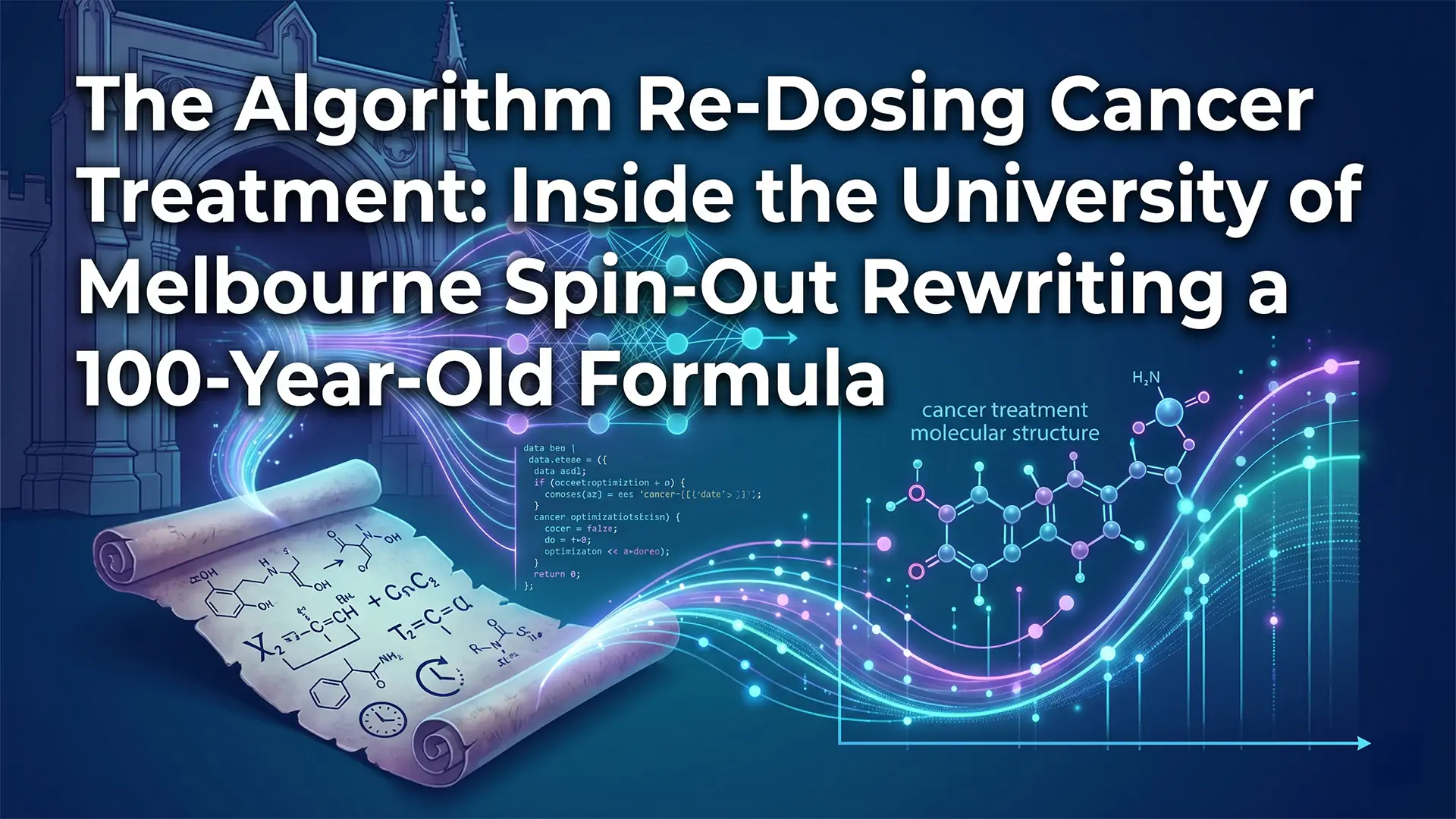
The Algorithm Re-Dosing Cancer Treatment: Inside the University of Melbourne Spin-Out Rewriting a 60-Year-Old Formula
- Published June 24, 2026 4:25AM UTC
- Publisher Jade Miguel
- Categories Capital Insights, Executive Interviews, Landing, Life Science Hub, Trending
The sterile predictability of an oncology ward hides a shocking clinical irony. While multi-billion-dollar immunotherapies and advanced genomic sequencing represent the bleeding edge of modern medicine, the actual calculation of a patient’s chemotherapy dose relies on a mathematical relic from the era of the Ford Model T.
Three years ago, tech executive Abhijeet Waykar sat down with Professor Justin Yeung, a leading colorectal surgeon and clinical researcher at the University of Melbourne and Western Health. Yeung posed a question that left Waykar utterly stunned: Did he know that oncology specialists still calculate chemotherapy doses based purely on a patient’s height and weight?
For Waykar, the problem struck an immediate, deeply painful chord. “My family went through cancer as well, and I felt an instant connection,” Waykar says, reflecting on the genesis of PredicTx. “Throughout my 15- to 20-year career working with medical imaging giants like Siemens, Philips, and 4DMedical, I’ve seen a lot of legacy thinking. But to find out how chemotherapy is still being given to patients, I was completely shocked. I knew there had to be a better way.”
Driven by a clinician’s frustration and a founder’s personal “why,” the duo launched PredicTx, a University of Melbourne spin-out engineered to drag cancer dosing into the era of precision medicine.
The ‘Sumo vs. Bodybuilder’ Blind Spot
To appreciate the technological leap PredicTx is commercialising, one must understand the profound flaws of the current Standard of Care. The century-old formula used globally operates on a “one-size-fits-all” assumption of human body surface area.
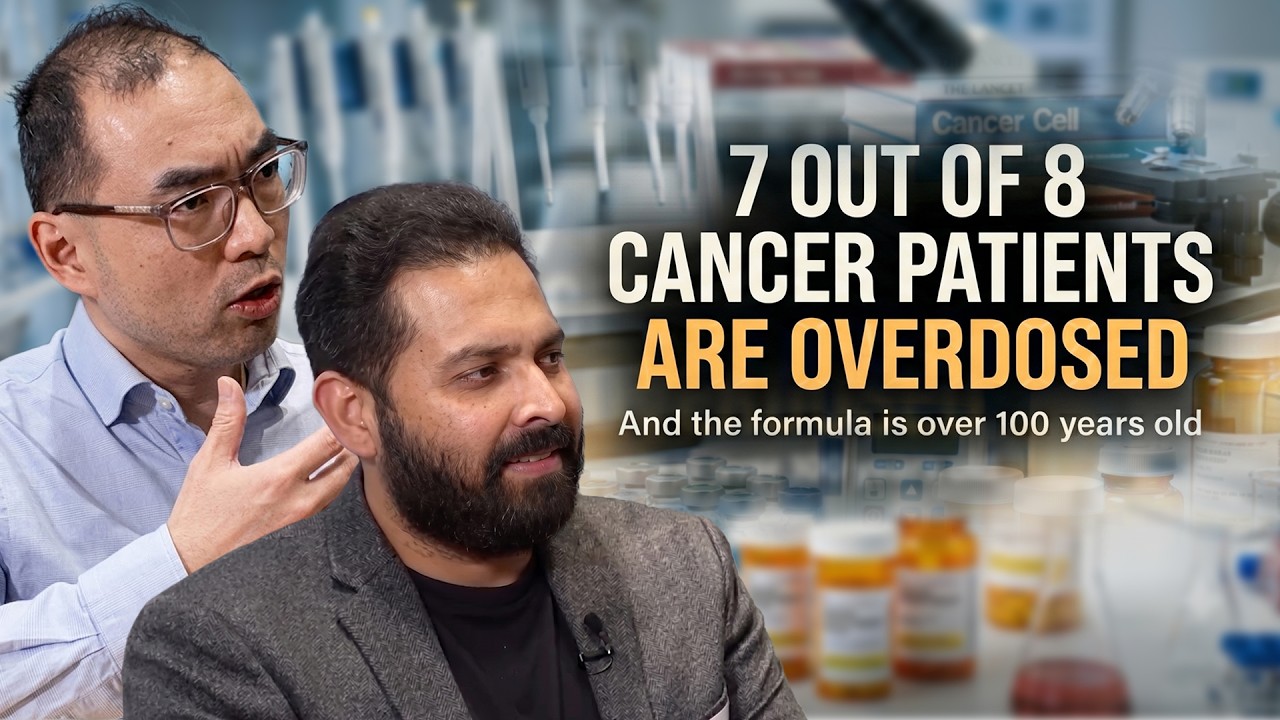
“You can have two patients who have the exact same height and weight,” explains Professor Justin Yeung. “Think of a bodybuilder and a sumo wrestler. Under the current system, they receive the exact same chemotherapy dose. But the sumo wrestler will suffer severe toxicities because they are incorrectly overdosed, while the bodybuilder tolerates it well. Because we just use very simple parameters, women are also terribly overdosed compared to men.”
The clinical consequences are devastating. According to Yeung, seven out of eight cancer patients are currently overdosed by specialists working with inadequate data. This systemic overdosing triggers an avalanche of side effects, leading to a catastrophic statistic: one out of three overdosed patients never get to finish their treatment. In the most brutal terms, patients run out of options because they cannot survive the toxicities of the cure.
The PredicTx solution does not require patients to undergo a single extra test or invasive procedure. Instead, its proprietary AI acts as a “molecular decoder,” mining millions of data points hidden inside routinely performed CT scans that patients have already had. The algorithm reads complex patterns through advanced machine learning that are completely invisible to the human eye, generating a hyper-personalised dosing report tailored to how that specific body will tolerate the treatment.
A Multi-Billion-Dollar Drain on the Healthcare Balance Sheet
Beyond the human toll, the economic friction of bad dosing is a massive, unhedged liability for healthcare networks. Currently, a hospital spends anywhere from $50,000 to upwards of $500,000 per patient just managing the toxic downstream complications, emergency readmissions, and wasted drugs associated with incorrect chemotherapy doses.
“When a patient gets hit with severe toxicities, that day-treatment chair sits empty, and a highly expensive, pre-made chemotherapy drug gets thrown away,” Yeung notes. “The doctor, nurse, pharmacist, and support services are just waiting there to treat someone who isn’t there. It is a terrible waste of resources.”
PredicTx is tackling this head-on with a simple business model: charging hospitals $500 per CT scan to generate a personalised dosing report.
For hospital chief financial officers, the economic logic is a no-brainer:
“We priced this based on our health economics assessment,” says CEO Abhijeet Waykar. “At $500 a report to mitigate a minimum $50,000 toxicity risk, we are delivering a 100x return on investment (ROI) straight back to the hospital’s bottom line.”
Lean Operations, Zero Workflow Friction
The graveyard of healthcare technology is filled with brilliant software that clinicians simply refused to use because it added to their administrative burden or exacerbated healthcare burnout. Waykar, who has previously founded a digital health company, engineered PredicTx to avoid this trap.
The platform integrates directly into existing hospital databases, consolidating scattered patient metrics into a single platform. Instead of burning time toggling between legacy systems that don’t talk to each other—or losing track of critical data when patients have blood tests done nearer to home—clinicians save 15 to 20 minutes per patient per consult. It is an elegant operational play that combats widespread staff burnout while driving clinical adoption.
By operating a highly scalable software-driven model, PredicTx keeps capital expenditure exceptionally low. The company leverages the world-class pedigree of its founders and its institutional roots at the University of Melbourne to bypass the heavy infrastructure costs traditionally associated with therapeutic biotech enterprises.
The Value Inflection Point: The Commercial Runway
PredicTx is moving swiftly down a well-defined commercialisation pathway. The company is currently in the middle of a capital raise to fund its next stage of deployment, bringing investors in at a critical point of value inflection.
Five years from now, the founders envision a paradigm shift where the patient is restored to the center of care. Instead of doctors spending their limited 10-minute consults buried in screens searching for scattered results and guessing doses, the software automates the logistics, allowing true precision medicine to take over.
For institutional investors, the “economic logic” of this milestone is where the valuation rerate lies. In medical software, moving from academic validation to active, revenue-generating hospital integration represents the ultimate de-risking event. Once the software is proven to consistently lower readmission rates and save clinical time across multiple departments, PredicTx transforms from an early-stage spin-out into an indispensable piece of global healthcare infrastructure.
The Investor Takeaway
The asset sits in an enviable “hot zone.” While traditional drug-development companies require hundreds of millions of dollars and a decade of high-risk clinical trials to achieve commercial viability, PredicTx is a pure-play AI platform leveraging data already paid for and sitting in the system.
At a time when global markets are heavily penalising capital-intensive, high-risk ventures, PredicTx offers a rare combination: the explosive scalability of software married to the defensive, non-cyclical multi-billion-dollar oncology market.
The information needed to dose every cancer patient correctly is already sitting idle on medical servers; we just haven’t been reading it. PredicTx is changing that, presenting a highly asymmetric risk-reward profile for forward-looking investors.
Trending
BlackRock has named the next Economy. What this latest paper means for Private Market Investors.
BlackRock has put a name on something the smart money has been circling for two years. Its digital assets research team calls it the machine-native economy. The thesis fits in one line. AI is machine-native intelligence. Digital assets are machine-native money. Both are built on the same architecture, and they are converging into a single […]

Where’s the beef? Blackstone just answered the AI question.
In 1984, a fast food ad asked a question that became a catchphrase. Where’s the beef? Jon Gray, President of Blackstone, used that line this month in front of global LPs. It is the question every capital allocator is asking about AI. Trillions of dollars are going into chips, data centres and power. That is […]
The Best of Both Worlds: How Omnique Fund is Rewiring Real World Assets via Tokenisation
For decades, the playbook for Australia’s wholesale investors has remained relatively unchanged: pick between the slow-moving, illiquid reliability of tangible assets like property and gold, or chase the frictionless, high-velocity liquidity of public equity and digital markets. But as macroeconomic volatility spikes and a structural housing deficit reshapes private debt demand, sophisticated investors are demanding […]
Backed By Leading Investment Groups and Family Offices