
News and Announcements
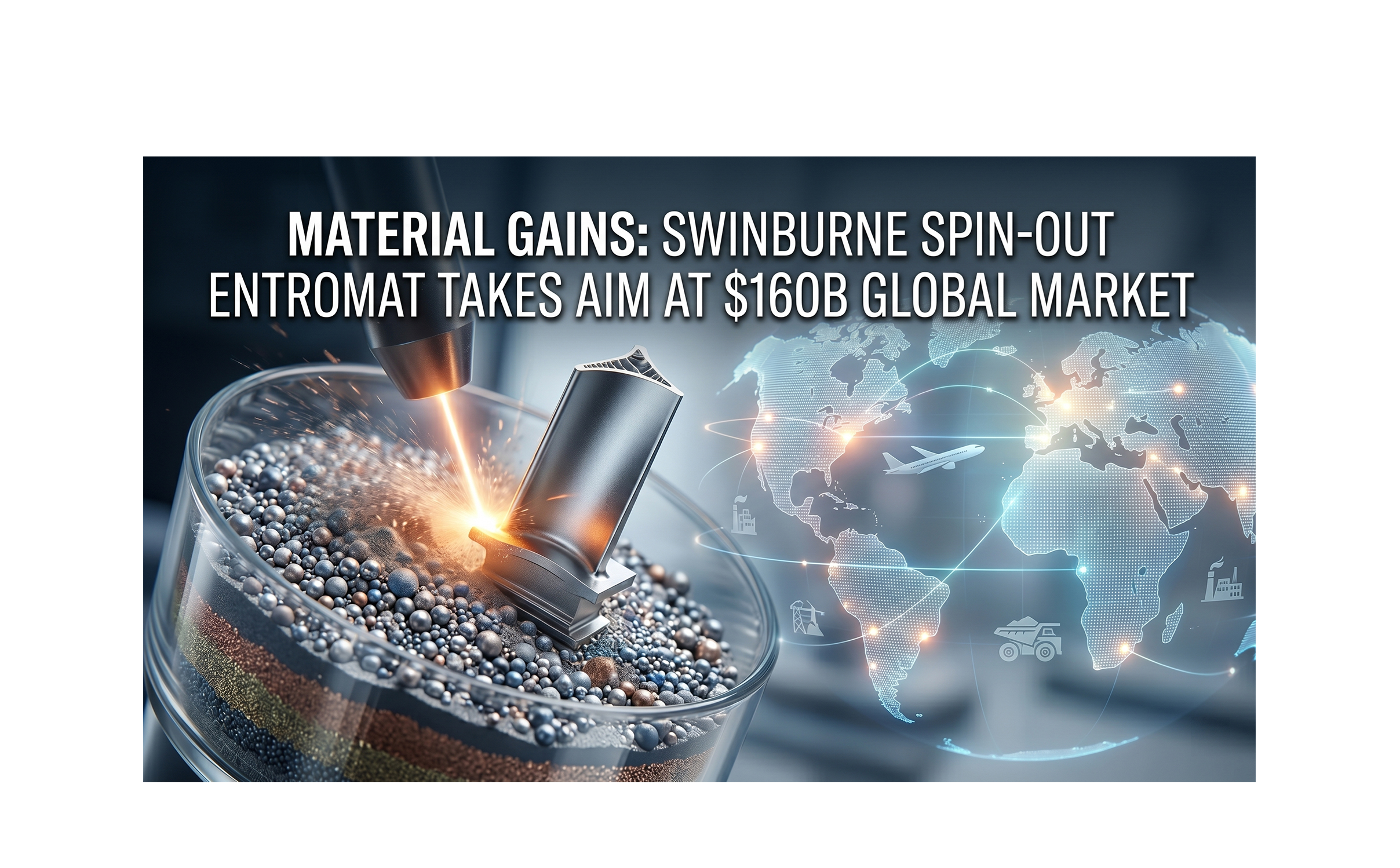
Material gains: Swinburne spin-out EntroMat takes aim at $160b global market
- Published June 24, 2026 3:43AM UTC
- Publisher Jade Miguel
- Categories Capital Insights, Executive Interviews, Landing, Trending
Traditional metallurgy has hit a wall, and Melbourne-based deep-tech startup EntroMat believes the answer lies in the trillions of atomic combinations it is unlocking via physics-based artificial intelligence.
Speaking on the sidelines of the Emergence 2026 flagship conference in Sydney, EntroMat chief executive Greg Lindsay revealed the company is on the cusp of commercial scaling, with eyes firmly set on disrupting the $9 billion global metal powder market and the broader $160 billion advanced materials sector.
A spin-out from Swinburne University of Technology, EntroMat is pioneering the development of high-entropy materials—next-generation alloys engineered to withstand the brutal operational environments that push conventional metals to catastrophic failure.

Decoding the complexity of “high-entropy”
For decades, industrial sectors like mining, aerospace, and energy have managed a delicate balance with component wear and tear. Traditional alloys fail under extreme heat, pressure, acidity, or particle erosion, costing operators millions in downtime and lost productivity.
EntroMat’s solution sidesteps traditional metallurgy by mixing five or more elements in equiatomic (equal) proportions.
“The challenge there is that you need to computationally predict [the outcomes] because there are trillions of combinations when you take into account the periodic table,” Lindsay explained.
To solve this, the company is commercialising predictive computational capabilities developed at Swinburne, accelerated by what Lindsay terms “physical AI.”
“This is not just AI where you throw it over the fence and somebody else manufactures it. We are actually going to manufacture the materials. We have lab-scale capability right now… we validate the results we achieve and feed that back into the AI. It’s science-based engineering knowledge driving the system.”
The green premium without the cost
Crucially for institutional investors eye-ing ESG mandates, EntroMat’s business model does not rely on virgin critical minerals. Instead, the company is building a circular feedstock loop.
“Where we need nickel, we won’t buy pure nickel,” Lindsay said. “We’ll buy scrap Inconel material—which is very high in nickel—and use other recycled materials. We want to reduce the demand on critical minerals.”
This circular approach has already yielded commercial interest in Europe. EntroMat is currently developing bespoke material solutions designed to bypass strict European REACH environmental regulations, offering continental heavy-industry players a compliant, highly durable alternative to hazardous legacy coatings.
The commercial runway
EntroMat is approaching a sharp technical-to-commercial inflection point. While the long-term horizon includes high-margin medtech applications like biocompatible, rejection-resistant implants, the immediate revenue thesis is anchored in heavy industry.
The company is currently running proof-of-concept projects across:
- Australia: Partnering with the local tier-one mining sector to combat asset erosion.
- North America & Europe: Deploying field tests for extreme industrial applications.
The financial runway is heavily non-dilutive. Swinburne University was recently awarded an Australian Government grant with EntroMat as the exclusive industry partner, effectively creating a three-times R&D multiplier. “We put in $1 million, we get $3 million worth of R&D,” Lindsay noted.
Investor outlook
The timeline for investors is compressed. EntroMat expects to install and commission commercial-scale manufacturing equipment by early 2027.
With commercial contracts expected to land in the second half of this year, the company expects a rapid transition into full commercial supply by 2027.
“We are quite small currently, but we have the customers right now, we have access to the equipment, and we have large-scale R&D activity in place,” Lindsay said. “We have a very fast path to growth right in front of us.”
Trending

The A$20.4 Million Inertia Trap: How Kepa Software Is Unlocking Value in Enterprise Capital Allocation
A government agency renewed the same maintenance decision nine years running, because auditing the original choice was deemed too expensive. When the portfolio was finally tested, A$20.4 million of low value spend was identified in a single year. Kepa Software’s capital governance platform was built to expose and eliminate precisely these boardroom blind spots. For […]
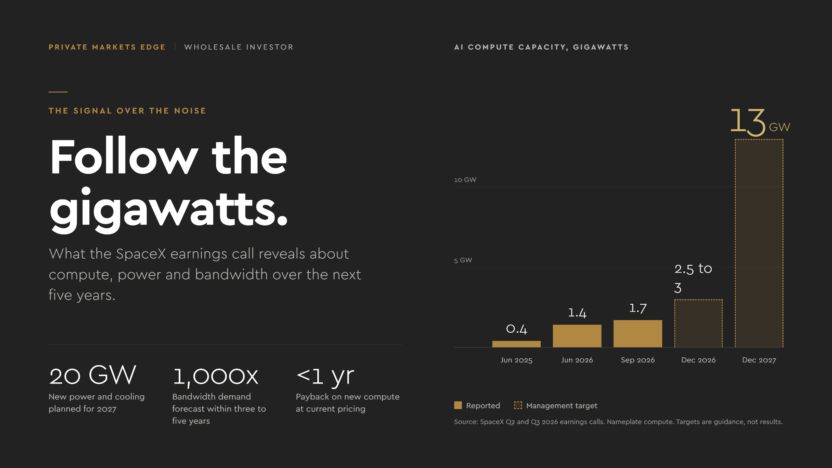
Forget the share price. SpaceX just published a map of the next five years.
Most coverage of SpaceX’s result focused on a 9.1% share price fall. That is noise. The signal is in the transcript: compute, power, bandwidth and demand over the next five years.

The prefab company that deliberately leaves part of the house unbuilt
BuiltQuik prefabricates the floor and roof structure and stops there. Co-founder Ryan Mullaney argues the omission is the product. Prefabricated housing usually means a factory. A large central facility, identical modules, limited room to move on design, and a logistics problem getting the finished box to site. BuiltQuik builds the opposite, and the design decision […]
Backed By Leading Investment Groups and Family Offices