
News and Announcements

A new corridor for wealth: PanGen Capital opens institutional property to the $100k investor
- Published June 24, 2026 2:26AM UTC
- Publisher Jade Miguel
- Categories Capital Insights, Executive Interviews, Landing, Trending
For decades, the crown jewels of Australian commercial real estate—trophy assets like Melbourne’s Highpoint Shopping Centre, Sydney’s Gateway Tower, and premium logistics hubs tenanted by Amazon and Nike—have been the exclusive playground of multi-billion-dollar superannuation funds and sovereign wealth funds.
Meanwhile, high-net-worth individuals and wholesale investors have been forced into a frustrating binary choice: direct property syndicates with high concentration risk, elevated gearing and heavy cost structures, or listed real estate investment trusts (A-REITs) that trade with the high volatility of the stock market.
Wealth management firm PanGen Capital calls this mismatch the market’s “structural gap.” In response, the firm has launched a targeted intervention designed to smash those institutional barriers.
Through its newly established vehicle, the PanGen Australian Real Estate Fund (PAREF), the firm is targeting wholesale investors with a minimum investment of $100,000. By pooling this capital, PanGen Capital buys directly into the very same institutional, unlisted wholesale funds managed by heavyweights like Dexus, GPT, Charter Hall and Goodman Group—underlying portfolios that collectively manage over $95 billion in premium real estate.
“To get into these institutional-grade funds directly, you typically need $10 million or more, and you have to be structured correctly,” explains Ryan Bass, Managing Director and Founder of PanGen Capital. “When I was managing money inside institutional funds like UniSuper, we had several billion invested across these vehicles. The core thesis behind PanGen was simple: why can’t sophisticated, non-institutional investors access these cycle-tested, low-fee, well governed assets?”

Institutional pedigree meets wholesale wealth
PanGen Capital’s investment strategy is backed by deep institutional muscle. Founder Ryan Bass brings a 25-year track record inside institutional property markets, having been directly involved in over $8 billion worth of major property transactions.
His background includes a senior tenure at UniSuper, where key milestones included the acquisition of a one-third stake in Perth’s Karrinyup Shopping Centre (followed by a $800 million redevelopment) and partnering with CBus in the landmark acquisition of Sydney’s Macquarie Centre and Queensland’s Pacific Fair—the largest retail property transaction in Australian history.
Now, PanGen Capital is deploying that exact institutional playbook for the wholesale market. Through PAREF, the firm provides its investors with immediate exposure to premium unlisted underlying vehicles, such as the $13 billion Dexus Wholesale Property Fund (DWPF), which holds blue-chip assets like Quay Quarter Tower and the Horizon 3023 logistics hub in western Melbourne.
“These are what I call ‘forever assets,'” Bass notes. “They are the sort of properties you hold for the long term because they possess an enduring capacity to grow income and capital value.”
A ‘Goldilocks’ call on returns
The fund’s launch coincides with what PanGen Capital describes as a rare “Goldilocks period” for commercial property, prompting the firm to upgrade its short-to-medium-term total return outlook to over 10% per annum.
While the broader property market has suffered a painful four-year repricing driven by aggressive interest rate hikes and pandemic disruptions, PanGen Capital argues that the correction has created a major mispricing of risk and return.
“We are starting from a revalued entry point with higher incoming yields,” Bass explains. “Crucially, construction costs have skyrocketed and CBRE forecasts another 18% rise over the next couple of years from an already elevated base. This will further constrict an already highly constrained forward supply pipeline.”
At the same time, Tier-1 corporate and retail tenants, including national giants like Coles, Woolworths, and JB Hi-Fi, are refusing to compromise on space, concentrating demand in premium, institutional-grade assets.
“We are entering a severe demand-supply squeeze in the prime sector, which is driving surging rental growth,” says Bass. “Historically, this asset class delivers 8% to 10% total returns with very low risk and low gearing. With a double-digit return outlook in the short to medium term right now means you are getting an exceptional return profile for what is fundamentally a defensive asset class.”
Deploying the ‘Q3AP’ filter
To navigate the post-rate-hike landscape, PanGen Capital relies on a strict proprietary investment framework dubbed Q3AP:
- Quality Assets: Focusing on well positioned, prime properties that can attract and retain quality tenants..
- Quality Managers: Partnering with institutional platforms that possess deep funds management, leasing, asset management, and development capability.
- Quality Structures: Ensuring robust governance, conservative financial leverage, and frequent independent valuations across all underlying assets.
- Attractive Pricing: Utilising a proprietary time-series database monitoring over 40 listed and unlisted securities to quantitatively identify mispriced entry points.
“Investment is a mix of art and science,” Bass notes. “The database gives us the quantitative snapshot that we overlay with decades of institutional judgment and committee experience.”
Rethinking asset allocation
Within a multi-asset portfolio, PanGen Capital views core unlisted property as a critical diversifier that fills a gap listed REITs no longer address.
| Asset Feature | PanGen Real Estate Fund (PAREF) | Listed REITs (A-REITs) | Traditional Syndicates |
| Asset Type | Unlisted Institutional Core Property | High Equity Correlation / Dev. Risk | Single-asset / Secondary Grade |
| Liquidity | Monthly applications / Quarterly redemptions | Daily stock market pricing | Illiquid (5–7 year lock-ups) |
| Gearing / Leverage | Conservative / Low | Variable | High |
| Capital Efficiency | $1.00 invested buys ~$1.00 in net tangible assets (NTA) | Subject to market sentiment | ~85¢ buys NTA (due to stamp duty/fees) |
“Many investors believe they have commercial property exposure through listed REITs, but the A-REIT index has shifted significantly. Today, more than 50% of that sector is weighted toward property developers and fund management companies,” Bass argues. “That moves you away from what core property actually is—stable, income-producing real estate.”
Furthermore, PanGen Capital highlights the structural efficiency of its vehicle. Unlike direct property syndicates where upfront stamp duty and high manager fees immediately dilute an investor’s capital—often reducing an initial dollar to 85 cents of asset value—PAREF buys into established institutional funds where the stamp duty has already been paid.
“Every dollar an investor puts into our fund goes to work as a dollar of net tangible assets,” Bass says.
Where PanGen Capital is moving capital
Sector selection is highly nuanced in the current climate. PanGen Capital’s highest-conviction bet right now is dominant retail malls, such as Highpoint Shopping Centre (currently ranked number three in Australia by sales volume).
“The best retail malls are essentially full,” Bass says. “The retailers in these highly productive centers are generating strong sales and profitability, and many national retailers want to expand their footprints. Because no new mega-malls are being built, landlords’ pricing power for these malls are increasing.”
In the office sector, the firm is avoiding secondary assets, focusing exclusively on “super-core” CBD assets in Sydney and Brisbane, where high construction barriers are translating into strong net effective rental growth. In logistics, we like well-located prime warehouses positioned in in-fill markets close to major population hubs and with strong linkages to major transport nodes and critical infrastructure hubs such as airports and ports.
With monthly applications, quarterly distributions, and structured quarterly liquidity of up to 5% of Net Asset Value (NAV), PanGen Capital believes it has introduced a missing liquidity mechanism to unlisted real estate.
“We’ve built a genuine pathway for wholesale investors to sit at the table with the country’s largest super funds,” Bass concludes. “It’s institutional-quality access, conservative gearing, and genuine diversification at a point in the cycle where the risk-return equation is strongly in the buyer’s favour.”
Trending

The A$20.4 Million Inertia Trap: How Kepa Software Is Unlocking Value in Enterprise Capital Allocation
A government agency renewed the same maintenance decision nine years running, because auditing the original choice was deemed too expensive. When the portfolio was finally tested, A$20.4 million of low value spend was identified in a single year. Kepa Software’s capital governance platform was built to expose and eliminate precisely these boardroom blind spots. For […]
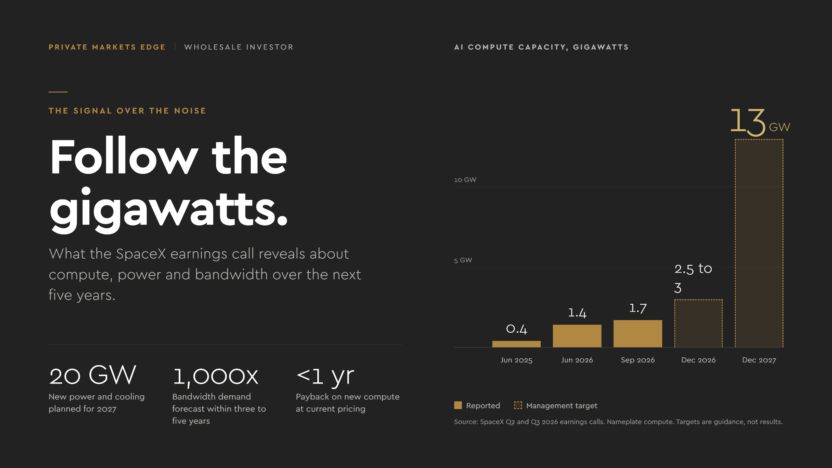
Forget the share price. SpaceX just published a map of the next five years.
Most coverage of SpaceX’s result focused on a 9.1% share price fall. That is noise. The signal is in the transcript: compute, power, bandwidth and demand over the next five years.

The prefab company that deliberately leaves part of the house unbuilt
BuiltQuik prefabricates the floor and roof structure and stops there. Co-founder Ryan Mullaney argues the omission is the product. Prefabricated housing usually means a factory. A large central facility, identical modules, limited room to move on design, and a logistics problem getting the finished box to site. BuiltQuik builds the opposite, and the design decision […]
Backed By Leading Investment Groups and Family Offices