
News and Announcements

The Concierge of Cure: How Cicada Innovations is Solving the ‘Lab-to-Bedside’ Gap
- Published June 24, 2026 2:22AM UTC
- Publisher Jade Miguel
- Categories Capital Insights, Executive Interviews, Landing, Life Science Hub, Trending
In the high-stakes world of deep tech, there is a recurring tragedy: a world-changing medical breakthrough that never leaves the laboratory. For many scientist-founders, the distance between a successful petri dish and a clinical trial can feel less like a gap and more like a canyon.
“Building a successful health tech company isn’t just about having breakthrough science,” explains Lilly Bojarski, General Manager at Cicada HealthTech Hub at Westmead. “It requires access to clinical networks, regulatory expertise, the right infrastructure, and more to actually test and validate your story with real patients.”
As the leader of Cicada’s Health Tech Hub at Westmead, Bojarski isn’t just providing office space; she is operating a connection pathway to the heart of Australia’s largest health district.

The Connection to Clinical Reality
While the global med-tech sector often fixates on funding, Bojarski identifies a more critical “blind spot”: the lack of integration between innovators and the messy reality of a working hospital.
Cicada’s Health Tech Hub is strategically located within the Westmead Health and Innovation District, an ecosystem housing four major hospitals and over 1,200 active clinical trials. This proximity creates a “concierge system” that allows startups to “cut to the chase” and engage directly with the people who will ultimately use their products.
“We’ve helped our residents meet with clinicians, surgeons, and hospital leadership to understand what parameters are actually important,” Bojarski says. “What do they need to see to derisk a new digital health technology before onboarding it into the hospital?”
By facilitating over 40 one-on-one clinical meetings for residents in just two years, the Hub ensures that product development plans are built on clinical feedback rather than assumptions.
Translating ‘Science’ into ‘Business’
Cicada’s track record is formidable: in its 25-year history, it has supported over 500 deep tech ventures that have collectively raised approximately $6.5 billion, including some of Australia’s most promising med and biotech ventures; Clarity Pharmaceuticals, Osara Health, SpeeDX, Tetratherix. Yet the pattern of success often hinges on a single, difficult transition: the founder’s ability to speak the “language of business.”
Many of Bojarski’s early-stage founders are clinicians or researchers by training. They are fluent in the language of science and research, but often struggle to articulate value inflection points to an investor.
“It’s often counterintuitive for a researcher to articulate how a financial partner will realise the value of their investment down the road,” she notes. Cicada’s educational programming focuses on upskilling these experts, ensuring their “miracle molecules” are packaged as viable, scalable assets that can survive the transition to market.
The 2026 Inflection Point: Why Health Tech Now?
As the investment community gathers for the Emergence 2026 conference in Sydney, the conversation around health tech has reached a fever pitch. Bojarski argues that the sector is uniquely positioned for 2026, offering a “human-level” impact that traditional industry verticals like real estate cannot match.
The Economic Logic:
- Derisking through Integration: Startups at Westmead gain key feedback from “customers” through consultation with clinical stakeholders, reducing the “failure-to-adopt” risk.
- Advanced Manufacturing: Westmead is increasing its focus on manufacturing facilities for gene and cell therapies, keeping the intellectual property and production on-shore.
- Unmet Need: With global populations aging, the demand for non-invasive diagnostics and digital health tools represents a multi-billion dollar opportunity.
The Investor Takeaway: The ‘Hot Zone’ of Innovation
For investors seeking exposure to high-growth biotechnology, the current valuation of Australian health tech often lags behind its international peers, despite the world-class clinical research being conducted at precincts like Westmead.
Bojarski’s mission is to bridge that valuation gap by connecting early-stage founders with the broader investment community early and often. “Health tech can be just as attractive as any other industry vertical,” she concludes. “In some cases, more so—because we are all affected by health. Supporting these entrepreneurs to bring assets to market is about making all of our lives better.”
In the, high-stakes sprint of medical innovation, Cicada Innovations is proving that the most important tool in a health-tech founder’s kit isn’t a microscope—it’s the ability to connect with the customer – the healthcare delivery teams at hospitals and clinics.
Cicada Innovations at a Glance
- For every public dollar invested to establish Cicada, more than $400 in economic activity has been generated, proof of the power of long-term investment in deep tech.
- Total Ventures Supported: 500+
- Total Capital Raised: $6.5 Billion
- Key Location: Westmead Health and Innovation District
- Current Milestone: Expanding through new incubators such as the “Jumar” sister incubator in Melbourne to create a national health tech corridor.
Trending

The A$20.4 Million Inertia Trap: How Kepa Software Is Unlocking Value in Enterprise Capital Allocation
A government agency renewed the same maintenance decision nine years running, because auditing the original choice was deemed too expensive. When the portfolio was finally tested, A$20.4 million of low value spend was identified in a single year. Kepa Software’s capital governance platform was built to expose and eliminate precisely these boardroom blind spots. For […]
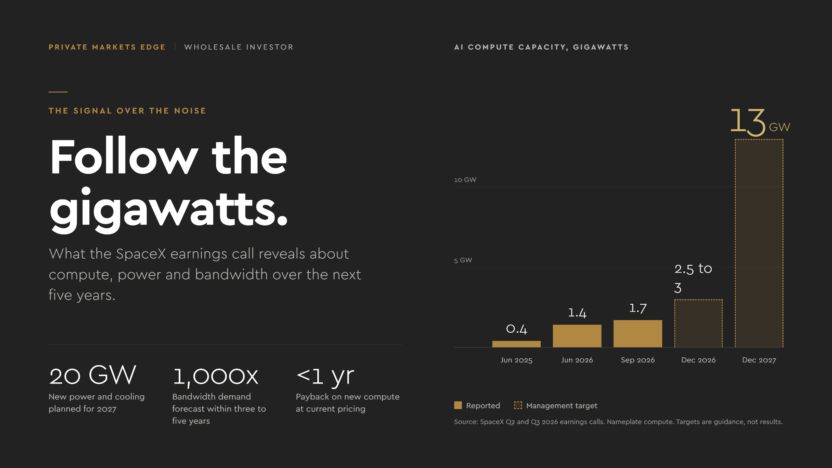
Forget the share price. SpaceX just published a map of the next five years.
Most coverage of SpaceX’s result focused on a 9.1% share price fall. That is noise. The signal is in the transcript: compute, power, bandwidth and demand over the next five years.

The prefab company that deliberately leaves part of the house unbuilt
BuiltQuik prefabricates the floor and roof structure and stops there. Co-founder Ryan Mullaney argues the omission is the product. Prefabricated housing usually means a factory. A large central facility, identical modules, limited room to move on design, and a logistics problem getting the finished box to site. BuiltQuik builds the opposite, and the design decision […]
Backed By Leading Investment Groups and Family Offices