News and Announcements

The Zero-Copyright Trap: Why Corporate Australia is Bleeding Intellectual Property to Big Tech
- Published June 19, 2026 4:41AM UTC
- Publisher Jade Miguel
- Categories Capital Insights, Executive Interviews, Landing, Trending
Every time an employee pastes data into a mainstream artificial intelligence tool like ChatGPT or Microsoft Copilot, corporate Australia is making an unforced error: it is voluntarily surrendering its intellectual property.
That is the blunt warning from Robert Leroux, founder of Digilabs, the venture builder behind local-first AI engineering platform NYEX.AI (frequently dubbed NYX). While corporate executives focus heavily on public data retention policies, Leroux warns they are missing a far more critical legal cliff: the complete absence of copyright protection.
“Under current legal frameworks globally, AI is not recognised as a legal entity or person,” Leroux says, citing ongoing consultations with Dr. Jillian Dempsey, a Queensland barrister and leading authority on the intersection of AI and copyright. “AI is classified as a tool or a product. Because of that, there is actually zero copyright in any work generated on these public platforms.”
The implications for enterprise security are stark. In a legal landscape where AI-generated outputs lack intellectual property protections, corporate data effectively enters a “free-for-all” zone. Even if a frontier model provider promises not to retain data for training, the lack of proprietary ownership means competitors or the public could theoretically exploit that work without legal recourse.
“This issue about protecting private information—and the escalating cost of API tokens—was the exact impetus behind us building NYEX,” Leroux says.

Redefining the AI Mode: Local-First and Model Agnostic
Digilabs, which is simultaneously scaling software deployment venture One Copy and the NYEX platform, took a different approach born out of necessity. While building One Copy, the team faced a dual burden: safeguarding their own intellectual property and footing a skyrocketing monthly bill for public cloud computing.
Their solution was to build NYEX as a “local-first,” model-agnostic agentic AI platform. It allows businesses to run complex AI workflows locally on their own infrastructure, ensuring data never leaves the building.
Crucially, the platform acts as an orchestrator. It passes highly complex tasks to frontier cloud models only when necessary, while routing routine tasks to open-source, locally hosted models like Meta’s Llama.
By shifting to this hybrid infrastructure, Leroux claims Digilabs achieved what most chief financial officers are desperately looking for: a 50% to 60% reduction in AI computing costs, all while locking down their core IP.
This pragmatic approach to AI infrastructure has already triggered significant organic traction. Since launching its alpha and beta builds in February, NYEX has logged over 3,000 downloads from a public repository with zero marketing spend. While early adopters have been primarily technical developers, Leroux notes that startups and non-technical founders have begun downloading the platform ahead of its stable release.
The Next Trillion-Dollar Shift: Services as a Software (SaaS 2.0)
For the venture capital and investment community, the bigger play lies in what Leroux terms the transition from Software-as-a-Service (SaaS) to “Services-as-a-Software”—a market shift he projects will follow the trajectory of the global SaaS industry toward a $1 trillion valuation by the 2030s.
Rather than buying static software licenses to input data manually, Leroux envisions a future dominated by specialised “extensions” that sit on top of AI engineering platforms like NYEX. These domain-specific, plug-and-play applications are driven entirely by natural language prompts rather than code.
To prove the concept, the company recently deployed a diagnostic extension app to troubleshoot a client’s lagging system.
“We used NYEX to analyse the system. It identified exactly where the bottleneck was in the process flow, diagnosed the root cause, and recommended a fix,” Leroux explains. “It then prompted us for human approval. We gave it the green light, and NYEX executed the fix. No coding, just prompting.”
The company plans to aggressively expand these extensions into traditional white-collar service sectors like accounting and bookkeeping. Instead of manual data entry into legacy accounting software, a user will simply prompt the platform—connected securely via local APIs to bank statements and receipts—to compile and execute monthly journal entries automatically.
Building a Moat Against the Tech Giants
In a market brutally dominated by trillions of dollars of Big Tech capital, small AI startups face an existential question: How do you survive against Google, Microsoft, and OpenAI?
Leroux insists that the tech giants’ greatest strength—their massive, centralised cloud ecosystems—is also their fundamental vulnerability.
“Where we believe we’re going to win is by building a moat around privacy,” Leroux says. “There is an accelerating corporate backlash. Enterprises want to keep their information private and protect their intellectual property. Because NYEX is local-first, the data stays on your device.”
To solidify this defensibility, Digilabs is working on introducing proprietary features like “persistent memory” and an “open brain” architecture to ensure AI retains contextual corporate memory without risking data leakage. Long-term, the company aims to train its own proprietary, open-source large language model optimised specifically for local agentic orchestration.
As corporate boards increasingly query their exposure to shadow IT and uncontrolled cloud spend, the local-first architecture championed by NYEX may transition from an alternative architecture into the standard enterprise compliance blueprint.
Trending

The A$20.4 Million Inertia Trap: How Kepa Software Is Unlocking Value in Enterprise Capital Allocation
A government agency renewed the same maintenance decision nine years running, because auditing the original choice was deemed too expensive. When the portfolio was finally tested, A$20.4 million of low value spend was identified in a single year. Kepa Software’s capital governance platform was built to expose and eliminate precisely these boardroom blind spots. For […]
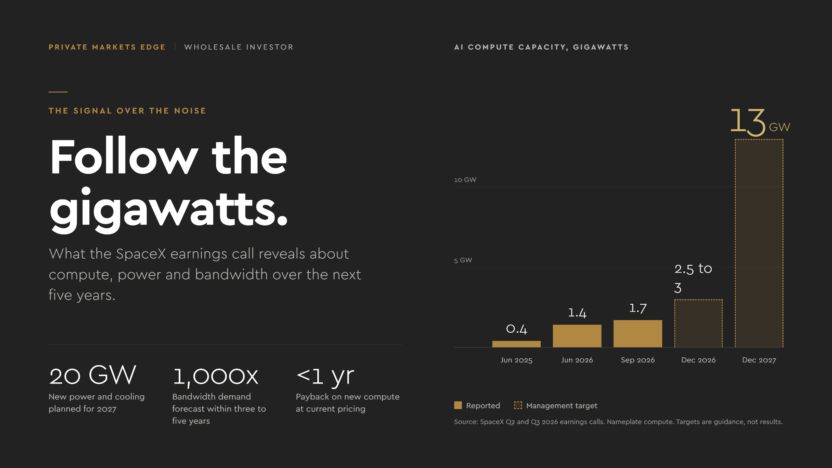
Forget the share price. SpaceX just published a map of the next five years.
Most coverage of SpaceX’s result focused on a 9.1% share price fall. That is noise. The signal is in the transcript: compute, power, bandwidth and demand over the next five years.

The prefab company that deliberately leaves part of the house unbuilt
BuiltQuik prefabricates the floor and roof structure and stops there. Co-founder Ryan Mullaney argues the omission is the product. Prefabricated housing usually means a factory. A large central facility, identical modules, limited room to move on design, and a logistics problem getting the finished box to site. BuiltQuik builds the opposite, and the design decision […]
Backed By Leading Investment Groups and Family Offices