
News and Announcements

THE TAX CHANGED. NOW THE PRODUCT IS CHANGING TO MATCH.
- Published August 12, 2026 5:26AM UTC
- Publisher Steve Torso
- Categories Capital Insights, Events, Landing, Trending
From 1 July 2027, the 50% capital gains tax discount is gone. Gains will be taxed under cost base indexation with a 30% minimum. That received Royal Assent on 26 June 2026. It is law, not a proposal.
Most commentary since has focused on what investors will do about it. That is the obvious half of the story, and it is largely settled. Tax growth harder, leave income alone, and capital rotates toward yield.
The half almost nobody is watching is what managers are doing about it. They are not waiting to receive rotating capital. They are redesigning products to catch it.
THE MATHS DRIVING EVERYTHING
For an investor on the top marginal rate, the effective tax on a capital gain moves from roughly 23.5% under the old discount to a minimum of 30%. On shorter-duration, high-growth holdings, it can reach the full 47%.
Income has not been touched.
That single asymmetry is now the most powerful force in Australian private capital. It does not just change which assets look attractive. It changes how a return has to be delivered to be worth holding.
A dollar of growth and a dollar of income are no longer equivalent. The wrapper now matters as much as the underlying asset.
WHAT I AM ACTUALLY SEEING
In early June, three weeks after the Budget, I wrote to a colleague that I was about to spend a lot more time with property, private credit and private equity companies.
It took roughly eight weeks to show up in my calendar. About one in four of my external calls last month involved private credit, private equity or a business exit. That is not what my calendar looked like a year ago.
The volume is not the interesting part. What is being built is.
One manager launched an evergreen fund on 1 August, holding 60% private equity and 40% private credit. It targets 12% to 15% net and pays a 5% distribution from day one.
The credit allocation does two jobs. It generates contractual interest income immediately, and it provides the liquidity to offer redemptions without forcing a sale of equity positions.
The effect is to remove the J curve. Investors no longer sit through three to five years of negative paper returns before seeing anything.
Separately, an established commercial property lender is building a unitised income trust targeting returns above the RBA cash rate and taking it to the wealth advice channel.
Consider what that does to the business. A balance sheet lender earns a spread and is capped by its funding. Unitise the loan book and distribute through advisers, and investor capital becomes the funding source. The business shifts from earning net interest margin to earning fees on assets under management. Capital light, and far more scalable.
Two very different starting points. Both arriving at income and growth in a single wrapper.
The next iteration is already visible, and it is not property.
Warehouse facilities are being established right now to fund ownership transitions in privately held businesses. One senior banker leaving a major institution is building exactly that. A listed manager is separately evaluating wholesale funding against a vendor finance succession book.
Australia has a generational business succession problem and a banking system that has never served it well. Private credit is moving into that gap.
Expect a run of new products built around business lending over the next 18 months. Not property credit with a different label, but genuine lending into SME ownership change.
THE BIGGER PICTURE
Not every response has been to build. One manager I spoke with shelved a new structure entirely. His words were that the CGT changes had parked it.
That is the same signal read in reverse. Capital is being reallocated, and product is being rebuilt, and the managers who move first will define the category.
The rotation was predictable. What gets manufactured to meet it is still being decided, and that is where the next decade of Australian private capital takes shape.
Steve Torso is the Founder of Wholesale Investor and CapitalHQ.
Trending

BlackRock has named the next Economy. What this latest paper means for Private Market Investors.
BlackRock has put a name on something the smart money has been circling for two years. Its digital assets research team calls it the machine-native economy. The thesis fits in one line. AI is machine-native intelligence. Digital assets are machine-native money. Both are built on the same architecture, and they are converging into a single […]
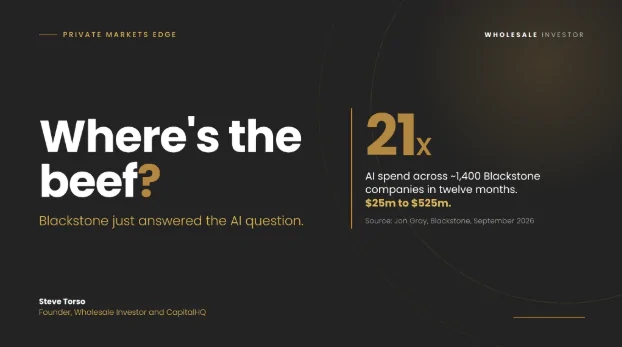
Where’s the beef? Blackstone just answered the AI question.
In 1984, a fast food ad asked a question that became a catchphrase. Where’s the beef? Jon Gray, President of Blackstone, used that line this month in front of global LPs. It is the question every capital allocator is asking about AI. Trillions of dollars are going into chips, data centres and power. That is […]
The Best of Both Worlds: How Omnique Fund is Rewiring Real World Assets via Tokenisation
For decades, the playbook for Australia’s wholesale investors has remained relatively unchanged: pick between the slow-moving, illiquid reliability of tangible assets like property and gold, or chase the frictionless, high-velocity liquidity of public equity and digital markets. But as macroeconomic volatility spikes and a structural housing deficit reshapes private debt demand, sophisticated investors are demanding […]
Backed By Leading Investment Groups and Family Offices