
News and Announcements
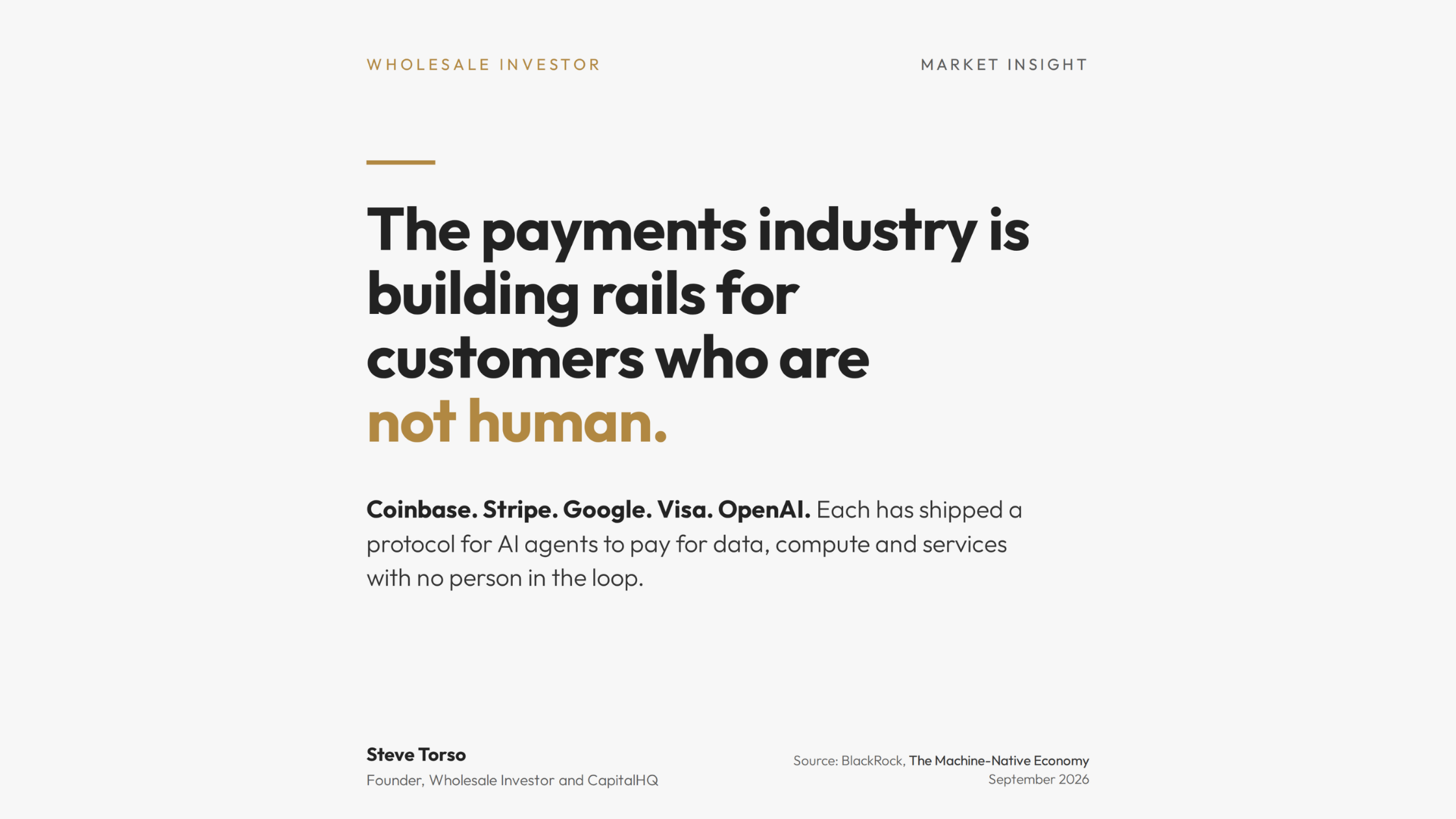
BlackRock has named the next Economy. What this latest paper means for Private Market Investors.
- Published September 25, 2026 4:23AM UTC
- Publisher Steve Torso
- Categories Capital Insights, Trending
BlackRock has put a name on something the smart money has been circling for two years. Its digital assets research team calls it the machine-native economy.
The thesis fits in one line. AI is machine-native intelligence. Digital assets are machine-native money. Both are built on the same architecture, and they are converging into a single infrastructure layer.
When the world’s largest asset manager publishes that view under the names of its Head of Digital Assets and its US Head of Equity ETFs, the conversation has moved. This is no longer a crypto conversation. It is an infrastructure conversation.
The idea in one paragraph
Both systems tokenise. A large language model breaks text into tokens, maps them to numbers and works on them at scale. A blockchain represents an asset as a standardised token on a shared ledger, with the rules for moving it written in code.
The consequence is simple. An AI agent can read and act on blockchain data more directly than it can on legacy financial systems built from bespoke integrations and manual reconciliation. Machines prefer machine-readable rails. That preference is the whole story.
Why agents need new payment rails
Agentic AI systems plan and execute multistep tasks with limited human intervention. BlackRock’s point is that these agents will transact, and the rails we have were never built for them.
Existing payment systems need a human to open an account, hold a credential and authorise a payment. Merchant fees make very small transactions uneconomic. ACH settles within a business day. None of that works for an agent making thousands of sub-cent payments for data, compute and API calls, around the clock.
So the industry is building new rails. The paper lists them:
- x402 from Coinbase, using the HTTP “payment required” status code to let machines pay for resources on demand
- Machine Payments Protocol from Stripe and Tempo
- Agentic Commerce Protocol from Stripe and OpenAI, for programmatic checkout with existing merchants
- Agents Payment Protocol from Google, with cryptographic audit trails for user authorisation
- Trusted Agents Protocol from Visa, so merchants can verify which agents to trust
Read that list again for the names. Coinbase, Stripe, OpenAI, Google and Visa. The payments industry is building rails for customers who are not human. That is not a fringe development.
The numbers behind the shift
Stablecoins are the settlement asset the paper expects to lead because an autonomous system needs a stable unit of account.
The scale is already there. Circulating stablecoin market capitalisation passed $300 billion as of September 2026. Adjusted stablecoin transaction volume exceeded $11 trillion in 2025, which BlackRock places in the same broad range as the annual payment volumes of Visa and Mastercard.
It is still well short of ACH, which moved $93 trillion in 2025. But the growth rates tell the real story. From 2020 to 2025, stablecoin volume grew at an 80% compound annual rate. ACH grew at roughly 8.5%.
Regulation is catching up rather than holding back. The GENIUS Act in the US, MiCA in Europe and licensing regimes in Hong Kong and Singapore all give institutions a framework to operate inside.
Compute becomes an asset class
The second half of the paper is the part most private investors will skip and should not.
Some estimates put cumulative AI capital spending above $5 trillion between 2025 and 2030. Using hyperscaler cloud revenue as a proxy, BlackRock sees the combined revenue of AWS, Microsoft’s Intelligent Cloud and Google Cloud reaching approximately $1.1 trillion by 2030, a 29% compound annual growth rate from 2025.
And the shape of that demand is changing. Inference is expected to become the largest AI workload by 2030. Training is done by a small number of very large players. Inference is consumed by enterprises and individuals, a far larger and more fragmented buyer base.
That is what turns compute into a market. The paper describes GPU-backed financings, platforms built around long-duration usage-linked compute revenue, and the prospect of exchange-traded compute futures for price discovery and hedging. It points to Stripe’s August 2026 agreement to acquire OpenRouter as an early signal that compute procurement, usage-based billing and programmable settlement are converging into one piece of financial infrastructure.
I wrote recently about hyperscalers shifting from funding AI capex out of cash flow to funding it in public debt markets. This is the same story from the other side. The compute bill is being financialised, and financialised assets eventually get their own markets.
What this means for private market investors
Three observations.
The picks and shovels are private first. Payment protocol infrastructure, compute financing, tokenisation platforms and the energy behind data centres are, for the most part, private companies and private credit structures today. Public market investors will get access to this theme later and at a different price.
Take BlackRock’s caution at face value. The paper is explicit that the ecosystem remains nascent, with agentic payment activity and compute-market liquidity still limited. The structural direction is clear. The timing is not. Anyone pricing this as a 2027 story rather than a 2030 story is taking timing risk they may not have priced.
Founders will be judged against this map. Every AI, fintech or infrastructure raise over the next five years will land in front of investors who have read this paper or one like it. Founders who cannot explain where they sit in the stack, and which of these rails they depend on, will find the conversation harder than it needs to be.
The question for a private investor is not whether machines will transact with each other. BlackRock has settled that. The question is who owns the rails when they do.
Trending
BlackRock has named the next Economy. What this latest paper means for Private Market Investors.
BlackRock has put a name on something the smart money has been circling for two years. Its digital assets research team calls it the machine-native economy. The thesis fits in one line. AI is machine-native intelligence. Digital assets are machine-native money. Both are built on the same architecture, and they are converging into a single […]
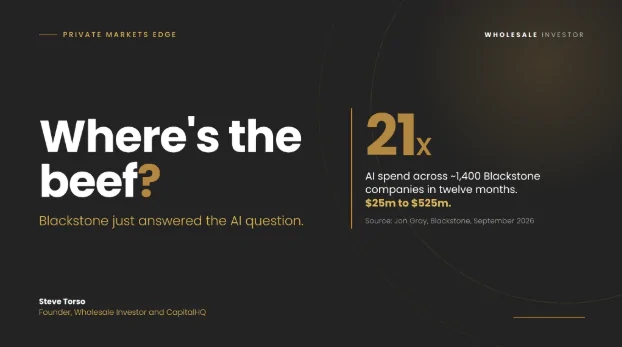
Where’s the beef? Blackstone just answered the AI question.
In 1984, a fast food ad asked a question that became a catchphrase. Where’s the beef? Jon Gray, President of Blackstone, used that line this month in front of global LPs. It is the question every capital allocator is asking about AI. Trillions of dollars are going into chips, data centres and power. That is […]
The Best of Both Worlds: How Omnique Fund is Rewiring Real World Assets via Tokenisation
For decades, the playbook for Australia’s wholesale investors has remained relatively unchanged: pick between the slow-moving, illiquid reliability of tangible assets like property and gold, or chase the frictionless, high-velocity liquidity of public equity and digital markets. But as macroeconomic volatility spikes and a structural housing deficit reshapes private debt demand, sophisticated investors are demanding […]
Backed By Leading Investment Groups and Family Offices