
News and Announcements
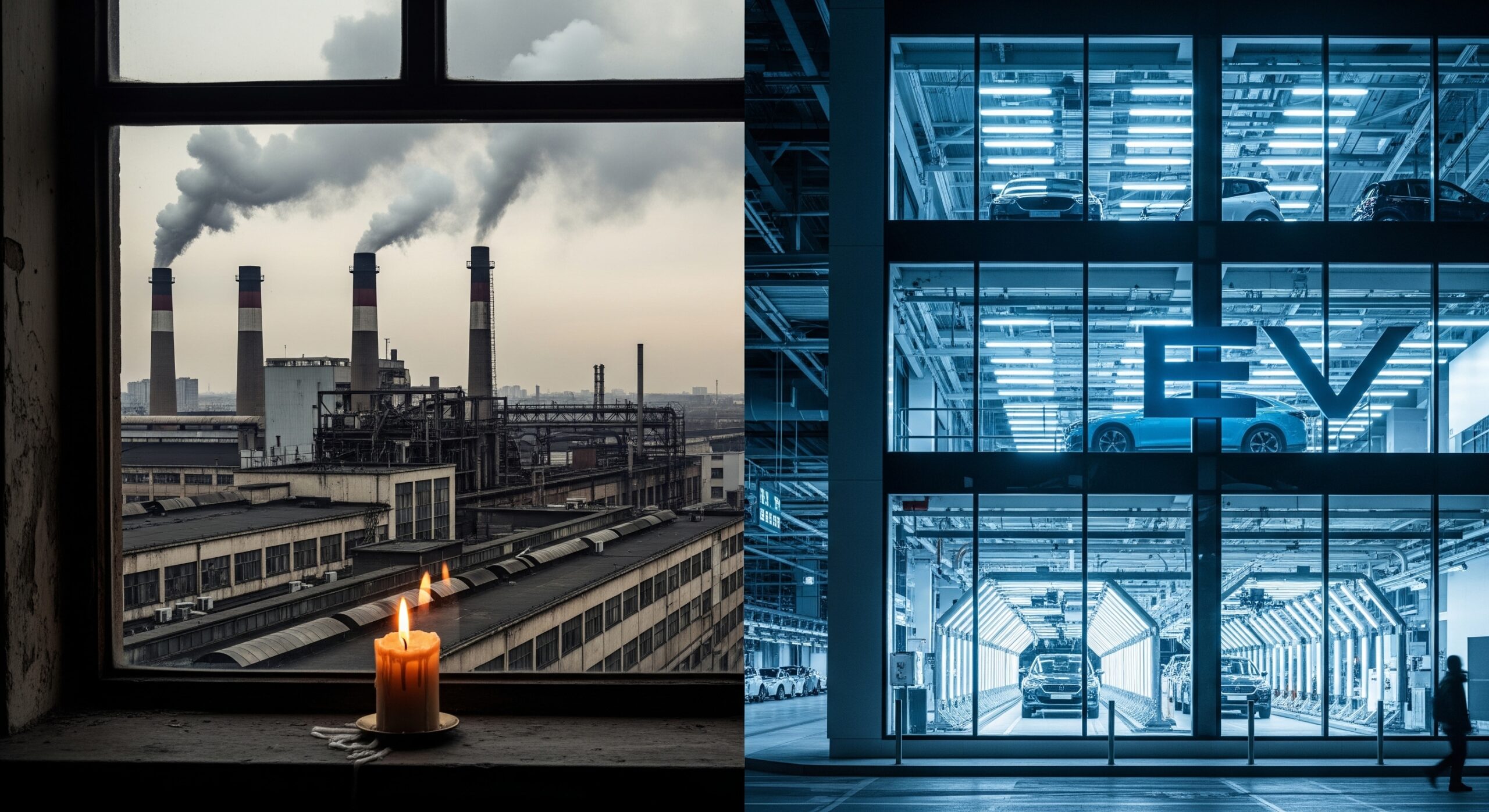
The Great Corporate Collapse of 2026: Why Ford Surrendered and the Innovator’s Dilemma
- Published December 17, 2025 11:39PM UTC
- Publisher Steve Torso
- Categories Capital Insights, Landing, Trending
We are walking into the single most significant corporate collapse in business history.
The data suggests 2026 will be the tipping point where the “Sheep Effect” kicks in and boards finally panic.
For the last 12 months, I have been warning about the “Innovator’s Dilemma” facing the legacy corporate world. This week, we saw the definitive signal that the collapse is not just a theory. It is happening now.
The Ford Surrender
Ford has just announced a $19.5 billion write-down.
They have effectively killed the F-150 Lightning successor and cancelled their three-row electric SUV. They are retreating to hybrids because, in their own words, they see “no path to profitability” for large electric vehicles.
Think about that statement.
At the same moment Ford is admitting defeat, BYD sales are up 31% and Tesla deliveries are up 29%. They are not just profitable. They are accelerating.
This is the Innovator’s Dilemma in its purest form.
Ford is a “candle” company. They are retreating to hybrids – building better candles – because they cannot figure out how to build the electric stack profitably. They are trying to patch legacy factories, legacy unions, and legacy supply chains.
Meanwhile, the native players like BYD and Tesla didn’t try to renovate the candle factory. They built the electric house from scratch.
The result is that the legacy players are capitulating. They are handing the entire future vertical of “transport-as-compute” to the native players.
The Bigger Picture: Candles vs. Electricity
This is not just about cars. This is about the entire economy.
The situation facing almost every S&P 500 company today is identical to the one Ford faces. They are homeowners trying to upgrade a candle-lit house to electricity.
Instead of wiring the house (building a new stack), they are trying to invent an automated match-striker to light the candles faster (patching legacy systems).
By the time they realise they need to rewire the house, the cost of electricity will have dropped so low that their candle business model is already bankrupt.
We are seeing the early tremors of this shift in the labour market right now.
- In 2025, we have seen 1.1 million layoffs, the highest number since the pandemic.
- In 71% of comparisons, machines are now performing knowledge work better than humans.
- They are doing it at more than 11 times the speed and less than 1% of the cost.
Yet, like Ford, most corporations remain paralysed. Out of 20 major companies, three are taking appropriate action. The rest are flailing.
The Sheep Effect
The turning point arrives in 2026.
Right now, adoption is slow. Boards are cautious. But once a few early adopters—the “electric” companies—see their valuations jump 10x, the “Sheep Effect” will trigger.
Boards will force executives into panic mode. They will demand immediate integration of “compute” to survive.
But for many, it will be too late. You cannot compete for top AI talent against billion-dollar signing bonuses. You cannot patch legacy code in C or Java when the competition is running on AI-native stacks.
This is why we are seeing a mass exodus of senior executives who are choosing to retire rather than navigate this transition. They know they cannot manage this new world.
The Ford news is a $19.5 billion warning shot.
The legacy vertical is dying. Everything is becoming “compute.” You can either cling to your candles or start wiring the house.
The choice is yours, but the timeline is short.
Trending

The asset class where the market has no vote
Litigation funding returns are decided in a courtroom, not a cycle. Knightsbridge’s Head of Capital is careful to call that a different risk rather than a lower one, and his answer to it is spread, not concentration. Most alternative assets still answer to something. Property answers to rates. Private credit answers to defaults. Even the […]

The listing fee vendors pay whether the house sells or not
Australia’s property portals collect more than $2 billion a year while national listings sit flat. An Australian-built AI platform is targeting the economics, not just the interface. An Australian vendor listing a home pays a vendor-paid advertising fee on top of agency commission. Rama Dwarapudi, Founder and Chief Executive Officer of RealSearch, puts a typical […]

Reinventing the Condom: How an Australian Deep-Tech Startup Plans to Disrupt a $12 Billion Market
For more than half a century, the global condom industry has remained fundamentally unchanged, constrained by standard materials like latex and solid synthetic polymers. Despite widespread consumer demand for better alternatives, product design has treated the device strictly as a mechanical barrier, sacrificing feel for function. Sydney-based Eudaemon Technologies is setting out to upend that […]
Backed By Leading Investment Groups and Family Offices