
News and Announcements
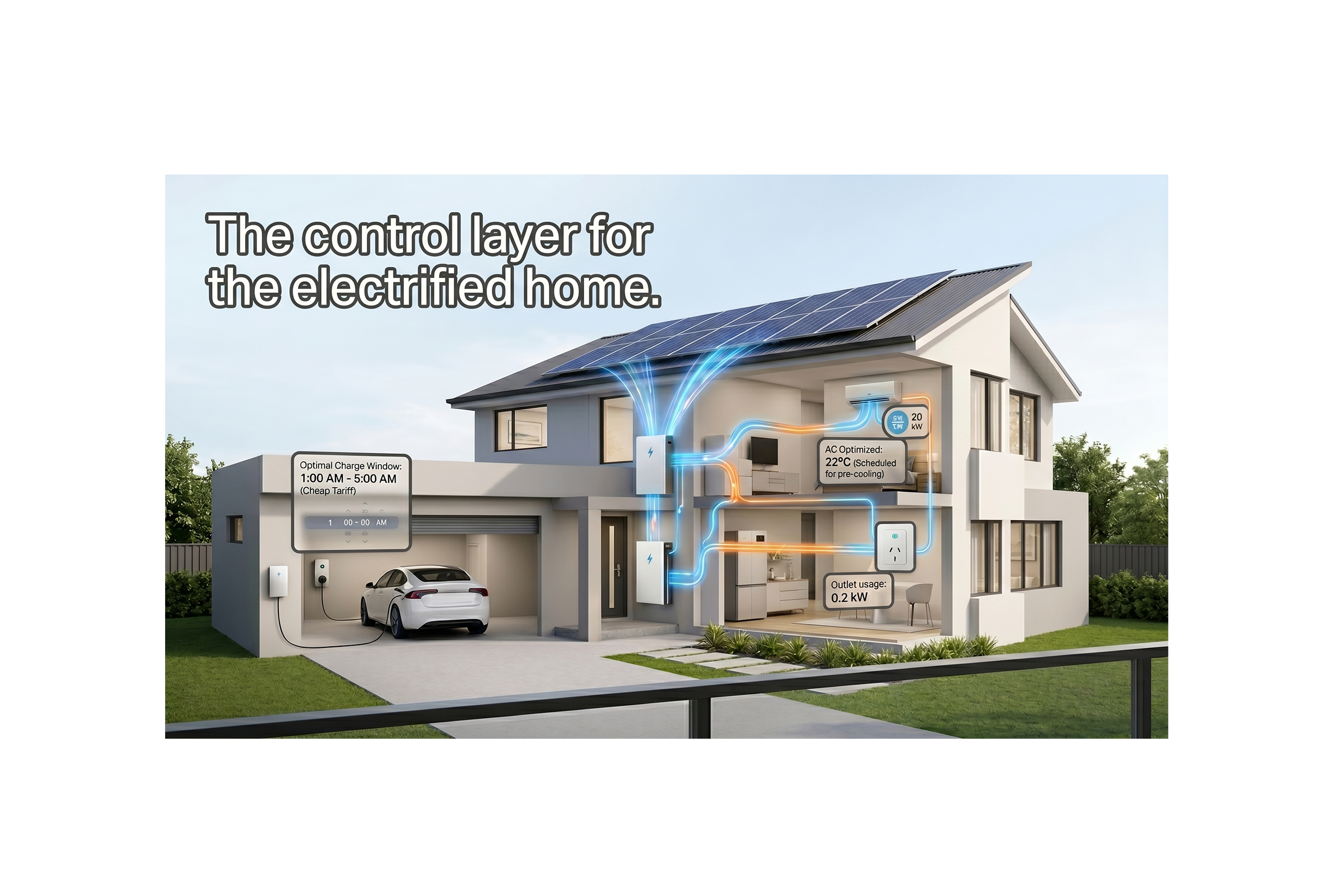
The control layer for the electrified home
- Published May 12, 2026 5:46AM UTC
- Publisher Jade Miguel
- Categories Capital Insights, Executive Interviews, Landing, Trending
THE MARKET SHIFT
Australian households have been pulled into a real-time energy market they never knowingly signed up for.
Flat electricity tariffs are disappearing. In their place: dynamic, time-of-use pricing that changes depending on when power is consumed.
Electricity is now cheapest when solar floods the grid in the middle of the day — and most expensive during the morning and evening peaks, when households actually need power most.
Homes able to adapt their energy usage are rewarded and protected from continually rising electricity costs. Everyone else increasingly overpays.
Yet roughly 9.5 million Australian homes still operate on fixed analogue routines inside this dynamic pricing system.
To participate effectively, households must now coordinate more than 100 interconnected decisions across tariffs, air-conditioning systems, hot-water systems, pool pumps, solar, batteries, EV charging, major household appliances, rebates, financing and energy usage — decisions requiring continuous optimisation as both household behaviour and market conditions evolve.
Most households neither understand nor trust the system. They simply know their bills keep rising.
Households did not choose this shift. Electricity is no longer a passive utility bill — it has become a continuously managed financial system.

THE BEHAVIOURAL FAILURE
Will Leitch, founder and chief executive of Energy Assistant, believes the energy industry has fundamentally misunderstood how consumers respond to that complexity.
The market assumed households would behave rationally — actively comparing providers, shifting usage patterns and continuously optimising for the best deal as pricing structures changed.
They do not.
Complexity, distrust and decision fatigue cause most households to disengage long before action occurs.
“Most consumers do not want more advice, more comparison tools or more decisions,” Leitch says. “They want someone they trust to simply handle it.”
That insight sits at the centre of Energy Assistant — the control layer for the home energy economy and Australia’s $157 billion electrification transition.
The company’s premise is simple: households should not have to coordinate a rapidly electrifying home themselves.
THE CONTROL LAYER
Energy Assistant continuously plans and executes each household’s electrification journey — matching the home to the right tariff, air-conditioning system, hot-water system, pool equipment, solar, battery, EV charging solution, appliance, supplier and financing structure at the optimal time and price through an independent marketplace.
The result is a coordinated two-sided market where households reduce complexity while suppliers gain qualified, high-intent demand.
The entry point is the electricity bill.
Energy Assistant continuously monitors the market against the household’s actual usage profile, automatically identifying when a better tariff exists. The customer simply approves the switch.
No forms. No research. No comparison websites.
Once embedded inside the household, Energy Assistant becomes its trusted operator and steward — continuously learning how each home behaves, acting in the customer’s best interests and seamlessly delivering validated savings over time.
At its core, the platform functions as a continuously learning operating system for household electrification.
That spans virtually every major energy-consuming and energy-producing asset inside the home — from air-conditioning systems, hot water and pool pumps through to solar, batteries, EV charging and major household appliances.
Every home receives a tailored transition pathway — coordinating tariffs, air-conditioning systems, hot-water systems, pool pumps, batteries, solar, EV charging, major appliances and finance around that household’s actual energy usage, financial position and behavioural patterns.
The complexity sits inside the platform, not with the customer.
Energy Assistant continuously validates market pricing, supplier offers, rebates, financing structures and household economics — identifying the optimal timing for upgrades and executing them through its independent marketplace.
FROM ADVICE TO EXECUTION
If a hot-water system fails, the household does not begin researching replacement options from scratch. The replacement journey has already been coordinated through Energy Assistant.
When the customer opens the app, the optimal replacement system — economically validated, competitively priced and matched with verified high-service installers — is already waiting, alongside pre-arranged financing if required.
The same model coordinates the broader electrification journey.
When upgrading assets such as air-conditioning systems, hot-water systems, pool pumps or major appliances becomes financially compelling, Energy Assistant proactively recommends more efficient systems integrated into the home’s solar and battery ecosystem and optimised to shift energy-intensive usage into lower-cost pricing periods.
As technologies improve, rebates emerge or supplier pricing changes, the platform continuously remodels household economics and updates recommendations, ROI pathways and installation options automatically.
Even discretionary upgrades — replacing older appliances, HVAC systems, pool equipment or household energy assets with newer, more efficient alternatives — are already coordinated and ready for execution.
The customer never needs to navigate the complexity. The decision has already been modelled, validated and prepared.
That distinction — moving from advice to execution — defines the category.
THE TWO-SIDED MARKET
Existing players largely monetise fragments of the energy transition. Retailers sell electricity. Installers sell hardware. Comparison sites monetise switching.
Manufacturers sell products.
Energy Assistant coordinates the system itself.
Its platform aggregates household demand and routes it through an independent marketplace connecting retailers, installers, OEMs and financiers directly to high-intent households at the exact moment decisions occur.
In effect, it creates a two-sided market around household electrification.
For households, the proposition is lower costs, reduced complexity and frictionless execution. For suppliers and partners, the value is qualified demand, lower acquisition costs and a continuously compounding behavioural dataset built around how households actually make electrification decisions.
The behavioural dataset created through that coordination layer becomes a compounding strategic asset unavailable to traditional retailers, installers or comparison platforms.
Energy Assistant is building a live behavioural model of each household: how electricity is used, which appliances operate when, how consumers respond to pricing signals, when assets are likely to fail and what decisions households are willing to execute.
No retailer sees that full picture. No installer sees it. No comparison platform sees it.
“The most valuable layer in electrification is not the infrastructure,” Leitch says. “It is the decision layer sitting above it.”
THE INFRASTRUCTURE OPPORTUNITY
The implications extend far beyond energy.
Banks, insurers, loyalty platforms and mortgage brokers already sit inside trusted household relationships, yet currently capture little value from electrification itself.
Energy Assistant allows those groups to participate directly — monetising household demand while materially deepening their understanding of customer behaviour, financial pressure and upgrade intent.
That is why the company is deliberately avoiding the traditional energy-retailer model of high-cost direct customer acquisition.
Instead, Energy Assistant distributes through existing trust networks — insurers, loyalty programs, supermarkets, lenders and payment ecosystems already embedded inside the household relationship.
The economics are structurally different. Acquire once. Monetise continuously.
The business generates revenue through subscriptions, partner platform fees, marketplace transaction margins and routed supplier demand across solar, batteries, hot-water systems, air-conditioning, pool equipment, EV charging, major appliances and financing products.
One household becomes multiple recurring revenue streams compounding over the life of the home.
For investors, the implications are structural.
The energy transition is forcing households into an expanding web of financial and behavioural decisions. At the same time, agentic AI is making it possible for software not simply to advise — but to decide, coordinate and execute continuously on behalf of users.
Energy Assistant sits at the convergence of those two forces — creating an entirely new category.
Not another energy retailer. Not another comparison site.
But the operating system managing the household’s relationship with energy itself.
The home is becoming a coordinated system. Energy Assistant controls it.
Trending

The Algorithm Re-Dosing Cancer Treatment: Inside the University of Melbourne Spin-Out Rewriting a 60-Year-Old Formula
Oncology specialists are still calculating toxic chemotherapy doses using a formula from the era of the Ford Model T, leading to a system where seven out of eight patients are routinely overdosed. University of Melbourne spin-out PredicTx is dismantling this legacy approach, utilizing advanced AI to analyze existing patient CT scans, deliver precision medicine to the bedside, and return a massive 100x financial rerate to hospital networks.

Asset over thematic: Centuria’s Andrew Essey warns against ‘blanket strategies’ as global capital eyes Australia
Relying solely on broad macroeconomic trends is the single biggest mistake property investors make today. Centuria Capital CIO Andrew Essey explains why asset-level “lettability” always trumps the overarching sector thematic, and reveals where global institutional capital is quietly pivoting to capture high-octane returns.

Material gains: Swinburne spin-out EntroMat takes aim at $160b global market
Traditional metallurgy has hit a performance wall. Discover how Swinburne University spin-out EntroMat is leveraging physics-based AI and circular critical minerals to engineer high-entropy alloys capable of surviving the world’s most extreme industrial environments.
Backed By Leading Investment Groups and Family Offices