
News and Announcements
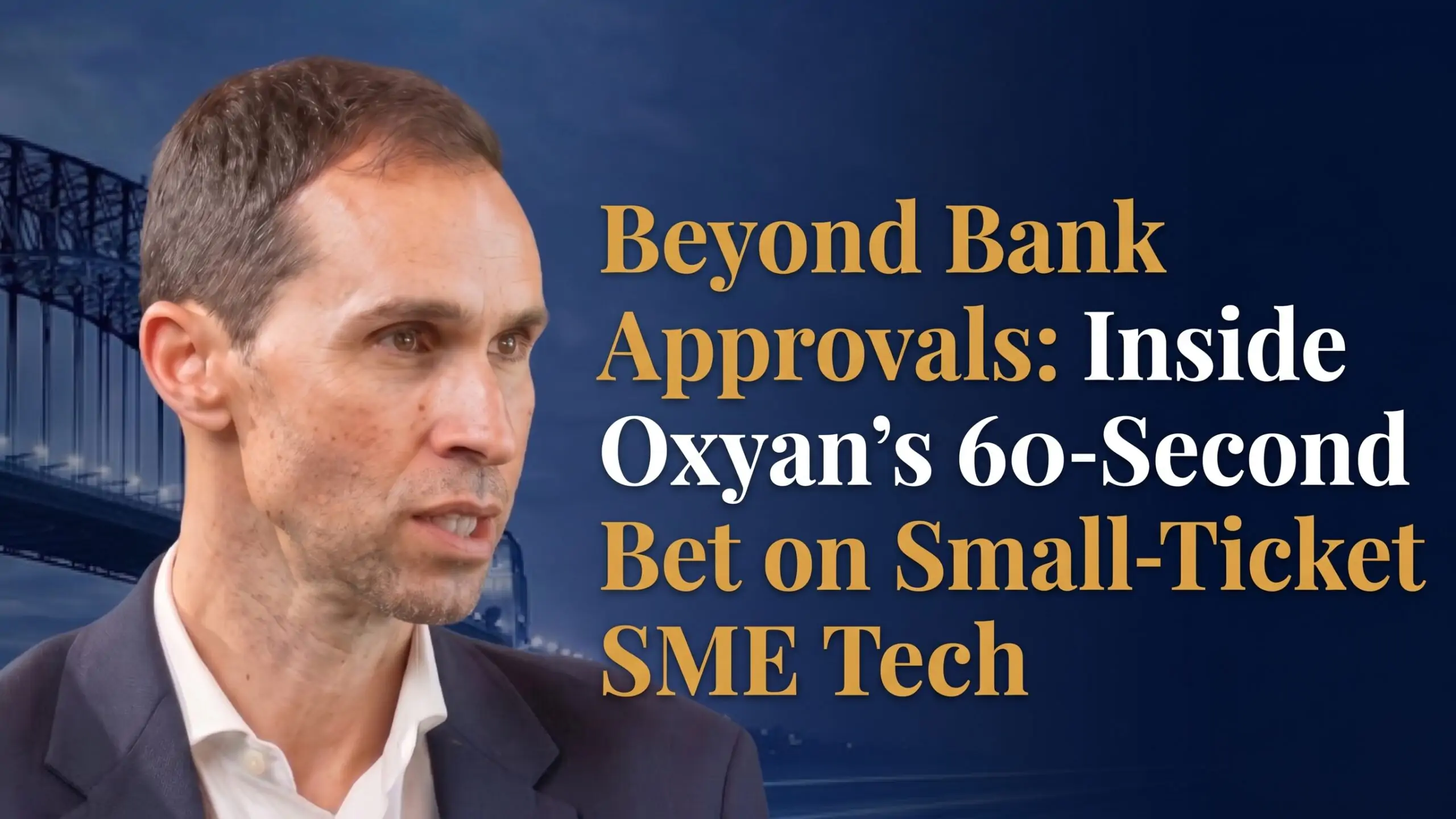
Beyond Bank Approvals: Inside Oxyan’s 60-Second Bet on Small-Ticket SME Tech
- Published November 13, 2026 3:47AM UTC
- Publisher Jade Miguel
- Categories Capital Insights, Executive Interviews, Landing, Trending
Roughly three-quarters of hardware and software acquired by Australian small businesses falls below the threshold that institutional financiers are willing to touch. Now, fintech entrepreneur Victor Ferreira is betting institutional capital that the smallest deals represent private credit’s most durable defensive moat.
Victor, whose embedded lender Oxyan recently took out the Innovation of the Year in Embedded Finance title at the WeMoney (2026 Innovation Awards), is currently in the market securing a $10 million senior secured debt warehouse facility to back an aggressive rollout into distributor and merchant checkouts nationwide.
The platform integrates directly into vendor and merchant payment funnels, delivering point-of-sale credit approvals in under 60 seconds for IT hardware and software orders valued between $5,000 and $25,000.
For Victor, the thesis rests on unbundling the economics of enterprise technology from blunt corporate balance-sheet debt.
“Technology depreciates so quickly. Within two to three years, an asset is effectively obsolete,” Victor said. “For a small business, it’s not about ownership; it’s about cash-flow matching and total cost of use. Businesses need low-risk structures where monthly commitments are predictable, and at the end of term, they retain the flexibility to refresh, retain, or return the gear.”

Battle-Tested Through Covid-19
Unlike venture-backed founders pitching unproven algorithmic risk models, Victor cut his teeth managing underwriting across the Australian asset finance sector. Having previously built commercial distribution networks spanning more than 1,000 partners and overseeing 25,000 contracts over a five-year cycle, including the peak dislocation of the pandemic, his small-ticket portfolio maintained actual net loss rates below market benchmark. .
That performance across a full macroeconomic credit cycle informs Oxyan’s current underwriting policy.
“Most lenders misjudge small-ticket business risk in Australia,” Victor said. “When your average repayments sit at around $150 to $200 a month, default risk behaves very differently than mid-market or corporate debt. The asset is critical to their daily operations. As long as your credit matrix is disciplined and you don’t chase marginal volume, loss rates remain remarkably stable.”
Rather than deploying standalone broker distribution or redirecting buyers into external loan application portals, Oxyan embeds directly into major technology distributors, system integrators, and B2B retailers. Automated digital identity verification and real-time business credit assessments happen at the point of sale, removing friction that historically caused SME checkout abandonment.
The Debt Pitch: Granular Spread vs Bulk Risk
For fixed-income and private credit investors evaluating the $10 million warehouse line, Victor argues that portfolio granularity offers natural downside protection that concentrated middle-market corporate loan books lack.
Oxyan’s platform has already generated roughly $300,000 in early trial originations while testing integration architecture with key vendors.
“Equipment leasing has existed for thousands of years, but as my dear friend Allan Macdougall states, the T&C’s that run leasing have been in Australia since 1950. . So, the asset class itself isn’t experimental,” Victor said. “The difference in small-ticket transactions is how you model recovery and margin. You price margin provisions up front to absorb predictable loss curves, so investor returns remain insulated even during broader downturns.”
Looking forward, Victor expects demand for hardware-as-a-service to accelerate rather than moderate, fueled by the refresh cycles necessary to support enterprise AI capabilities and hybrid workspace infrastructure.
“Every SME in Australia is having to invest more in processing power, devices, and infrastructure just to keep pace,” he said. “Hardware costs are rising, and vendors need embedded finance tools to convert transactions at the checkout counter. The demand is structural.”
Trending
Beyond Bank Approvals: Inside Oxyan’s 60-Second Bet on Small-Ticket SME Tech
While three-quarters of SME tech purchases fall below traditional financing thresholds, fintech lender Oxyan is using embedded, 60-second approvals and a Covid-tested 2% loss rate to turn small-ticket IT leasing into a defensive private credit asset.

Why lenders with the right policy never find the borrowers who need it
Jordan Ralph spent two decades inside banks watching good borrowers get declined. His diagnosis is not that lenders are too strict. It is that finding the right borrower costs more than the loan is worth. Every time an Australian borrower approaches a lender, they rebuild their financial profile from scratch. Identity verified again. Income proved […]

Michael Myer joins Valloop Australia as senior advisor
Valloop Australia has appointed seasoned founder, venture capitalist, and Sidney Myer’s grandson Michael Myer as Senior Advisor. Bringing four decades of business leadership, he will help Australian SME owners and their advisers evaluate employee ownership as a path to realise value and secure their legacy.
Backed By Leading Investment Groups and Family Offices