
News and Announcements
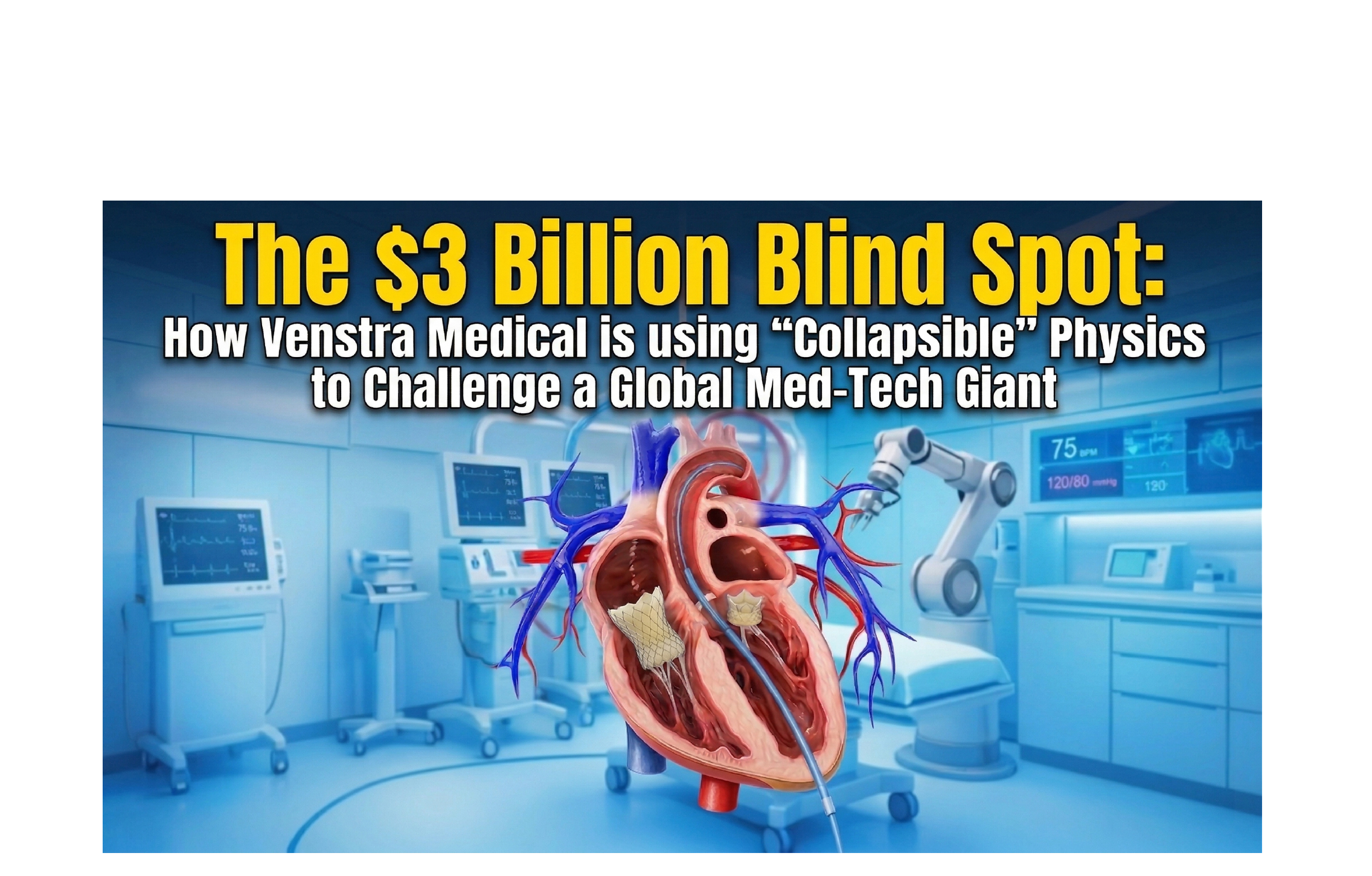
The $3 Billion Blind Spot: How Venstra Medical is using “Collapsible” Physics to Challenge a Global Med-Tech Giant
- Published April 09, 2026 12:18AM UTC
- Publisher Jade Miguel
- Categories Capital Insights, Executive Interviews, Landing, Life Science Hub, Trending
In the high-stakes theater of the cath lab, cardiogenic shock is the ultimate emergency. Now, a PhD in fluid mechanics and a frontline cardiologist are deploying a “collapsible” breakthrough to disrupt a 30-year monopoly.
The Engineer’s Mission
For Dr. Martin Cook, the stakes of medical engineering aren’t measured in blueprints, but in heartbeats. A PhD in fluid mechanics with 25 years embedded in the world of mechanical circulatory support, Cook has spent his career mastering the physics of how blood moves when the human body fails.
“I’ve been developing blood pumps for two and a half decades; it’s my core competency,” Cook says. But it was a conversation with his co-founder, interventional cardiologist Dr. Suku Thambar, that revealed a glaring, multi-billion-dollar irony: the technology keeping the world’s most critical cardiac patients alive hadn’t significantly changed in 30 years.
Together, they founded Venstra Medical. Based in Newcastle, the team is taking aim at cardiogenic shock—a catastrophic event where the heart suddenly cannot pump enough blood to sustain vital organs. It is a clinical “black hole” with a mortality rate that has stubbornly hovered around 50% for decades.

The “Drinking Straw” Breakthrough
The current standard of care is dominated by a single player: the Impella device (owned by Johnson & Johnson). While revolutionary in its time, the technology presents a classic medical Catch-22.
To get enough blood flow to support a failing heart, you need a large pump. However, a large pump requires a high-diameter catheter, which risks “limb ischemia”—blocking blood flow to the leg—and severe bleeding.
“It’s a competition between size and flow,” Cook explains. “You can have a small catheter that’s easy to insert but provides little support, or a large one that provides flow but carries massive complication risks.”
Venstra’s solution is a “quantum leap” in design: a collapsible and expandable pump.
- The Insertion: The device is folded and crimped into a catheter roughly the size of a drinking straw.
- The Deployment: Once advanced into the heart, the catheter is retracted, and the device naturally expands.
- The Result: A small-profile entry that transforms into a high-flow engine, providing full cardiac support without the “heavy-duty” vascular trauma of legacy tech.
Closing the Gender Gap in Cardiology
Beyond general efficacy, Venstra is addressing a documented disparity in female cardiac care. Women, who often have smaller arterial structures, are frequently ineligible for current large-bore support devices or suffer higher complication rates when they are used.
“Women have historically been offered this therapy to a much lesser extent than men,” Cook notes. By shrinking the access point to “drinking straw” dimensions, Venstra effectively opens the door to life-saving support for female patients and those with peripheral vascular disease who were previously considered “untreatable.”
A Market Ripe for Disruption
The commercial landscape for Venstra is as compelling as the clinical one. The market for catheter-based blood pumps is currently valued at $3 billion annually and is growing at 18%.
The space is defined by a total monopoly held by Abiomed (acquired by J&J for $17 billion in 2022). For investors, the “moat” around this monopoly is starting to look like a target.
“It’s the biggest market no one’s ever heard of,” says Cook. “And it’s completely monopolised by 30-year-old technology. Cardiologists would change to a better, smaller, more powerful device overnight.”
The industry is already taking notice. Venstra has:
- Published research in collaboration with the Mayo Clinic.
- Attracted a cohort of cardiologist investors.
- Hosted three major global med-tech strategics for on-site due diligence.
The 2026 Value Inflection
Venstra is currently moving into its most critical “value inflection point”: a 10-patient First-in-Human (FIH) trial.
The study will focus on “high-risk PCI” patients—those undergoing complex stenting who require temporary circulatory backup. This represents a strategic entry point; while cardiogenic shock is the “big” market, high-risk PCI allows for faster enrollment and a clear demonstration of the device’s safety, deployment, and retraction mechanics.
As the company prepares for these trials, the “economic logic” for investors is clear. In an ecosystem where global giants (worth $100B+) prefer to acquire innovation rather than build it, and with only three or four credible players in the PVAD (Percutaneous Left Ventricular Assist Device) space, Venstra sits in a “seller’s market.”
“We are looking at a situation where there are more buyers than sellers,” Cook concludes. “We have a unique product that, to our knowledge, no other device even comes close to. We’re itching to prove it in the clinic.”
With a veteran leadership team, a validated clinical need, and a massive incumbent ripe for disruption, Venstra Medical represents a high-conviction play in the “hot zone” of cardiac technology.
Trending

The Algorithm Re-Dosing Cancer Treatment: Inside the University of Melbourne Spin-Out Rewriting a 60-Year-Old Formula
Oncology specialists are still calculating toxic chemotherapy doses using a formula from the era of the Ford Model T, leading to a system where seven out of eight patients are routinely overdosed. University of Melbourne spin-out PredicTx is dismantling this legacy approach, utilizing advanced AI to analyze existing patient CT scans, deliver precision medicine to the bedside, and return a massive 100x financial rerate to hospital networks.

Asset over thematic: Centuria’s Andrew Essey warns against ‘blanket strategies’ as global capital eyes Australia
Relying solely on broad macroeconomic trends is the single biggest mistake property investors make today. Centuria Capital CIO Andrew Essey explains why asset-level “lettability” always trumps the overarching sector thematic, and reveals where global institutional capital is quietly pivoting to capture high-octane returns.
Material gains: Swinburne spin-out EntroMat takes aim at $160b global market
Traditional metallurgy has hit a performance wall. Discover how Swinburne University spin-out EntroMat is leveraging physics-based AI and circular critical minerals to engineer high-entropy alloys capable of surviving the world’s most extreme industrial environments.
Backed By Leading Investment Groups and Family Offices