
News and Announcements
The New ‘Blue’ Gold: Canopy Blue’s $10bn Bet on the Humble Seaweed
- Published March 23, 2026 11:13PM UTC
- Publisher Jade Miguel
- Categories Capital Insights, Executive Interviews, Landing, Trending
The solution to Australia’s most pressing agricultural headaches—soil degradation, methane emissions, and supply chain fragility—might not be found on land, but drifting off the coast of Western Australia.
Josh Masel, CEO of Canopy Blue, is betting that the burgeoning “blue economy” is ready for its prime-time commercial breakthrough. While seaweed has long been a darling of ESG enthusiasts, Masel is repositioning it as a critical industrial feedstock for a terrestrial farming sector desperate for sustainable alternatives.
“Currently, there are products using seaweed feedstock, but their supply is running out,” Masel shared. “We want to start cultivating seaweed species at a very large scale to develop local Australian products for these markets.”

A Tale of Two Coasts
Canopy Blue’s strategy is a geographic split-play designed to capture both high-volume agricultural needs and high-margin scientific markets:
- The South & West: Focusing on Golden Kelp (Ecklonia radiata). This will be processed into animal feed supplements and bio-stimulants for terrestrial crops.
- The North: Cultivating tropical red seaweed species in northern Western Australia. These are destined for the “high-value” extraction of bioactives for the pharmaceutical and nutraceutical industries.
The scale is ambitious. Through strategic partnerships, the company has secured approximately 8,000 hectares of marine leases across Western Australia—a “moat” that Masel believes gives Canopy Blue a significant first-mover advantage.
The global bio-stimulant market—products that help crops withstand heat, salinity, and nutrient stress—is projected to explode from US$3 billion today to US$10 billion by 2035. This is only strengthened by recent, global supply chain shocks skyrocketing fertiliser prices here in Australia.
“The locally grown seaweed bio-stimulant answers a lot of these questions, particularly if it’s produced locally,” says Masel. “We believe our offtake routes and market opportunities are far broader than what we can supply in the next few years.”
The Power of the ‘First Nations’ Partnership
Perhaps the most critical pillar of Canopy Blue’s credibility is its deep integration with the Kimberley Land Council (KLC). Representing an area larger than California, the KLC is a primary stakeholder in the company’s northern operations.
“They are very supportive of our mission to create jobs throughout Western Australia and have a strong environmental impact through seaweed aquaculture,” Masel explains.
The company isn’t just waiting for crops to grow, either. To accelerate revenue, Canopy Blue is applying for a wild harvesting license in the southwest. By utilising a First Nations ranger program, Masel forecasts getting products into the hands of offtake partners within the next six to seven months.
The Bottom Line for Investors
For the “Suits” on Chifley Square, the appeal lies in the infrastructure. Canopy Blue has:
- Long-term Security: Leases held for up to 40 years.
- Built-in Distribution: Partnerships with LawrieCo (managing 800,000 hectares of farmland) and ProFauna for animal feed sales.
- Low CapEx Entry: The wild harvesting program provides a fast-track to cash flow while the larger cultivation sites scale.
“This is a commercial business with commercial opportunities,” Masel insists. “But at its heart, it’s going to have a positive impact for people and the environment.”
As the world looks for ways to decouple agricultural growth from environmental destruction, Masel is proving that the greenest solutions are often blue.
Trending

The A$20.4 Million Inertia Trap: How Kepa Software Is Unlocking Value in Enterprise Capital Allocation
A government agency renewed the same maintenance decision nine years running, because auditing the original choice was deemed too expensive. When the portfolio was finally tested, A$20.4 million of low value spend was identified in a single year. Kepa Software’s capital governance platform was built to expose and eliminate precisely these boardroom blind spots. For […]
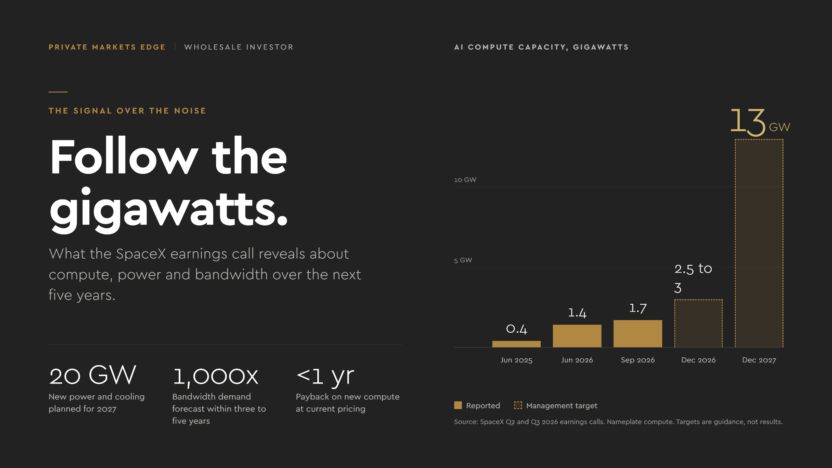
Forget the share price. SpaceX just published a map of the next five years.
Most coverage of SpaceX’s result focused on a 9.1% share price fall. That is noise. The signal is in the transcript: compute, power, bandwidth and demand over the next five years.

The prefab company that deliberately leaves part of the house unbuilt
BuiltQuik prefabricates the floor and roof structure and stops there. Co-founder Ryan Mullaney argues the omission is the product. Prefabricated housing usually means a factory. A large central facility, identical modules, limited room to move on design, and a logistics problem getting the finished box to site. BuiltQuik builds the opposite, and the design decision […]
Backed By Leading Investment Groups and Family Offices