News and Announcements
Australia’s 60,000 Business Succession Crisis: Why Good Companies Will Close Their Doors
- Published March 18, 2026 3:00PM UTC
- Publisher Bella Battsengel
- Categories Capital Insights, Capital Raising Tips, Executive Interviews, Venture Investor Interviews
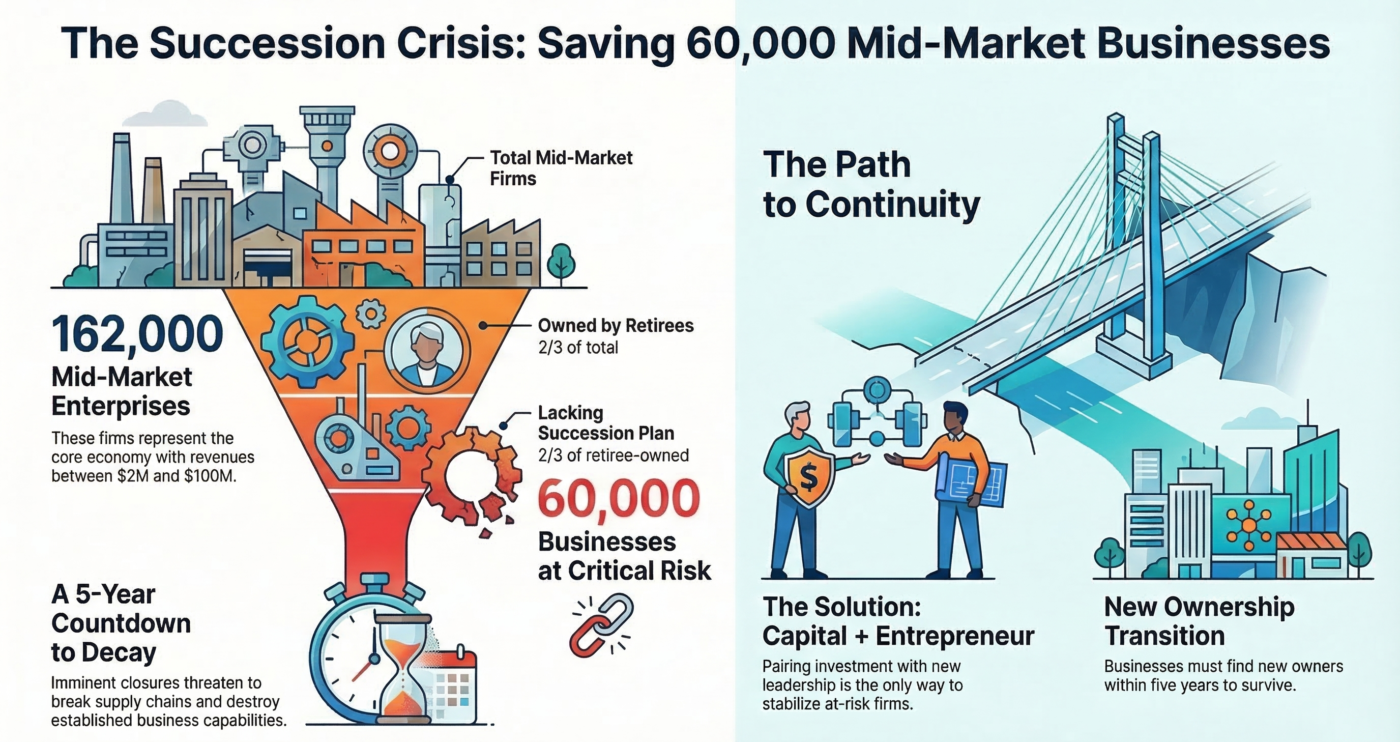
The Australian Business Growth Fund identified approximately 162,000 privately held businesses in Australia with revenue between AUD$2 million and AUD$100 million.
More than two-thirds are owned by people of retirement age. When surveyed, another two-thirds do not have a succession plan in place.
The mathematics are stark. 60,000 businesses owned by someone of retirement age without a succession plan. Sometime in the next five years, something needs to happen to those businesses.
Pete Seligman, an investor who runs ETA Investor, outlined the crisis clearly. “If we don’t provide a new owner operator for those businesses, a vast majority of them will just have to shut their doors because there’s no other appropriate buyer for those particular businesses in those circumstances.”
Why Corporate Careers Leave High Performers Unsatisfied
Pete left a successful corporate career in 2012. Engineer. Project manager. Investment banker at Macquarie. Corporate executive. He had everything. A clear pathway ahead. Reasonable aspirations about where to get to.
But two things were missing. Accountability and autonomy.
“The autonomy piece was probably just what it says on the box. I wanted to have more ability to influence the direction and the outcome I was taking and my part of the business was taking. I got relatively good at navigating corporate structures and corporate politics. I worked out what’s required to get things done in those environments. But I wanted something that had a few less steps between me and an outcome.”
The accountability piece was more nuanced. Pete wanted more impact. Strangely, on the downside. “I wanted things to hurt a bit more if I fell over. It felt as though I’d managed to achieve some good things in my career. Obviously like everyone, I made mistakes along the way. But when I made those mistakes, the impact I don’t think was as big on me or I couldn’t feel it as much as I wanted to.”
Corporate careers have a built-in cushion. Large corporates are like big ships. They have lots of momentum. The momentum of that ship keeps it rolling forward. If certain people on that ship make mistakes, it does not stop the whole boat chugging forwards.
Pete wanted to get into a place where not only would he see the outcome quickly if he did things well, but if he did things badly, he would get really quick feedback because it would hurt quickly. “That’s what I mean by accountability.”
Those two requirements pointed toward smaller businesses with more control. He was definitely looking to challenge himself. “I’ve never been very stable. I probably only ever did things for three years in a row. I could say I got bored easily. I could say I wanted to test myself in lots of different environments. I’m constantly looking for ways to put myself in situations where there’s new things I need to learn.”
The Night He Signed His First Business Acquisition
Pete’s first purchase was in 2013. SRO Technology, a mining services business. He first met the owner in December 2012. “I think it might have even been Christmas Eve. I still remember because it was quite funny. He was quite an avid cyclist down in South Sydney. We met him out on site at the very small warehouse and office industrial park down in Miranda. We turned up after office hours as planned and no one was there. Then this old guy on a bike in full Lycra showed up. I’m like, who’s this guy. Anyway, it was the owner of the business. He’d just been for a ride and decided to come and meet us after that.”
They took ownership of the business on 10 June 2013. Looking back on that moment, Pete described a specific dynamic. “Lots of inexperience but wrapped in a presumption of lots of experience. I’d come from a 15-year career as an engineer and in finance. I’d navigated lots of complex situations and delivered lots of large projects. The thing I got wrong is I’ve always been an advocate of transferable skills. You learn something in one environment that you can transfer to another. I still advocate for that concept. But I think I overestimated how much I had learned that would be directly applicable to what I would now put into practice.”
The first one to two years of owning that first business taught him critical lessons about the differences between big corporates and small to medium enterprises. “Small business is a very different environment in the same way that sailing a maxi yacht is very different to sailing a 16-foot skiff.”
His advice to his past self. “Keep your eyes open and be ready to learn. In the famous words of Stephen Covey, seek first to understand before being understood.”
Why Buying a Business Beats Starting One From Scratch
Most entrepreneurs think the pathway is finding a problem, finding a solution, building capital, then scaling. Pete built an entire movement around a different pathway. Entrepreneurship through acquisition.
“I came across that pathway because it was something that suited me. I was very keen on exposing myself to the autonomy and accountability that entrepreneurship brings. But I’m not the kind of person that had a great new idea. The obvious answer at that point was to go and start a business of my own. But there was nothing in particular that I was really keen on bringing to the world. But I knew that I had some skills that could be useful in building teams, running businesses, scaling operations, doing those kinds of things. That’s where the idea came to just buy a business instead of starting one from scratch.”
He subsequently learned about the terminology around entrepreneurship through acquisition and search funds. A global movement perpetuated out of North America and Europe for decades but brand new in Australia and New Zealand.
Two sides explain why this pathway is critical. One is the great wealth transfer happening in Australia and globally from baby boomer founder owners without succession. “Everyone’s heard it over the last few years. It’s become slightly clichéd. But it’s real.”
Pete expected the tsunami to peak over the last five years and into the next five. “But I actually think that for a range of reasons those owners have deferred their sales by maybe 5 to 10 years. The owner when we first bought SRO Technology was 62 when he sold to us. That to me felt kind of normal. He did that because he wanted to have enough time whilst he was still fit to ride bikes and travel and do all that sort of stuff. I feel like what I’m seeing more often now in the market is the sellers are in their 70s, not in their 60s, and some are even in their 80s.”
There is even more pent up sell-side pressure yet to come into the market over the next 5 to 10 years. “If we don’t provide a new owner operator for those businesses, a vast majority of them will just have to shut their doors because there’s no other appropriate buyer for those particular businesses in those circumstances.”
The other side of the coin is hugely capable, experienced professionals in existing roles who could be really well suited to entrepreneurship but think the only way of doing it is to start a new business, not buy one. “When they think about starting one, like I did, they think well I don’t have any great ideas that I want to bring to the world, so maybe I’ll just stay in my corporate career. You see these people because they’re constantly changing jobs every three years. Either in the same company or with different companies, but they’re constantly wanting another problem to solve.”
These are the entrepreneurs who need to see the path. “If we can show them the path, they’ll actually think, you know what, actually I can be an owner operator without starting my own business. I can buy one instead.”
The Economic Impact of 60,000 Business Closures
The scale of the succession crisis is material to the Australian economy. Businesses with revenue between AUD$2 million and AUD$100 million represent the size that ETA investment and activity targets. These are businesses with employees between five or 10 and 80 to 100 depending on the business model.
The Australian Business Growth Fund identified 162,000 of these businesses in Australia. More than two-thirds are owned by people of retirement age. Over 100,000 businesses. When surveyed, of that two-thirds, another two-thirds do not have a succession plan in place. That is 60,000 businesses owned by someone of retirement age without a succession plan.
Sometime in the next five years, something needs to happen to those businesses. Some might be targets for private equity rollups. A private equity firm that already bought one major player in their sector might roll up smaller businesses in the space. That could work for some.
But for any other financial buyer, businesses of this size face a specific problem. “They’re slightly too big for the relatively small and frankly relatively inexperienced management team to take over or somehow structure an agreement with the owner to buy out over time. They’re too small for a financial buyer to buy or a private equity firm or someone to buy as their sole investment.”
The other critical factor is that regardless of how much owners say they are not involved in day-to-day operations, they have not properly delegated the operation of the business to the management team. “They’re still needed. So if they leave, the business does still need them. They can’t just retire, stop working, and the business just continues to chug along and pays dividends to their family because someone needs to run it.”
The solution required in this particular window of the market is capital and an entrepreneur. “They need the money and the operator. Without that, they’ll have to close.”
Pete cannot remember the latest stats from 2025, but the number of businesses that simply shut their doors annually is staggering. “Tens of thousands of businesses on an annual basis just shut up shop. These are good businesses. Without them there, they’re part of a supply chain and then they shut up shop and that supply chain will have to find that source somewhere else.”
Many of these businesses are in services, manufacturing, or product-based legacy or traditional marketplaces. “We’ll probably have to go offshore for that piece or that part. That’s also a decay on the Australian capability in a range of different sectors.”
If someone spent 30 or 40 years building up a business that has managed to survive that long and continue to spit out cash flow, it is a shame to let that business die without giving it a chance of new ownership. “If we don’t find a range of different mechanisms including ETA to solve that problem, the Australian market and capability and economy over the next 5 to 10 years will take a hit.”
The Shifting Bottlenecks in the ETA Market
Pete has been doing this for 15 years, with the last five focused on investing in others to achieve those outcomes and building out the market. When thinking about building a healthy ETA market in Australia and New Zealand, multiple actors are required.
Businesses to buy. There are lots. “It doesn’t mean it’s easy to find one or easy to buy one, but there are lots out there.”
Entrepreneurs to run those businesses. Accountants and lawyers and corporate advisers to support those entrepreneurs. Investors to back those entrepreneurs. Lenders to provide debt for those entrepreneurs.
“What I’ve found over the last five years is as the market has grown and the volume of ETA activity has grown, the lagging factor has changed. In some years we’ve got plenty of equity capital, plenty of debt capital, not enough entrepreneurs, plenty of businesses. So then we invest our time on how do we attract more entrepreneurs. We’ve had other times when we’ve had good equity, good entrepreneurs, not enough debt. So then it’s like okay, we need to speak to private lenders, banks, get them educated on the space.”
Each year the bottleneck slightly changes and requires constant rebalancing. Last year, the main thing lacking was domestic equity capital. “There’s plenty of offshore equity capital but it needs the domestic leader.” In the last six months, work has been done to raise a private equity fund in partnership with a fund manager to inject some equity capital domestically into the market.
Now the lagging factor has moved to another segment. Non-executive directors. “The next bottleneck I see for our growing ETA market in Australia and New Zealand is the availability of experienced capable non-executive directors with capacity to join the boards of these businesses post acquisition.”
Non-executive directors are important in any investment vehicle but particularly for ETA. “Those boards are coaching and mentoring and leading a relatively inexperienced CEO. Those boards need to be really capable at not only doing all the normal things that directors of boards need to do, but also upskilling and bringing on board a new entrepreneur into the space.”
For the next 12 to 18 months, the market needs lots of non-exec directors. The action to solve this bottleneck is marketing. “Ultimately we just need to get the message out there that this is a particular asset class and part of the business market or landscape that has a particular need and a unique opportunity for people looking for non-exec director roles that’s different to NED roles in other environments.”
Pete’s Biggest Investment Failure: The Travel Business
Not every acquisition succeeds. Pete and his business partner made one critical mistake. “We entered a market that we understood well enough. We partnered with an expert in that market. But we didn’t take good enough note of the headwinds that were coming.”
They bought a wholesale travel business that sold travel into Europe at almost exactly the same time as Airbnb, Hotel Beds, and Trivago were coming to the fore. “I think we mistakenly told ourselves at the time that we would be okay because our business had strong long-term relationships with our product providers in Europe. Those relationships struggled very quickly when the economics of Airbnb, Hotel Beds, and all those others started to cut through.”
That was very difficult to get out of, but they navigated it well enough to not burn too much in the process. The experience crystallised three questions Pete now asks before any investment.
First, what is the macro environment for that business. “What river is it paddling in. I’m not necessarily concerned if it lacks tailwinds, but I am concerned if there are obvious headwinds. It doesn’t need to be in a market that has huge underlying growth dragging it along. I’m kind of fine if it’s even flat because usually these businesses are so small that even in a flat market what you can do internally will produce enough growth. You can go from half a percent of a market to 1% of a market. The market won’t know but you will have doubled. There are ways you can grow small businesses even in the face of a flat market. But headwinds are hard to fight.”
Second, what does this business do that makes it a little bit unique. “Not completely unique like no one else does it, but a little bit unique. For example, SRO Technology is in the general mining services electrical services space, but it does the instrumentation. It’s got a very specialised part that it plays within that environment. There are other competitors that do the same thing, but it’s unique to the overall environment. That’s good for margins, it’s good for growth, it’s good for a whole range of other things.”
Third, what difference can this entrepreneur make. “When I was operating my own businesses, it was like what difference am I going to make. Because if I got nothing to add to it, if the only thing I’m doing is buying it and then holding it and then hoping I can sell it for more than I bought it for, that’s not really that great. Whereas I want to be able to do something with it. My question now backing other entrepreneurs is like what difference can this entrepreneur make to that business. How are they the catalyst for some value creation that the previous owner might not have been.”
If he can get across those three things, it is usually worth looking further and doing extra due diligence. “Wherever I’ve failed, it’s probably been as a result of one of those three things going wrong. Either some kind of macro failure, the business itself isn’t differentiated enough in its market, or me or the relevant entrepreneur didn’t have anything special to add.”
What Makes Someone Coachable Versus Stubborn
Pete spends significant time assessing entrepreneurs. Not in a judgmental way, but trying to work out whether it is appropriate. “If I conclude that this isn’t the right path for someone, it’s actually more important for them to get it right than for me to get them right. If they’re heading down a path that isn’t suited to them, they’re better off doing something else. I feel like it’s important that I’m very clear, at least from my perspective, whether or not I think there’s going to be a fit.”
The investment is significant. If someone is in their early 30s or late 20s or even their 40s and 50s and wants to go down the ETA path, it is probably going to be a 10 to 15 year journey. “Looking for the business, buying the business, improving the business, exiting. It’s going to be a large chunk. You don’t want to get that wrong. It’s not like applying for a job, after three years not quite liking it, and then going and applying for another. You’re in.”
Assessment goes into two buckets. Threshold criteria. “Jokingly I say you need to know how to add up and read and write and speak the language. But what I really mean is you need a certain level of capability. You need to be proficient at maths. You need to be proficient at communicating. You need to have a certain amount of leadership quality because there’s going to be people involved.”
These can be demonstrated in various ways. Surviving in certain organisations for certain periods proves competency. Graduating with an MBA proves competency. Not that an MBA is required, but it is a tick. “It says that you know how to do those things. You’ve survived difficult situations. That to me is more like a ticket to play.”
After that, the attributes are far more character-based. Coachability. “One of the great things about this model is that if you get the fit right between entrepreneur and the investor group, the entrepreneur should be able to extract real value from the investor group from their experience, their capability, their mentorship and coaching. But they can only do that if they’re coachable. If someone isn’t coachable, then you look at them and go look, you might do a great job, but you’re not going to maximise your outcome because you’re not sucking all that value out of your investor group.”
People leadership skills. This definitely has to play a part.
Grit. “It’s difficult. There are long days and weeks when you just are not enjoying life dealing with the kind of problems that occasionally have to deal with in the small business world. Every time you think you’ve conquered a mountain, you look up and there’s another mountain ahead of you. Grit and problem solving and the ability to get up each day and really enjoy the challenge. You don’t want to climb mountains just for the view from the top. You want to do it because you enjoy the climb. You don’t want to do it because all you’re thinking about is the big exit and getting the check and having the money. If you enjoy the journey and enjoy the challenge of that journey, then the rest of it will come. You won’t survive if you’re not enjoying that journey.”
Why the Greatest Talent Might Be Too Stubborn
What if the greatest talent found is very stubborn and does not want to learn. Pete believes they would probably be a very good startup founder. “Something that’s required in the startup world that’s different. That’s why startup founders can be so successful. They’re very dogged around what they know needs to be done and that’s how they actually cut through.”
There is a time and place for that approach. “They might find a group of investors who are happy to be passive, happy to give that person the runway to do what they need to do and provide the capital and leave them to their own devices. I definitely don’t want to be one to say that that’s not an option. But in my view, I don’t think that person would be maximising their outcomes without leveraging the experience of the investors they’ve got around them.”
The best performers are often the people that know how little they know. “They’re often the people asking the most questions, seeking the most coaching. They’re often the best. You look at all the number one players of any sport, and they still have a coach. That continuous learning is something that’s a pretty critical indicator of someone that’s going to be high performance.”
The Founder Gene Crisis in Professional Management
One of the big constraints to growth in the small business space is a lack of ability to delegate. “A lot of the founder owners that we buy these small businesses from have gotten to a certain size and then just capped out. The underlying driver to their inability to grow to the next level is that they haven’t been able to let go enough to allow other people within their business to do things so that then they can all step up.”
The excuses are familiar. “If you want it done properly, you got to do it yourself. I find it hard to delegate because I’m such a perfectionist. Those are just excuses. That’s just because you don’t know how to delegate. You’re not willing to admit the fact that someone else achieving a similar outcome, not the same outcome, but a similar outcome in a different way might be just as good as the way that you were going to do it.”
Pete learned to think of himself more like a gardener than a carpenter over the last 10 years. “Management is a bit more like a carpenter. You know, measure twice, cut once, get everything in the right spot. It’s very structured. Whereas leadership I think is a little bit more like a gardener. You’re creating the right environment, fertilising the right outcomes, pulling out the weeds, trimming the trees in the right spot. But ultimately you can’t tell it where to grow. You can’t control the weather. The leadership management balance is probably a lifelong journey.”
Why Pete Stays Hands-On as an Investor
Traditional investors invest in a company and lay back. Get the profit. Pete goes in, trains other people, stays involved in the business.
“From an investor’s perspective, particularly the kinds of investors that make their way into the entrepreneurship through acquisition space, they’ve often come from either an operating background or a management consulting background or an engineering background. Somewhere they’ve come from a place of really enjoying solving problems and really enjoying adding value through doing rather than adding value simply by contribution of capital.”
Similar dynamics exist in angel investing. “Angel investors have quite a lot of similarities with ETA investors because they like contributing capital to help founders along the way, but they also like providing access to their network and providing a sounding board as they’re facing challenges.”
Pete might get to a time when he just deploys capital. “But I just enjoy it. It’s like saying to the mechanic who has the old Mustang in their garage that they’ve been doing up for the last 10 years and tinkering with the engine. It’s like saying well there’s a mechanic down the road, why don’t you just get the mechanic to do it. You’re like yeah, but I can do it. And I enjoy doing it and I enjoy the challenge of it and I enjoy learning new things through that process. I enjoy the process of working with other people on it as well.”
From his perspective, he enjoys deploying both capital and time.
The Infrastructure Being Built: ETA Central
Pete and his community have spent the last five years building infrastructure. Multiple events each year. An online membership platform with continued investment over the next 12 months. The power of that community is continuing to develop this market.
“Check out ETA Central. Check out the ETA forums. If you’re interested in learning anything more about ETA, there’s lots of avenues now to learn about it compared to five years ago when there was almost nothing. We’re hopefully laying the runway for more growth in the space and the ability for more people to get involved.”
The Australian private market raised AUD$224 billion in 2025. Capital exists. But 60,000 businesses need succession solutions within five years. Without capital and entrepreneurs combined, good businesses will shut their doors. Supply chains will break. Australian capability in multiple sectors will decay.
The question is whether the infrastructure will scale fast enough to capture this once-in-a-generation opportunity before tens of thousands of businesses simply disappear.
#BusinessSuccession #EntrepreneurshipThroughAcquisition #ETAInvesting #SmallBusinessAustralia #WealthTransfer #BusinessAcquisition #FounderExit #AustralianEconomy
Venture Investor Interviews

Dogs First to Reduce Risk: QBiotics’ Smarter Path to Oncology Markets
QBiotics took a compound derived from a north Queensland rainforest tree all the way to veterinary registration before pursuing human oncology to de-risk its human cancer programme. Interim CEO Ebru Davidson argues that sequence – now backed by early responses across several human cancers – is the company’s real asset. The story that pulled Wholesale […]

Built on discipline, not complexity: inside an ASX equities income strategy
Haydn Froggatt and Zac Brabin have decades of derivatives experience between them and access to almost any strategy in the market. They use two of the simplest structures available, and wrote 202 positions with them last year. Published by Fairway Capital Management. Based on an interview with co-founders Haydn Froggatt and Zac Brabin. Two traders, […]
BlackRock has named the next Economy. What this latest paper means for Private Market Investors.
BlackRock has put a name on something the smart money has been circling for two years. Its digital assets research team calls it the machine-native economy. The thesis fits in one line. AI is machine-native intelligence. Digital assets are machine-native money. Both are built on the same architecture, and they are converging into a single […]
Backed By Leading Investment Groups and Family Offices