
News and Announcements

Why the Future of Heart Health is ‘Cuffless’
- Published February 09, 2026 3:12AM UTC
- Publisher Jade Miguel
- Categories Capital Insights, Executive Interviews, Landing, Trending
Dr Keith Joe spent 25 years in the emergency room watching a recurring story play out. It wasn’t just the patients arriving in crisis; it was the “spiderweb” of wires and tubes that trapped them once they were admitted.
“The more they were monitored, the less comfortable they would get,” Dr Joe recalls. “They were stuck with all this equipment on their chest, arms, and hands. They couldn’t get out of bed, couldn’t go to the toilet, and they definitely couldn’t get a decent night’s sleep.”
For Joe, an emergency physician, the irony was clear: the very tools used to save lives were making the experience of being a patient worse. But there was a deeper, silent problem lurking outside the hospital walls.
Hypertension—the “silent killer”—affects 1.4 billion people globally. In Australia, the statistics are sobering: one in three adults has high blood pressure, and half of them don’t even know it. Despite decades of access to traditional blood pressure machines using a cuff around the arm, the rates of stroke, dementia, heart attack, and kidney failure linked to hypertension continue to rise.

From Thunder and Lightning to MedTech
Now the Founder and Managing Director of Zaplutus Health, Dr Joe is ditching the bulky blood pressure cuff for something more elegant. His solution, Ora Connect, is a “peel-and-stick” wearable that monitors blood pressure and vital signs wirelessly and continuously.
To explain how a tiny patch on the chest can measure blood pressure without the squeeze of a cuff, Dr Joe uses a surprisingly simple analogy: a summer storm.
“When you have a thunderstorm, you see lightning and then you start counting—one thousand and one, one thousand and two—until you hear the thunder. You know the storm is two kilometres away,” he explains.
“We do exactly the same thing. There’s an electrical activity which triggers the heart to squeeze, and then blood is ejected. We detect when that blood travels from one part of the body to another. The delay tells us the driving force—the blood pressure.”
The “Dream Combination”
The technology isn’t just a passion project; it’s the result of a decade-long “dream combination” between clinical expertise and engineering. Dr Joe partnered with Professor Mehmet Yuce, an IEEE Fellow with over ten years of research in cuff-less blood pressure research.
While the market is flooded with consumer-grade smartwatches that track heart rates, Zaplutus is aiming for a different league. Ora Connect is designed to be a regulated medical device, providing “hospital-grade” data over hours and days that doctors can actually trust for diagnosis and treatment.
Scaling Beyond the Hospital
As Zaplutus Health opens a $2.5 million capital raise, the goal is clear: secure TGA approval and get the device into the hands of GPs, cardiologists, and remote communities.
For a country like Australia, where the “tyranny of distance” often dictates health outcomes, the implications are massive. Dr Joe envisions a future where a device can be mailed to a patient in a remote town, allowing for high-level monitoring via telehealth that was previously impossible.
“We want to make hospitals safer by using AI to predict who is going to become unwell before the human eye can see it,” says Dr Joe. “But we also want to move care outside the hospital walls.”
In a world where healthcare systems are under “massive pressure,” Zaplutus Health isn’t just offering a new gadget—it’s offering a way for patients to breathe, move, and sleep again, all while staying safely under their doctor’s watchful eye.
Trending

Built on discipline, not complexity: inside an ASX equities income strategy
Haydn Froggatt and Zac Brabin have decades of derivatives experience between them and access to almost any strategy in the market. They use two of the simplest structures available, and wrote 202 positions with them last year. Published by Fairway Capital Management. Based on an interview with co-founders Haydn Froggatt and Zac Brabin. Two traders, […]
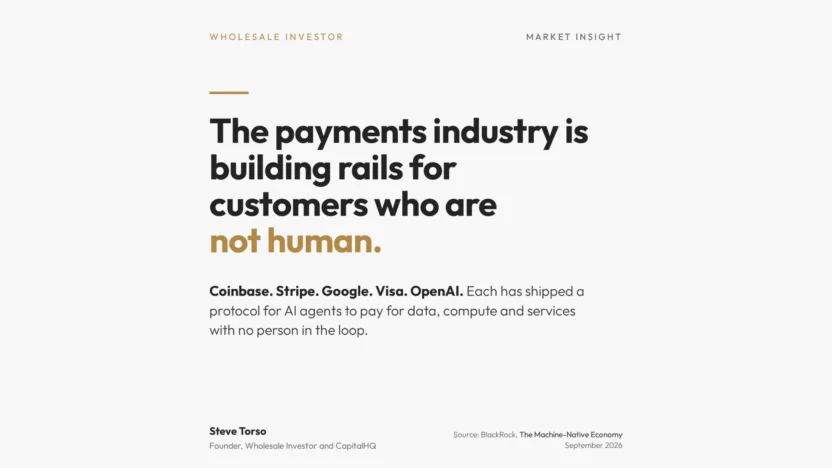
BlackRock has named the next Economy. What this latest paper means for Private Market Investors.
BlackRock has put a name on something the smart money has been circling for two years. Its digital assets research team calls it the machine-native economy. The thesis fits in one line. AI is machine-native intelligence. Digital assets are machine-native money. Both are built on the same architecture, and they are converging into a single […]

Where’s the beef? Blackstone just answered the AI question.
In 1984, a fast food ad asked a question that became a catchphrase. Where’s the beef? Jon Gray, President of Blackstone, used that line this month in front of global LPs. It is the question every capital allocator is asking about AI. Trillions of dollars are going into chips, data centres and power. That is […]
Backed By Leading Investment Groups and Family Offices