
News and Announcements

The Decoupling of Compute: Why the Next Infrastructure Trade isn’t on Earth
- Published December 17, 2025 11:00AM UTC
- Publisher Steve Torso
- Categories Capital Insights, Landing, Trending
For years, the concept of data centres in space was dismissed as science fiction. It was a fringe theory for futurists.
In the last week, that narrative collapsed. It has become the new industry consensus.
We are witnessing a rare alignment among the most powerful technology capital allocators. When Google, Bezos, and Musk all move in the same direction at the same time, it is no longer a question of “if”. It is a race for “who” builds the stack first.
This is not just an innovation story. It is a pragmatic solution to an existential bottleneck.
The Earth-Bound Energy Crisis
The constraints of terrestrial infrastructure are becoming impossible to ignore. AI demand is outpacing the capacity of our power grids. We are hitting physical limits on cooling and energy generation.
The solution isn’t to build more land-based power plants. The solution is to shift consumption to where energy is abundant.
Consider the signals that have hit the market in just the last few days.
The Titans Are Aligning
Google has made its position clear. Sundar Pichai confirmed “Project Suncatcher,” targeting TPU constellations by 2027. His rationale is mathematically undeniable: the sun emits 100 trillion times more energy than humanity produces. Space is the only environment where we can capture that power without interruption.
Jeff Bezos and Blue Origin are forecasting gigawatt-scale data centres in orbit within 20 years. Crucially, Bezos explicitly stated they will beat terrestrial costs. This is an economic play, not a vanity project, driven by 24/7 solar access.
Elon Musk is pitching a future where Starship delivers 300GW of solar-powered AI satellites annually.
And while the giants plan, the startups are executing. Starcloud, an Nvidia-backed venture, just successfully trained the first AI model (NanoGPT) in orbit on an H100 GPU.
The Three Drivers of the Orbital Economy
The rush to space is driven by three pragmatic factors that Earth-based centres cannot solve.
- Energy Efficiency: Solar panels in orbit are 3x to 8x more productive than on Earth. They run 24/7 with no night cycles and no atmospheric interference.
- Thermal Management: The vacuum of space provides free radiative cooling. This solves the heat bottleneck that currently caps high-performance compute and drives up operational expenditure on Earth.
- Latency and Speed: Optical laser links in a vacuum are faster than fibre optic cables on Earth. This enables the creation of low-latency global grids that physical geography cannot match.
The New Asset Class
We are watching the decoupling of compute from the power grid.
For investors and strategists, the implication is clear. The next major infrastructure asset class is not industrial land or data centre REITs. It is orbit.
We are moving from a world where geography dictates capacity to one where the only limit is launch cost. And launch costs are plummeting.
In 10 years, we will look back at this week as the moment the infrastructure of the internet began its migration off-planet.
P.S. This shift creates a new ecosystem of vendors, from launch providers to orbital maintenance. The opportunities are not just for the giants. Watch this space closely.
Trending
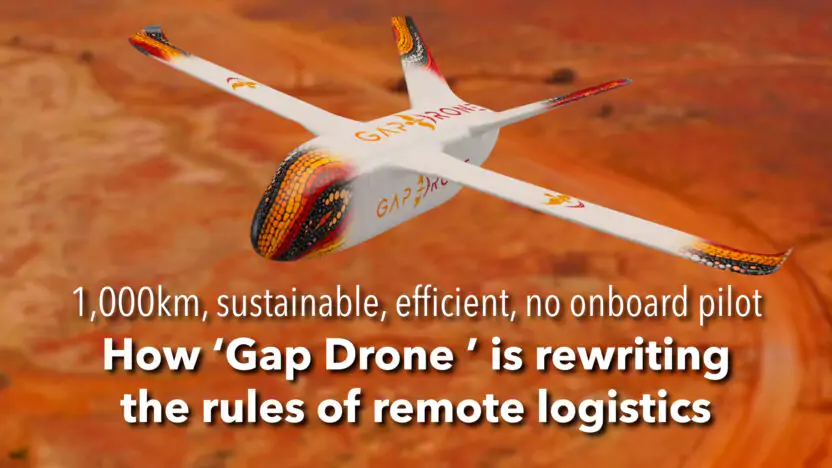
1,000km, sustainable, efficient , no onboard pilot: How ‘Gap Drone ’ is rewriting the rules of remote logistics
Can autonomous drones solve Australia’s “tyranny of distance”? GAP Drone CEO Liesl Haris thinks so. With the launch of ATLAS—an autonomous transport logistics aircraft system—the company is bypassing traditional infrastructure to deliver 50kg payloads over 1,000km. Dubbed the “Uber of airfreight,” GAP Drone is tackling the “too hard basket” of remote logistics, partnering with Australia Post to provide First Nations communities and regional hubs with reliable, low-cost access to medicine, food, and economic opportunity. By operating within current regulatory frameworks and utilising a “no-runway” launch model, GAP Drone is transforming air freight from an expensive luxury into a scalable utility.

Precision Care, Zero Clicks: Why the Future of the NDIS is Voice-First
Carelogix is solving the healthcare burnout crisis by replacing manual typing with a sophisticated AI “care co-pilot.” By reclaiming nearly half of a caregiver’s day, the platform offers a significant value inflection point for providers and investors in the trillion-dollar care economy.
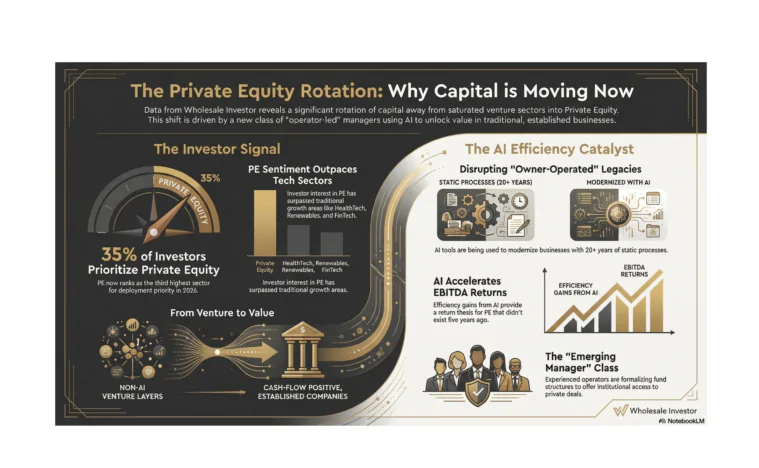
The Private Equity Signal I Am Watching Very Closely
Pattern recognition in private markets is not about predicting the future. It is about reading what is already moving before the wider market notices. I spotted the same signal in life sciences 18 months before it became consensus. We are watching it happen again, this time in private equity.
Backed By Leading Investment Groups and Family Offices