
News and Announcements
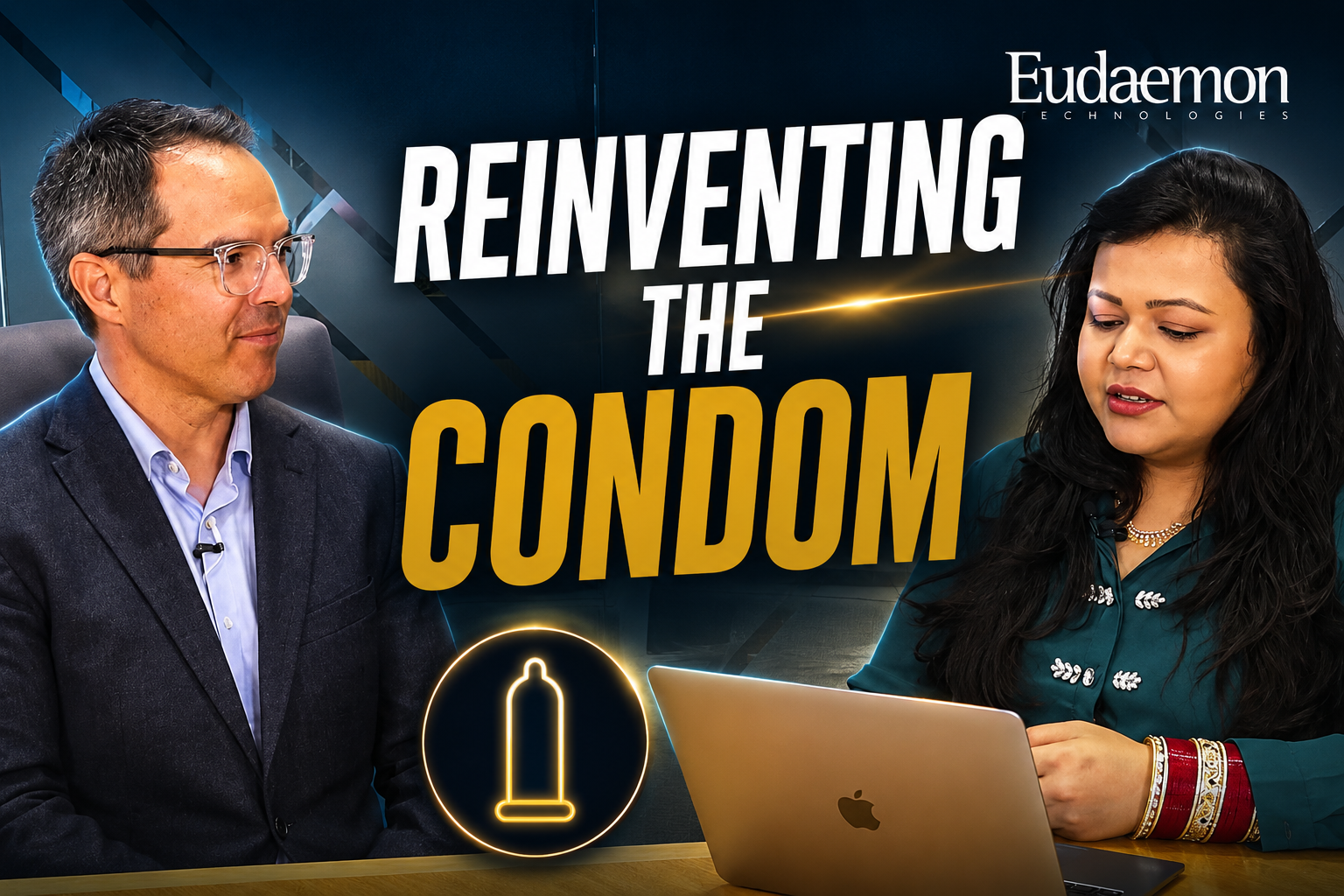
Reinventing the Condom: How an Australian Deep-Tech Startup Plans to Disrupt a $12 Billion Market
- Published August 28, 2026 5:24AM UTC
- Publisher Bella Battsengel
- Categories Company Updates, Executive Interviews, Life Science Hub
For more than half a century, the global condom industry has remained fundamentally unchanged, constrained by standard materials like latex and solid synthetic polymers. Despite widespread consumer demand for better alternatives, product design has treated the device strictly as a mechanical barrier, sacrificing feel for function.

Sydney-based Eudaemon Technologies is setting out to upend that paradigm. Spun out of Wollongong University and Swinburne University following an initial challenge grant from the Bill & Melinda Gates Foundation, the deep-tech firm has spent over a decade developing what was long considered a material science impossibility: a commercially viable hydrogel condom.
“If you think about what a condom is, it’s a Class II medical device designed to block pathogens and prevent unplanned pregnancy,” says Nick Northcott, Executive Chairman of Eudaemon Technologies. “Historically, manufacturers created a solid block polymer. But the real barrier to adoption is experience. People want a natural feel, and current products interrupt intimacy.”
Eudaemon’s answer lies in hydrogels—water-absorbing polymers similar to those used in modern soft contact lenses. Composed of 50 per cent water, the material mimics human tissue through alternating layers of polymer and moisture.
According to Northcott, the technology shifts both the physical experience and the brain’s response. While traditional latex can trigger an unconscious “turn-off” reaction, neurological testing indicates Eudaemon’s hydrophilic material activates a novelty response. Crucially, the material boasts the lowest modulus, a measure of stiffness and force required during use, of any product currently on the market, allowing it to feel practically imperceptible.
The commercial opportunity is substantial. The global market is currently valued at $12 billion USD and projected to reach $20 billion USD. Eudaemon is initially targeting the high-margin premium synthetic segment, growing at 10 per cent annually, before eyeing mass-market latex replacement.
Commercialisation and Market Entry
- Clinical Progress: Completed a successful first-in-human pilot safety trial involving 34 Australian couples, demonstrating strong safety, efficacy, and consumer preference signals.
- Manufacturing Scale-Up: Constructing a pilot manufacturing facility in Sydney capable of producing 27 million units annually using proprietary robotics and automation.
- Funding & IP: Supported by $15 million in non-dilutive funding, backed by 54 patents alongside extensive trade secrets, and currently completing a $5 million seed funding round.
- Go-to-Market Strategy: Operating an asset-light model by owning the core IP and manufacturing technology end-to-end, entering the market as an OEM before scaling via global licensing agreements with major strategic brands.
“Hydrogels took 99 per cent of the contact lens market over 30 years ago because the user experience was vastly superior,” Northcott notes. “We expect a similar trajectory here—first dominating premium synthetics in key markets like the US and China, then displacing latex across the broader market.”
With a pivotal clinical trial and a US FDA 510(k) submission on the horizon, Eudaemon presents a rare hybrid proposition: a defensive Class II medical device paired with a high-margin consumer product unaffected by AI disruption. For investors, the company offers a clear path to high-margin cash flows in a market ripe for long-overdue innovation.
Life Science Hub

Dogs First to Reduce Risk: QBiotics’ Smarter Path to Oncology Markets
QBiotics took a compound derived from a north Queensland rainforest tree all the way to veterinary registration before pursuing human oncology to de-risk its human cancer programme. Interim CEO Ebru Davidson argues that sequence – now backed by early responses across several human cancers – is the company’s real asset. The story that pulled Wholesale […]
Built on discipline, not complexity: inside an ASX equities income strategy
Haydn Froggatt and Zac Brabin have decades of derivatives experience between them and access to almost any strategy in the market. They use two of the simplest structures available, and wrote 202 positions with them last year. Published by Fairway Capital Management. Based on an interview with co-founders Haydn Froggatt and Zac Brabin. Two traders, […]

BlackRock has named the next Economy. What this latest paper means for Private Market Investors.
BlackRock has put a name on something the smart money has been circling for two years. Its digital assets research team calls it the machine-native economy. The thesis fits in one line. AI is machine-native intelligence. Digital assets are machine-native money. Both are built on the same architecture, and they are converging into a single […]
Backed By Leading Investment Groups and Family Offices