
News and Announcements

Following the Billions: Where the Hyperscalers are Betting on the Future
- Published November 28, 2025 1:13AM UTC
- Publisher Jade Miguel
- Categories Capital Insights, Landing, Trending
In the noise of the AI revolution, most investors and business leaders are struggling to separate hype from durable signal. But as Steve Torso argued in his recent keynote, the roadmap for the next decade isn’t hidden in a startup’s pitch deck—it’s written plainly on the balance sheets of the Hyperscalers.
Microsoft, Amazon, Google, and Meta aren’t just playing with AI; they are making foundational bets that dwarf the talent acquisition frenzies of the past. If you want to know where the future of technology and capital is heading, follow the trillion-dollar infrastructure money.

The Three Pillars of the AI Buildout
The collective investment of the top tech giants is flowing into three key, non-negotiable areas, signaling where true value and bottlenecks will emerge:
- GPU Chips (The New Gold): The foundational processing power needed to train and run large AI models. This is the bedrock of the entire buildout.
- Data Centres (Now “AI Factories”): The simple rebranding of data centres to “AI Factories” is not a marketing gimmick; it signals a fundamental shift in expected output and utility. These are not just storage facilities; they are production centres for digital intelligence.
- Energy (The Ultimate Constraint): The single biggest long-term barrier to scaling AI. The staggering demand for electricity is driving massive strategic investment.
This investment focus highlights that the race is no longer about who can build the cleverest software, but who controls the physical infrastructure required to run it.
The Geopolitical Race for Energy Dominance
Energy has quickly become a geopolitical battleground. The US and China are locked in a race for technological and energy dominance, prioritising sheer energy capacity over purely sustainable sources to power their digital ambitions.
The Hyperscalers’ energy investments reflect this urgency: the leading areas of capital flow are nuclear and natural gas, with renewable energy and storage following closely behind.
The scale of this energy demand is staggering: the investments already outlined by the top six tech companies alone could generate enough electricity to supply 24 million homes. This entire capacity is being built solely to feed their future AI factories, underscoring the severity of the bottleneck.
The Grand Convergence: $7–$20 Trillion Impact
Torso argues that the current era is not just another tech cycle—it’s a historical event, directly paralleling the Second Industrial Revolution, which saw the convergence of electricity, the internal combustion engine, and telecom lead to a two times increase in GDP.
Today’s convergence is built on:
- AI
- Robotics
- Energy Storage
- (Complemented by Blockchain and Multi-omics)
This convergence is projected to create an additional GDP impact of between $7 and $20 trillion by 2030. Crucially, this growth is expected to be non-inflationary and deflationary, powered by technology that drives radical efficiency.
The Macro Case for Digital Assets
The discussion on platform convergence is incomplete without the inclusion of Crypto—the complementary platform technology that handles the rapid, permissionless exchange of value.
The macro investment case for digital assets is now undeniable:
- ETFs as the Floodgate: The launch of accessible ETF products for Bitcoin and Ethereum is a game-changer. It bypasses the “ridiculously painful” process of dealing with banks and allows pension funds and institutional capital to enter the market with unprecedented ease.
- Simple Economics: Bitcoin, as an asset with fixed and limited supply, faces exponentially increasing demand due to this institutional access. The economic result points toward long-term price appreciation.
- The “Everything Code”: A powerful macro thesis shows a reliable correlation between the M2 money supply (global liquidity) and the price of Bitcoin, offering a powerful, albeit delayed, signal for major price movements.
- Stablecoin Dominance: The sheer volume transacting through stablecoins has surpassed Mastercard and Visa, signaling their critical role as the new rails for digital finance. Companies like Tether are generating immense profits, making them arguably one of the most profitable financial institutions per employee globally.
The convergence of AI, which drives unprecedented efficiency, and Crypto, which facilitates the exchange of value, represents the most powerful alignment of platform technologies since the last industrial age. For builders, the challenge is clear: build defensible moats around data dominance, network effects/ecosystems, and domain expertise to capitalise on this exponential future.
Trending

Why the 20-Year Hold Is the Secret to Australian Life Sciences Returns
Australia represents 0.3% of the world’s population. Yet it generates more than 3% of global research output. Cochlear implants. Wi-Fi. The HPV vaccine. These are not statistical anomalies. They are proof points of a structural advantage that Australia has failed to capitalise on. The country has a world-class research base. But it watches companies scale […]

The ‘Unused Billion’: How Points4Purpose is Disrupting the Flatlining Loyalty Market
The loyalty industry is plagued by “sameness,” leaving billions in value dormant. Ivan Schwartz’s Points4Purpose is disrupting this flatlining market by turning rewards into a liquid currency for rent, bills, and over 1.8 million charities.
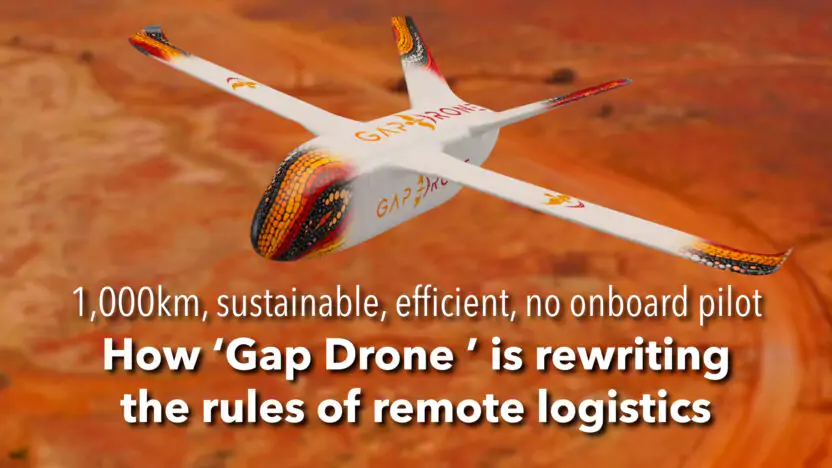
1,000km, sustainable, efficient , no onboard pilot: How ‘Gap Drone ’ is rewriting the rules of remote logistics
Can autonomous drones solve Australia’s “tyranny of distance”? GAP Drone CEO Liesl Haris thinks so. With the launch of ATLAS—an autonomous transport logistics aircraft system—the company is bypassing traditional infrastructure to deliver 50kg payloads over 1,000km. Dubbed the “Uber of airfreight,” GAP Drone is tackling the “too hard basket” of remote logistics, partnering with Australia Post to provide First Nations communities and regional hubs with reliable, low-cost access to medicine, food, and economic opportunity. By operating within current regulatory frameworks and utilising a “no-runway” launch model, GAP Drone is transforming air freight from an expensive luxury into a scalable utility.
Backed By Leading Investment Groups and Family Offices