
News and Announcements
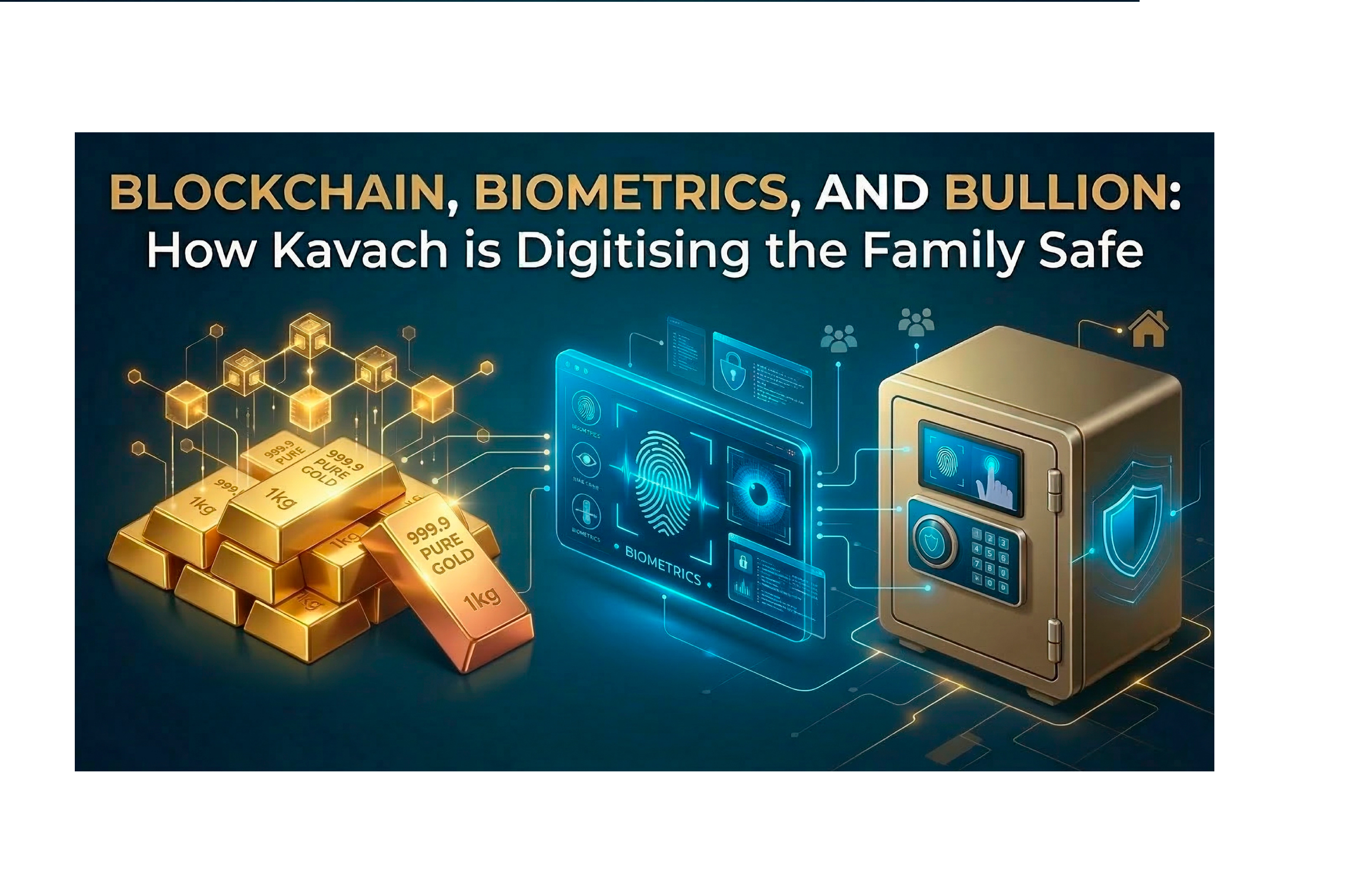
Blockchain, Biometrics, and Bullion: How Kavach is Digitising the Family Safe
- Published March 19, 2026 11:25PM UTC
- Publisher Jade Miguel
- Categories Capital Insights, Executive Interviews, Landing, Trending
In Australia, there is one safety deposit box for every 82 families. In mature markets, that ratio sits between 1-in-20 and 1-in-27. That gap is not a market inefficiency — it is an investment thesis.
The traditional Big Four bank branch is in retreat, but for Australia’s growing migrant communities, the disappearance of the local vault is not just an inconvenience — it is a security crisis.
Dinesh Dindukurthi, a seasoned cybersecurity and ICT programme management professional with over 20 years of large-scale delivery experience across Federal and State Government agencies and major enterprise clients, is the founder of Kavach. He believes he has identified the convergence of several structural forces in the Australian property and security market: record gold prices, a documented rise in Victorian property crime, and the accelerating withdrawal of banks from physical security infrastructure.
“For every one safety locker available today, there are 82 families waiting. The banks are moving to a purely transactional, digital model — leaving 27 million Australians with fewer than 50 private vault facilities across the entire country.” — Dinesh Dindukurthi, Founder, Kavach Vaults
The geographic imbalance compounds the supply gap. While the post-pandemic demographic shift has pushed families into outer suburbs, 98 per cent of existing private vault capacity remains anchored in CBDs. For a family in Melbourne’s outer west or Sydney’s north-west, protecting irreplaceable heirlooms requires navigating city traffic within restrictive business hours — a friction point Kavach is explicitly designed to eliminate.

From Sentiment to Security
The name Kavach is derived from the Sanskrit word for armour or protective covering — a deliberate signal of the cultural nuance underpinning the business model. For many South Asian, Middle Eastern, and Southern European families, gold and jewellery represent not just stored wealth but intergenerational memory.
“Insurance doesn’t cover emotions. When a grandmother passes down an ornament, or you have your wedding ring, it is a story. My goal is to safeguard those stories before the crime rate gets worse.”
Kavach’s site selection model is deliberately suburban and data-driven. Each location is identified using ABS Census data, catchment demand modelling, and proximity to high-density multicultural communities — whether that is Melbourne’s outer west or Sydney’s north-west growth corridors such as Marsden Park. The flagship facility is designed to prove the unit economics before the network scales.
The addressable demand within any single catchment is substantial. A typical Kavach target suburb contains tens of thousands of asset-holding households from South Asian, Middle Eastern, and Southern European communities — demographics with historically high rates of physical asset ownership. An occupancy target of under 12 per cent of a single demographic cohort within any given catchment represents a conservative entry threshold for facility viability.
The Technology Moat
While the business is anchored in physical steel, the competitive moat is digital. Unlike legacy providers operating on a key-and-clipboard model, Kavach’s operational architecture is designed to scale across a multi-site network without proportional increases in headcount or security overhead. The technology stack integrates four layers:
- Biometric Access and AI Surveillance — algorithms monitoring body language and facial recognition to flag threat indicators before they reach the secure area.
- Mobile Integration — real-time push notifications to customers when their locker is accessed, providing transparency across joint account holders.
- Private Blockchain Audit Trail — every access event recorded on a tamper-proof distributed ledger, providing an immutable record for insurance and legal purposes.
- Physical Hardening — four-hour drill-time rated vault infrastructure with 24/7 links to Grade A security monitoring centres.
Beyond Storage: A FinTech and Precious Metals Ecosystem
Kavach’s long-term value proposition extends beyond physical vault space. The business is architected as a platform — one that integrates financial technology services and strategic precious metals partnerships to deepen customer relationships and diversify revenue.
On the FinTech side, Kavach is developing in-vault and digital capabilities including asset digitisation, insurance-linked storage verification, and secure document custody — services that complement the core locker offering and create recurring, high-margin revenue streams without additional physical footprint.
Equally significant are Kavach’s planned precious metals dealing partnerships. By aligning with accredited bullion dealers and refiners, Kavach positions its vault network as a natural custody and transaction point for physical gold and silver — a market that has seen sustained demand from both retail and wholesale buyers as gold prices reach record highs. Customers can store, insure, and transact precious metals within a single, secure, regulated environment.
“We are not building a storage business. We are building a trust infrastructure — one that sits at the intersection of physical security, digital finance, and the way Australian families actually hold wealth.”
The Economics of Peace of Mind
The financial architecture is straightforward. A medium-sized locker is priced at approximately AUD $600 per year — roughly $50 per month — positioning Kavach as a fractional cost solution relative to the value of assets under protection.
PROJECTED: At 70% occupancy — the flagship store target within 18 months of opening — the facility is modelled to generate approximately AUD $1.8 million in annual revenue with an EBITDA of AUD $800,000. These are management projections based on stated pricing and occupancy assumptions and have not been independently verified.
The five-year roadmap targets seven facilities and 20,000 lockers across Australia. The Federal Government’s net overseas migration forecast of approximately 200,000 arrivals annually is expected to sustain demand pressure on an already undersupplied market.
“We are building trust-based infrastructure. The gap is rising and the need is now. We are not just building boxes — we are building a safety net for suburban Australia.”
Trending
Blockchain, Biometrics, and Bullion: How Kavach is Digitising the Family Safe
As Australian banks phase out physical safety lockers, Kavach is stepping in with a high-tech network of suburban vaults. Combining AI threat detection with private blockchain verification, founder Dinesh Dindukurthi is digitising the family safe for a new generation of wealth.

Wholesale Investor vs Retail Investor: Key Differences Explained
Wholesale Investor vs Retail Investor: What is the Difference? In Australia, every investor is classified as either retail or wholesale under the Corporations Act 2001. This classification determines which investment products you can access, what level of regulatory protection you receive, and what disclosure obligations apply to the issuers of the products you invest in. […]

Australia’s 60,000 Business Succession Crisis: Why Good Companies Will Close Their Doors
The Australian Business Growth Fund identified approximately 162,000 privately held businesses in Australia with revenue between AUD$2 million and AUD$100 million. More than two-thirds are owned by people of retirement age. When surveyed, another two-thirds do not have a succession plan in place. The mathematics are stark. 60,000 businesses owned by someone of retirement age […]
Backed By Leading Investment Groups and Family Offices