
News and Announcements

QBiotics – Drug trial offers hope for decimated devil population
- Published July 01, 2013 9:34AM UTC
- Publisher Wholesale Investor
- Categories Company Updates
Source: The Sydney Morning Herald By: Lawrence Money 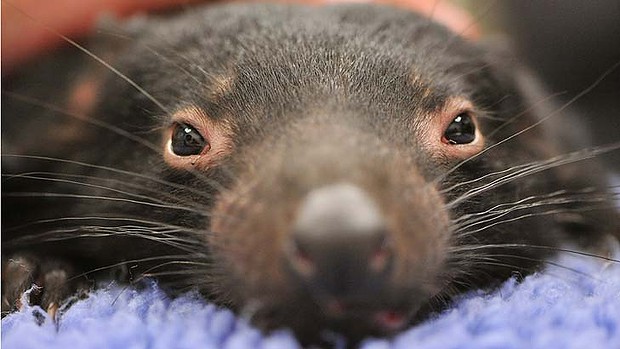 There is fresh hope for Tasmanian devils, with a new drug treatment showing dramatic improvements in facial tumours that are destroying the marsupials’ population. Trials by a Tasmanian government research team using a drug called EBC-46 slowed the growth of tumours in four captive devils in a way that had not been previously possible. Results of the trials will be released on Monday. Research team leader and veterinary pathologist Stephen Pyecroft said the results of trials using the drugs, produced by the Queensland biotechnology company QBiotics, were ”remarkable”. However, researchers warned that the findings were preliminary, and papers from the Tasmanian study are yet to be published. Devil facial tumour disease was originally detected in 1996 and has since reduced the devil population by up to 70 per cent. ”The devil program began in 2003 and we had tried all the usual treatment for animal carcinoma,” Dr Pyecroft said. ”In particular, those for canine venereal sarcoma. Nothing even touched the sides, so when we were approached by QBiotics, offering to help, I was keen to see it happen.” Dr Pyecroft, now a senior lecturer at the University of Adelaide, oversaw the program as manager of diagnostic services and principal pathologist at the Tasmanian government veterinary laboratories. The trials were part of the Save the Tasmanian Devil Program, an initiative formed 10 years ago by the Tasmanian and federal governments in response to public pressure to save the animals. A director of QBiotics, Geelong veterinarian Jack Ayerbe, said EBC-46 was derived from a plant unique to Australia’s tropical rainforest and he had used it with success on dogs and cats in his practice over the past few years. Dr Pyecroft said the four test devils in the Tasmanian program – with advanced disease on the face, tail or neck – had been injected with EBC-46 directly in to the primary tumours. ”There was either regression or palliation of the tumours in all animals,” he said. ”The potential importance of this work is that, for the first time, we may be able to develop a treatment to extend the length and quality of life of diseased devils in captivity. ”We could use this drug on nursing devil mothers that have come in from the wild, to get them through to the stage where their healthy young are weaned and independent. This would contribute to maintaining the genetic growth of this vulnerable species.” However, Dr Pyecroft said the drug would not control the disease among devils in the wild.
Company Updates

Built on discipline, not complexity: inside an ASX equities income strategy
Haydn Froggatt and Zac Brabin have decades of derivatives experience between them and access to almost any strategy in the market. They use two of the simplest structures available, and wrote 202 positions with them last year. Published by Fairway Capital Management. Based on an interview with co-founders Haydn Froggatt and Zac Brabin. Two traders, […]

BlackRock has named the next Economy. What this latest paper means for Private Market Investors.
BlackRock has put a name on something the smart money has been circling for two years. Its digital assets research team calls it the machine-native economy. The thesis fits in one line. AI is machine-native intelligence. Digital assets are machine-native money. Both are built on the same architecture, and they are converging into a single […]

Where’s the beef? Blackstone just answered the AI question.
In 1984, a fast food ad asked a question that became a catchphrase. Where’s the beef? Jon Gray, President of Blackstone, used that line this month in front of global LPs. It is the question every capital allocator is asking about AI. Trillions of dollars are going into chips, data centres and power. That is […]
Backed By Leading Investment Groups and Family Offices