
News and Announcements

Australian Cities – Globally Competitive But Can They Stay There?
- Published October 12, 2015 11:38AM UTC
- Publisher Wholesale Investor
- Categories Company Updates
The recent appointment of Jamie Briggs as the Minister for Cities and the Built Environment sends a strong message that our Federal leaders finally recognise that our cities are an essential ingredient in driving Australia’s economic and social prosperity.
Our cities are home to our most valuable capital – human capital. Almost 80% of the Australia’s population live in our major cities and over 60% live in Australia’s five largest cities alone – Sydney, Melbourne, Brisbane, Perth and Adelaide. Australia’s strong population growth is projected to continue into the future, with the ABS’s medium projection estimating that Australia will grow to just over 30 million people by 2031. The majority of this growth is expected to occur in and around Australia’s capital cities.
Australia’s cities generate the majority of the country’s GDP, and also house much of the nation’s key economic infrastructure, such as ports and airports and provide the majority of Australia’s jobs. Australia’s economic structure is changing rapidly as we move away from agriculture, manufacturing, and resources to a more service orientated economy that is heavily biased to cities.
Australian cities are among the fastest-growing in the developed world and on most major economic and livability rankings fight well above their weight. According to the latest Forbes Most Influential Cities Rankings[1], Sydney tied with Beijing as the eighth most influential city in the world, the 2015 Global Financial Centre Index[2] ranked Sydney 15th and Melbourne 27th while the Economist Intelligence Unit’s 2015 Global Livability Ranking[3] ranked Melbourne 1st, Adelaide 5th, Sydney 7th and Perth 8th.
To read the full article, please click here.
Company Updates
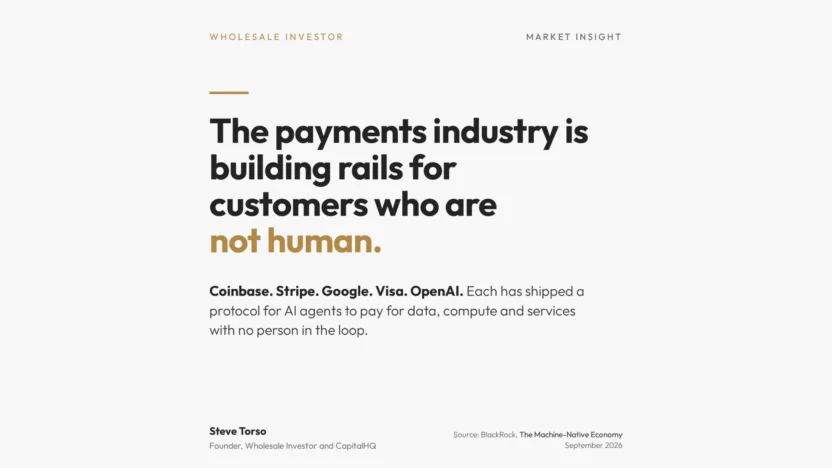
BlackRock has named the next Economy. What this latest paper means for Private Market Investors.
BlackRock has put a name on something the smart money has been circling for two years. Its digital assets research team calls it the machine-native economy. The thesis fits in one line. AI is machine-native intelligence. Digital assets are machine-native money. Both are built on the same architecture, and they are converging into a single […]

Where’s the beef? Blackstone just answered the AI question.
In 1984, a fast food ad asked a question that became a catchphrase. Where’s the beef? Jon Gray, President of Blackstone, used that line this month in front of global LPs. It is the question every capital allocator is asking about AI. Trillions of dollars are going into chips, data centres and power. That is […]

The Best of Both Worlds: How Omnique Fund is Rewiring Real World Assets via Tokenisation
For decades, the playbook for Australia’s wholesale investors has remained relatively unchanged: pick between the slow-moving, illiquid reliability of tangible assets like property and gold, or chase the frictionless, high-velocity liquidity of public equity and digital markets. But as macroeconomic volatility spikes and a structural housing deficit reshapes private debt demand, sophisticated investors are demanding […]
Backed By Leading Investment Groups and Family Offices