News and Announcements
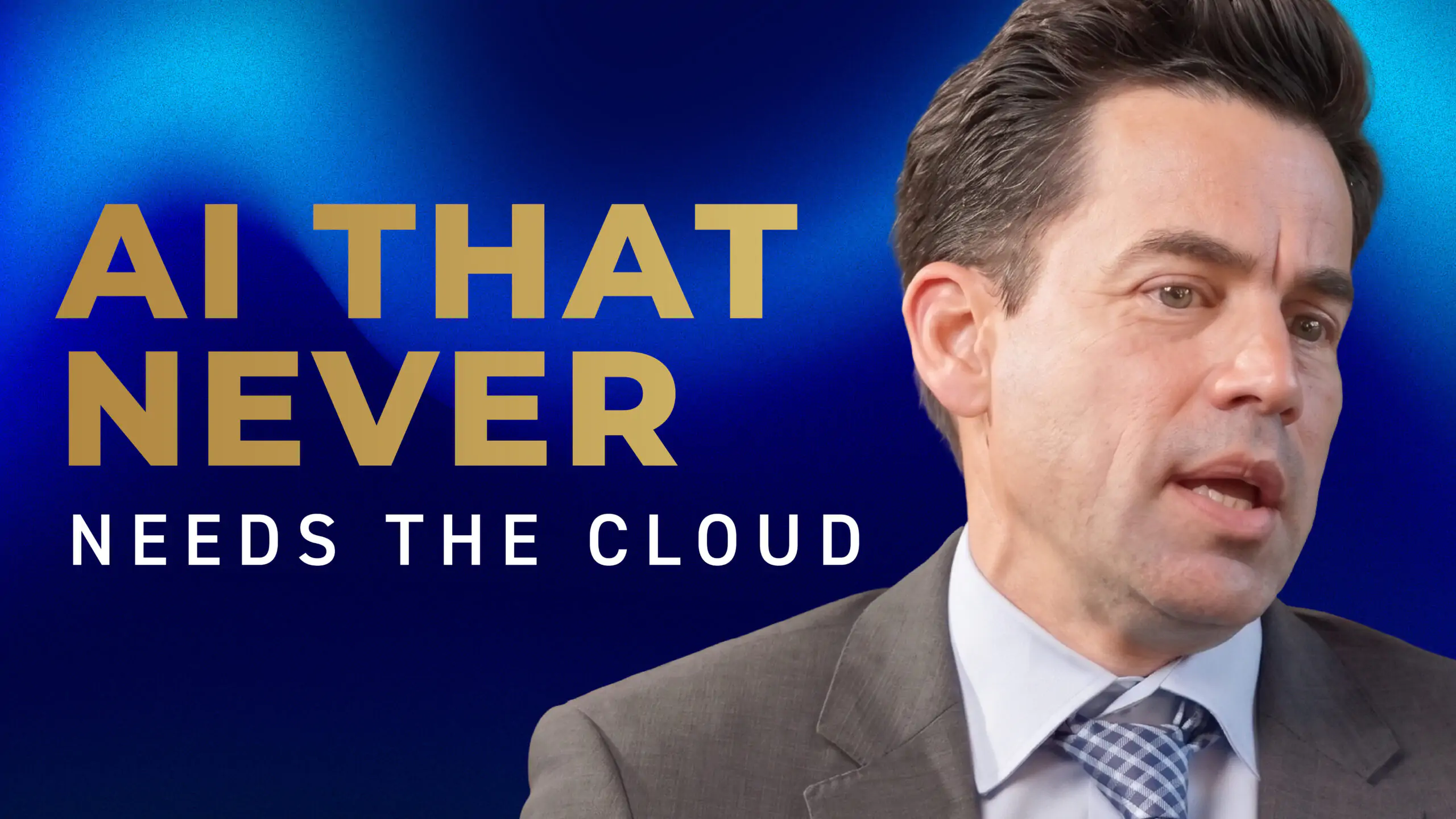
Industrial AI does not fail on models. It fails on context.
- Published November 02, 2026 11:58PM UTC
- Publisher Bella Battsengel
- Categories Capital Insights, Company Updates, Executive Interviews, Landing, Trending
VROC has spent a decade connecting operational data that sits in separate systems and does not talk to itself. Trevor Bloch’s argument is that this is the layer industrial AI needs, and that the window to own it is open now.
Every industrial plant already records almost everything that happens inside it.
The data exists. It is captured continuously, stored carefully, and guarded more closely than most other assets on site. What it does not do is assemble itself into anything a person or a machine can act on.
“Essentially all they were doing was recording data, and all of our customers were extremely protective of their data,” Trevor Bloch said in the interview. “Losing data was the cardinal sin.”
That gap, between data that exists and context that does not, is what VROC was built to close. The company describes the result as Operational Intelligence: connecting fragmented operational data and systems so that people, and increasingly the AI working alongside them, have the context needed to make faster and better decisions.
It is a broader proposition than the one the category labels suggest. VROC operates across industrial software and Asset Performance Management, and predictive maintenance is one application of the platform rather than a description of it.

Why context is the constraint
The reason this matters now is that the industry’s bottleneck has moved.
Models are abundant. Compute is abundant. What remains scarce in an industrial setting is an accurate, connected picture of what a facility is actually doing, assembled across control systems, historians and the equipment itself.
An AI with no context across those systems produces confident output about a plant it cannot see. The constraint is not intelligence. It is the state of the inputs.
That positions VROC’s layer underneath the AI story rather than in competition with it, and it is the clearest way to read the company’s investment case: industrial software, operational data and AI are converging, and the context layer is what the convergence runs on.
Trevor’s view is that the window matters as much as the position.
With a decade of deployment history, an established architecture and customers already in production, his argument is that VROC can take a strategic position in that market before it matures and the category hardens around larger incumbents. For an investor, that timing claim is a material part of the proposition and worth testing directly.
Where it started
Trevor has been an engineer for 25 years and began his career designing and commissioning the control systems that run industrial plants, the PLCs and SCADA layers.
What he noticed was not a technology gap. It was a usage gap.
Facilities guarded their operational data carefully and then did very little with it. Once a week, the plant’s maintenance manager would pull up trend pages and work through equipment piece by piece, reading the charts visually for any sign that something was starting to go wrong.
“This is the top maintenance person on the site,” Trevor said. “He’s got better things to do than look at trend pages all day.”
The observation that followed is the company’s founding logic. The most experienced person on site was manually assembling context from fragmented sources, one screen at a time, at a point when the technology to do it continuously was already more than a decade old.
What connected context produces
VROC reports more than $25 million in realised customer value across more than 200 critical assets, and the example Trevor gives shows why the cross-system view matters more than the single-asset one.
The facility is offshore oil and gas. Gas comes out of a subsea well, moves through a complex processing facility and goes out to a sales pipeline. VROC monitors the data across that entire chain rather than at any one point in it.
One well began producing more moisture than usual. In isolation, that is a reading. Against the rest of the chain, it was a constraint: the processing facility could not keep up with gas at that moisture content.
The system flagged it with a specific recommendation. Throttle that well back now, or the entire facility will shut down.
“So what the operator was able to do was throttle back that well, keep that plant running, and avoid a shutdown.”
That decision was only available because the well data and the processing data were read together. A warning about the well alone would not have told the operator what to do about it.
The economics are what make the case. Trevor says restarting the plant from a shutdown costs around $6 million on its own, before counting the lost gas production and the two days of work to get back online.
Not efficiency measured in percentages. One avoided event with a seven-figure cost attached.
Exposed to the shift, not to the trade
Asked what he would worry about most if he were sitting on the investor side of the table, Trevor went straight to the thing the room was already thinking about.
“What’s going to happen to AI in the future? You see a lot of money being spent on AI and data centres, so is it a huge bubble that’s going to burst tomorrow?”
Then he drew the distinction that matters.
“The AI that we’re actually using is old. It’s not the LLM that you need a huge data centre to process this data.”
The methods VROC runs on have been in use for decades. They are not resource intensive, they do not require frontier compute, and they are well enough understood that nobody needs to take a view on whether they work.
“The AI bubble that’s going to burst in LLM space, that’s not really going to affect us, because we’re already providing value to our customers.”
The useful way to read that is as a separation of two different exposures. VROC is exposed to the industrial AI opportunity, because the convergence of operational data and AI is the shift it is built for. It is not exposed to the economics of frontier models, because its unit costs do not depend on inference pricing, data centre capacity or model licensing.
Whether a broad correction in AI valuations would leave industrial software untouched is a question nobody can answer with confidence. Sentiment is not that discriminating. But the underlying distinction is real and it is the right one for an investor to interrogate.
The architecture, decided ten years early
The structural choice that now looks most valuable was made before the market rewarded it.
VROC runs on premises, at the edge, or in a private cloud, with no dependence on external AI services or APIs. The full stack, from data acquisition through processing to alerting and the user interface, sits under the company’s own control.
“If you have a defence application, you can deploy the technology completely airgapped from the internet. We don’t need to speak to any of the cloud service providers to provide the insights that we do.”
Trevor’s point is that the environment moved toward that position rather than away from it. Customers have become markedly more concerned about where their data goes, and the concern is sharpest in exactly the sectors VROC serves. Defence. Water and desalination. Wastewater. Power generation. The utilities a country has an interest in keeping under its own control.
He goes further, noting that some countries now prohibit any data from their manufacturing facilities leaving the country at all.
For a competitor built on hyperscaler infrastructure that is an architectural problem rather than a commercial one, and it cannot be fixed with a contract clause. For VROC it is the status quo.
What the raise is actually for
Contracted revenue has grown tenfold over four years, achieved substantially through founder-led sales rather than a dedicated commercial function.
That is the achievement and the constraint in the same sentence.
“There’s quite a strong pull from the market for us at the moment,” Trevor said. “We’re getting a lot of calls, a lot of opportunities where we may not have the capability to service all that demand.”
The $5 million raise is directed at that gap, and specifically at replacing founder-led selling with a commercial engine that works without him. Most of the capital goes into sales, customer acquisition, customer success and building out a channel partner network, with an experienced chief executive brought in to run it.
The logic is that each of those is a different problem. Sales capacity converts the demand already arriving. Customer success protects and expands it once it lands. A channel partner network reaches the facilities a direct team will never cover, which in a market measured in industrial sites rather than enterprise logos is where the scale actually sits.
None of it is a product problem, which is the point. The technology has a decade of deployment behind it and customers in production. What has not been built is the machine that sells it repeatably.
That is a more candid answer than most founders give when asked why they are raising, and it carries a real qualification. Commercial engines are harder to build than products, the chief executive has not been appointed, and the hire will shape the outcome more than the capital will. An investor is funding an organisational build, not a product roadmap.
The implication
The two things investors are currently most uneasy about are concentration in AI valuations and the sovereignty of operational data.
VROC’s position is that both are arguments in its favour. The methods predate the hype cycle, so the economics do not depend on it. The architecture predates the regulation, so compliance is not a retrofit. Ten years of deployment across oil and gas, water, energy and manufacturing supports the first. An airgapped stack is a structural fact rather than a positioning statement, which supports the second.
What remains unproven sits entirely on the commercial side. A company that has grown tenfold on its founder’s own selling has demonstrated that the product works and that buyers want it. It has not yet demonstrated that the same growth is available from a team, a channel and a process.
That is the question the raise exists to answer, and it is the right one to be asking at this stage.
Trending
Industrial AI does not fail on models. It fails on context.
Operational Intelligence connects fragmented operational data and systems across an industrial facility, including control systems, historians and equipment data, to give operators and AI tools a connected view of what a plant is actually doing. It sits within the broader industrial software and Asset Performance Management market, where predictive maintenance is one application among several, and can be deployed on premises, at the edge or in airgapped environments where operational data cannot leave the site.
It looks like a fund with no thesis. It is not really a fund.
An umbrella fund structure holds multiple single-purpose sub-funds, each with its own unit class and segregated assets held in the trustee’s name. Investors select an individual project rather than acquiring exposure to the whole portfolio, which means they carry concentrated exposure to that project and do not obtain diversification across the fund’s other investments.

What they took out paid for the production line
Flint’s paper battery is usually described by what it removes. Carlo Charles’s even more interesting point is that removing the materials also removed a lot of machinery, and that is why two products reached production on roughly US$4 million. Asked what is inside his battery, Carlo Charles starts with what is not. No lithium. No […]
Backed By Leading Investment Groups and Family Offices