
News and Announcements
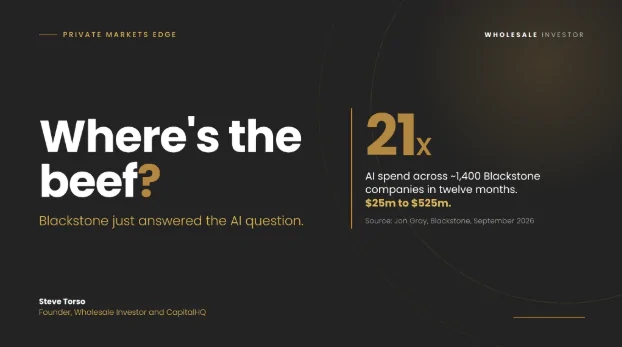
Where’s the beef? Blackstone just answered the AI question.
- Published September 24, 2026 12:35AM UTC
- Publisher Bella Battsengel
- Categories Capital Insights, Trending
In 1984, a fast food ad asked a question that became a catchphrase. Where’s the beef?
Jon Gray, President of Blackstone, used that line this month in front of global LPs. It is the question every capital allocator is asking about AI.
Trillions of dollars are going into chips, data centres and power. That is the bun. The beef is the return on investment.
I watched the full session. It is the clearest briefing on the AI capital cycle I have seen this year. Here is what stood out.
The demand numbers are not normal
Gray opened with a simple point. Geopolitics, inflation, rates and deficits all matter. But two letters are driving portfolio value today.
On his numbers:
- Google’s monthly token use went from almost nothing in 2024 to around 480 trillion, then to around 3.2 quadrillion by May 2026.
- Anthropic and OpenAI had close to zero revenue a few years ago. Gray put their combined run-rate at around $105bn as of July.
- Across roughly 1,400 Blackstone portfolio companies, GP stakes and borrowers, run-rate spend with Anthropic went from around $25m in September 2025 to around $525m. That is 21 times in a year.
That last figure matters most. Companies do not increase a budget line 21 times on a story. They do it because the spend is paying. Gray called the ROI extraordinary.
The infrastructure response has been just as large. He cited CapEx across the five hyperscalers of around $415bn last year, rising to around $820bn this year. That is roughly 2.5% of US GDP.
Blackstone’s own data centre leasing went from around 1 gigawatt in 2024 to 2 gigawatts in 2025. This year it is at least 6 gigawatts.
Where the beef is showing up
This was the strongest part of the talk. Gray did not argue the case in theory. He went company by company.
- Phoenix Tower processes leases five times faster. A $4m AI process now returns around $4.5m a year.
- Enverus is seeing around 18 times return on model spend for code fixes.
- Tricon processes rental applications around 90% faster.
- Chamberlain, an analog garage door business, built an AI vision product now at a $40m to $50m run-rate. Gray said the CEO sees a path to around $500m in five years.
Then the macro data. US annual productivity growth ran at around 1.5% for a decade. Over the past two and a half years, it has been around 2.6%. Gray was careful here. It is hard to isolate AI. But something moved.
He cited EBITDA margins up around 500 basis points across the S&P over four years, and around 700 basis points across the Blackstone portfolio.
The scoreboard line was the one I wrote down. Of Blackstone’s ten most appreciated investments in Q2, nine were AI-related. The exception was a hospital business in India.
Why this is not the railroads
Every investor with a memory is asking the bubble question. Gray took it head-on with history.
America in 1870 was farms, wood, horses and candles. By 1900 it was cities, steel, rail and electric light. Over those 30 years, labour productivity doubled, GDP grew four times, and the stock market grew seven times.
It was also a graveyard. Around 200 railroads went into bankruptcy or insolvency. The telecom build of the late 1990s ended the same way.
Gray’s distinction is the one to hold onto. In both of those busts, supply was built on high leverage ahead of demand.
Today demand is running well ahead of supply. Much of the contracted data centre and energy offtake sits with low-leverage counterparties.
He also pointed to valuation. He cited SK Hynix at around 4 times earnings after a rise of around 500%. Cisco in 2000 traded at around 150 times. The market is still sceptical.
He did not say nothing goes wrong. He said it is a different dynamic, and it needs to be watched while deploying.
The bottleneck is physical
Gray’s three beliefs are simple. Use cases proliferate. Demand for intelligence grows exponentially. The constraint is chips, power and data centres.
The supply side detail was striking.
- New turbines from GE Vernova mean getting in line for 2030 to 2031.
- Hyperscaler CapEx is up around 9 times in five years. The chip companies have not even doubled theirs.
- Gray put a full AI factory at around $55bn per gigawatt, including power, data centres and chips.
- He cited US utility CapEx of around $800bn over the prior five years. He expects it to nearly double over the next five.
- Entitlements, community concern and moratoriums are slowing builds globally.
The constraint is watts, turbines, chips and approvals. It is not the model demo.
What keeps him up at night
It is not a bubble. It is underestimating disruption.
Gray noted that public market multiples in professional services, software and information services have compressed, even where the underlying business is fine. He cited private equity software deals down 66%.
His analogy was 25 years of Amazon. Kmart, Sears and Toys R Us failed. Walmart, Costco and TJ Maxx thrived because the value proposition held.
The white-collar version is coming. His winners own vital systems of record and have management willing to move from selling seats to selling outcomes.
The other winners are scarce assets that AI cannot take away. He named an Indian cricket franchise, beachfront property and Rome airport. People still want the experience.
His risk list was direct. The first is a cyber incident at a financial institution that triggers a global political response. The second is that around 90% of advanced semiconductors are made in Taiwan. The third is companies with no revenue marked at $10bn.
His stated preference is the senior-most part of the stack, which is compute. That is where his confidence is highest.
What I take from it
Three things for private market investors here.
First, the test has changed. The question for any AI exposure is no longer the narrative. It is evidence of return at the company level. Ask where the beef is.
Second, the physical layer is local. Power, grid and data centres get built in real places with real approvals. Australia is already on the map. Firmus was among the deployments Gray named.
Third, every portfolio now has two questions. Which holdings have a value proposition that survives disruption? And which assets are scarce enough that it does not matter?
Active investors are already leaning this way. Technology (39%) and Deep Tech (37%) lead deployment priorities for the year ahead.
Source: CapitalHQ 2026 Investor Survey.
Gray closed with a point worth sitting with. The scale of CapEx required may itself constrain how fast AI usage can grow.
The bun is being built with trillions. On Blackstone’s numbers, the beef is starting to show up. The investors who do well from here will be the ones who keep asking the question.
Trending
Where’s the beef? Blackstone just answered the AI question.
In 1984, a fast food ad asked a question that became a catchphrase. Where’s the beef? Jon Gray, President of Blackstone, used that line this month in front of global LPs. It is the question every capital allocator is asking about AI. Trillions of dollars are going into chips, data centres and power. That is […]
The Best of Both Worlds: How Omnique Fund is Rewiring Real World Assets via Tokenisation
For decades, the playbook for Australia’s wholesale investors has remained relatively unchanged: pick between the slow-moving, illiquid reliability of tangible assets like property and gold, or chase the frictionless, high-velocity liquidity of public equity and digital markets. But as macroeconomic volatility spikes and a structural housing deficit reshapes private debt demand, sophisticated investors are demanding […]

Everything is now competing for the same dollar
Key takeaways As recently as 2022, Germany and Japan could borrow for 30 years at close to zero. That world is gone, and AI is now bidding for what is left. Over the past fortnight, I listened to founders, operators and allocators describe where their industries are heading. They covered four very different frontiers. Each […]
Backed By Leading Investment Groups and Family Offices