
News and Announcements
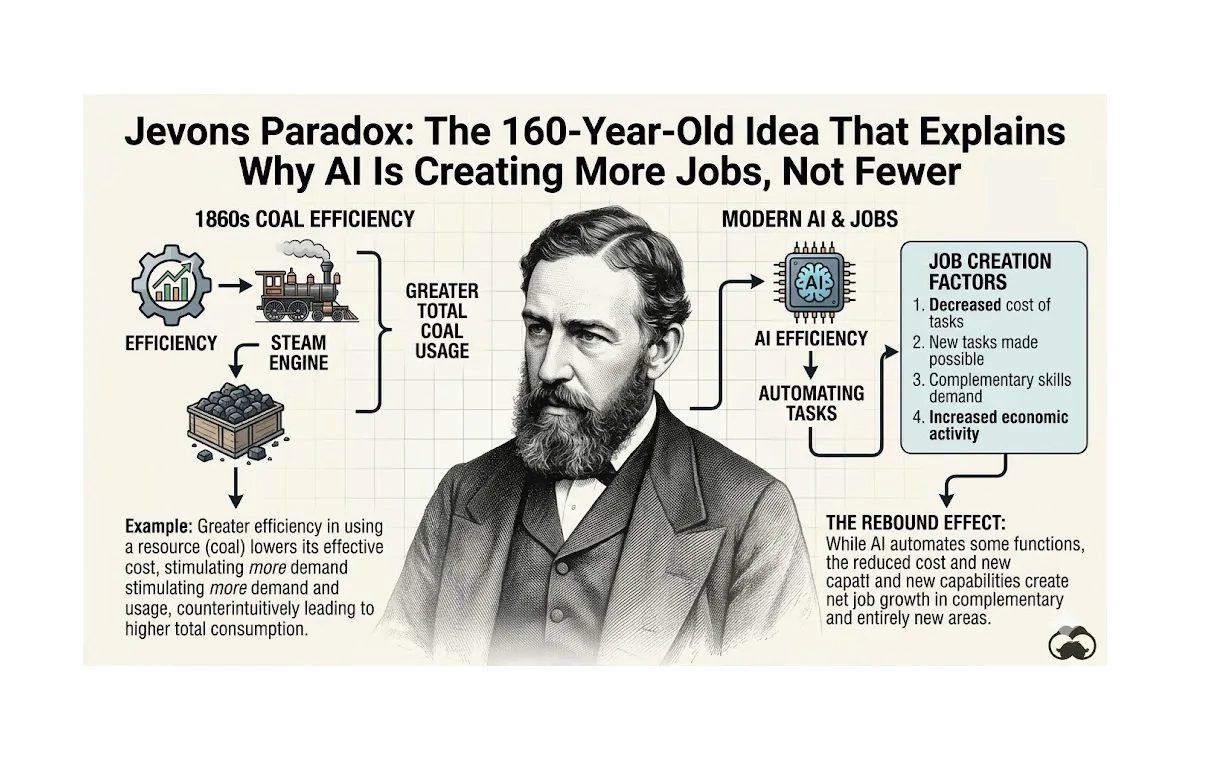
Jevons Paradox: The 160-Year-Old Idea That Explains Why AI Is Creating More Jobs, Not Fewer
- Published March 26, 2026 12:26AM UTC
- Publisher Steve Torso
- Categories Capital Insights, Landing, Trending
In the 1760s, a Scottish inventor named James Watt set out to solve an engineering problem. The steam engines of the day were wildly inefficient. Thomas Newcomen’s design, the industry standard at the time, consumed enormous amounts of coal to produce a modest amount of work. Watt believed he could do better.
He was right. His redesigned engine cut coal consumption by up to 75% per unit of output. It was one of the most significant engineering breakthroughs of the 18th century.
The logical conclusion was straightforward. Britain would use less coal. The nation’s reserves would last longer. The economics were simple. If you need 75% less fuel to do the same job, total fuel consumption should decline.
The opposite happened.
Watt’s efficient engine did not reduce demand for coal. It detonated it. Cheaper steam power suddenly made engines viable for factories, mines, railways, and ships. Industries that could never justify the cost of steam suddenly could. New applications emerged that nobody had imagined. Coal consumption in Britain did not decline. It tripled by 1900.
The efficiency did not conserve the resource. It industrialised the world.
The Economist Who Saw It Coming
An English economist named William Stanley Jevons watched this unfold and recognised something that most of his contemporaries missed.
In 1865 he published a book called The Coal Question. In it, he made an argument that was deeply counterintuitive at the time and remains counterintuitive today. He argued that technological improvements increasing the efficiency of a resource do not lead to lower consumption of that resource. They lead to higher consumption.
The mechanism is straightforward once you see it. Efficiency lowers the effective cost per unit of output. When something becomes cheaper to use, demand increases. New applications become viable. New industries emerge. New markets open. The per-unit savings are overwhelmed by the explosion in total usage.
Jevons warned that Britain’s coal reserves would be exhausted faster, not slower, because of Watt’s improvements. He was not arguing against efficiency. He was pointing out that efficiency fuels economic expansion in ways that most people fail to anticipate.
This idea became known as Jevons’ Paradox. And it has played out with remarkable consistency across 160 years of technological innovation.
Three Stories That Prove the Pattern
Coal and Steam: The Original Paradox
The coal story is where it all begins, but it is worth understanding the full scale of what happened.
Before Watt’s improvements, steam engines were expensive luxuries. Only the wealthiest mine operators could justify the cost. The engines were used primarily to pump water out of coal mines, which is ironic given what came next.
Watt’s efficiency gains completely changed the economics. Suddenly, steam power was affordable for textile mills, iron foundries, grain mills, and eventually locomotives and ships. Each new application created demand for more coal. Each new industry that adopted steam created demand for more engines. Each new engine consumed coal.
By the mid-1800s, the British economy was running on coal in ways that would have been unimaginable a century earlier. Jevons calculated that the nation’s coal consumption was accelerating, not decelerating, and that the trajectory was unsustainable.
He was making a point about resource depletion. But the broader insight was about how progress works. Efficiency does not optimise existing use. It expands the universe of what is possible.
Automobiles: From 10,000 Horses to a Million Cars
In 1900, Los Angeles had approximately 10,000 horses providing transportation. By 1950, the city had over a million cars.
The automobile did not simply replace the horse. It created an entirely new way of living. Suburbs. Commuting. Road trips. Interstate commerce. Drive-through restaurants. Shopping centres are built around parking lots.
Throughout this transformation, engines became steadily more fuel-efficient. Aerodynamics improved. Materials got lighter. Every decade, cars burned less fuel per mile than the decade before.
Total fuel consumption soared.
Because efficiency did not just make existing trips cheaper. It made new trips possible. People who could never afford to travel now could. Businesses that could never afford to ship goods across the country now could. The cost per mile dropped, so the total miles driven exploded.
The same pattern held with every subsequent improvement. Fuel injection. Turbocharging. Hybrid engines. Electric vehicles. Each generation of efficiency gains has been accompanied by rising total vehicle miles travelled.
The resource got cheaper to use. So we used more of it.
Commercial Aviation: From Elite Luxury to Budget Flights
The Wright brothers achieved powered flight in 1903. For decades afterwards, flying was expensive, dangerous, and reserved for the wealthy or the military.
Then came jet engines. Better aerodynamics. Advanced materials. Each generation of aircraft became dramatically more fuel efficient per passenger mile. The cost of moving a human being through the air dropped by orders of magnitude.
The logical expectation would be that aviation fuel consumption would decline as efficiency improved.
Instead, demand exploded. Budget airlines emerged. Global tourism became a mass market industry. Business travel became standard practice. Routes multiplied. Frequencies increased. Airports expanded.
Total aviation fuel consumption rose massively, even as the fuel burn per seat per kilometre continued to improve.
Halving the cost of a trip does not halve the number of trips. It more than doubles the number of people who can afford to fly. The efficiency gains were real. But they were overwhelmed by the expansion of demand that those gains unlocked.
Flying went from elite to everyday. The resource got cheaper. Total consumption increased.
The AI Chapter: Jevons Paradox in Real Time
Now we arrive at the current moment. And the parallels are striking.
When large language models and AI coding tools began to mature, the prediction was immediate and nearly universal. AI would automate software engineering. Coding jobs would disappear. Just as steam engines replaced manual labour and cars replaced horses, AI would replace the people who write code.
The logic felt airtight. If AI can generate code faster and cheaper than a human, why would companies hire humans to do it?
This is the exact same logic that said Watt’s engine would reduce coal consumption. The exact same logic that said fuel-efficient cars would reduce total fuel use. The exact same logic that said efficient aircraft would lead to fewer flights.
And the exact same thing is happening.
Software engineer job postings have spiked to multi-year highs. As of early 2026, there are approximately 67,000 open software engineering roles globally and around 26,000 in the United States alone. These are not legacy postings from a pre-AI era. These are new roles being created because AI changed the economics of building software.
The mechanism is textbook Jevons.
AI makes software development faster and cheaper. This lowers the effective cost of building software. Which means companies are now building far more software than they ever would have without AI. AI copilots. Autonomous agents. Personalised features. Internal tools for industries where custom software was previously too expensive to justify.
The resource in this case is not coal or fuel. It is human engineering talent and compute power. AI made cognition cheaper. So we are consuming more cognition than ever before.
What the Data Actually Shows
The evidence is concrete and recent.
Job postings tell one story. But the structural shift is deeper than headcount numbers.
Tech leaders are now explicitly invoking Jevons Paradox by name. Microsoft CEO Satya Nadella has used it to explain why his company is hiring more engineers, not fewer, as AI capabilities advance. Economists like Erik Brynjolfsson have applied the framework to explain why roles in coding, translation, and radiology are growing due to AI productivity gains.
The shift in how engineering teams operate tells another part of the story. AI handles the repetitive, boilerplate work. But this does not eliminate the need for engineers. It moves engineers up the value chain into architecture, integration, debugging, and innovation at higher levels of complexity. The grunt work gets automated. The frontier of what software can do continues to expand.
Analysts tracking the market note a clustering of hiring in AI hubs, particularly the Bay Area, and a shift toward more ambitious projects. The roles being created are not the same as the ones that existed five years ago. They are higher-value positions working on problems that only became addressable because AI reduced the cost of the foundational work.
This is not universal optimism or dismissal of disruption. Some roles are being displaced. Some tasks are being fully automated. But at the aggregate level, the paradox holds. The total demand for software engineering talent is increasing because the total addressable market for software is expanding faster than AI can automate the work.
Why This Keeps Happening
Jevons Paradox is not a curiosity of economic history. It is a fundamental feature of how innovation interacts with markets.
The reason it keeps happening is that efficiency does not just optimise existing use cases. It creates new ones. When something becomes cheaper, it does not stay confined to its original application. It spreads into new industries, new markets, and new applications that nobody anticipated.
Coal was used to pump water out of mines. Until it was for powering factories, locomotives and ships.
Cars were for the wealthy. Until they were for commuters, truckers and teenagers.
Flying was for the elite. Until it was for tourists, salespeople and students on gap years.
Software was for companies that could afford engineering teams. Until AI made it accessible to every business in every industry.
Each time, the efficiency gain unlocked latent demand that was invisible before the cost dropped. The demand was always there. It was just priced out of the market.
This is why pure efficiency gains almost never reduce total resource consumption without external constraints like caps, taxes, or behavioural shifts. The economic incentive always pulls toward expansion. Cheaper resources fuel growth. Growth consumes more resources. The savings per unit are real, but the total number of units consumed grows faster.
What This Means for Founders and Investors
The implications for anyone operating in private markets are significant.
For founders, the Jevons lens reframes the AI conversation entirely. The question is not whether AI will disrupt your industry. It will. The question is whether you are positioned to capture the demand that AI efficiency unlocks.
Every industry where software was previously too expensive is now a potential market. Every manual process that can be augmented with AI is an opportunity. Every business that could not justify custom technology can now afford it.
The founders who understand this are not worried about AI replacing their teams. They are using AI to build faster, reach new markets, and tackle problems that were previously uneconomical.
For investors, Jevons Paradox is a framework for identifying where value will be created in the next cycle. The opportunity is not in betting against technology. It is in identifying the industries and markets where reduced costs will unlock massive new demand.
This is the pattern that created the industrial revolution, the automobile industry, global aviation, and the software economy. The same pattern is now playing out with AI.
The companies and funds that recognise this will deploy capital into the expansion, not away from it.
The Paradox Is Not a Flaw
There is a temptation to frame Jevons Paradox as a problem. A failure of efficiency to deliver on its promise. A cautionary tale about unintended consequences.
But that framing misses the point.
Watt did not fail because his engine led to more coal consumption. He succeeded because his engine industrialised the world. Ford did not fail because fuel-efficient cars led to more driving. He succeeded because he made transportation accessible to millions.
The paradox is not a flaw in the system. It is the system working exactly as it should. Efficiency creates abundance. Abundance creates new possibilities. New possibilities drive growth. Growth consumes more resources but also creates more value, more prosperity, and more opportunity.
AI is following this pattern with remarkable precision. It is not eliminating engineering jobs. It is creating a world where every company, in every industry, needs more software than ever before. The cost of building dropped. The appetite for building exploded.
William Stanley Jevons identified this dynamic 160 years ago. The technology has changed. The economics have not.
The question is never whether efficiency will replace human effort. The question is what new forms of human effort will emerge when the cost of the old ones drops to near zero.
That is where the next wave of opportunity will be found. And the founders and investors who understand this will be the ones who capture it.
Trending

The asset class where the market has no vote
Litigation funding returns are decided in a courtroom, not a cycle. Knightsbridge’s Head of Capital is careful to call that a different risk rather than a lower one, and his answer to it is spread, not concentration. Most alternative assets still answer to something. Property answers to rates. Private credit answers to defaults. Even the […]

The listing fee vendors pay whether the house sells or not
Australia’s property portals collect more than $2 billion a year while national listings sit flat. An Australian-built AI platform is targeting the economics, not just the interface. An Australian vendor listing a home pays a vendor-paid advertising fee on top of agency commission. Rama Dwarapudi, Founder and Chief Executive Officer of RealSearch, puts a typical […]

Reinventing the Condom: How an Australian Deep-Tech Startup Plans to Disrupt a $12 Billion Market
For more than half a century, the global condom industry has remained fundamentally unchanged, constrained by standard materials like latex and solid synthetic polymers. Despite widespread consumer demand for better alternatives, product design has treated the device strictly as a mechanical barrier, sacrificing feel for function. Sydney-based Eudaemon Technologies is setting out to upend that […]
Backed By Leading Investment Groups and Family Offices