News and Announcements
Australia Just Unlocked Access to the World’s Largest R&D Funding Pool. Here’s What It Means for Life Sciences and Deep Tech
- Published March 25, 2026 2:01AM UTC
- Publisher Steve Torso
- Categories Capital Insights, Landing, Trending
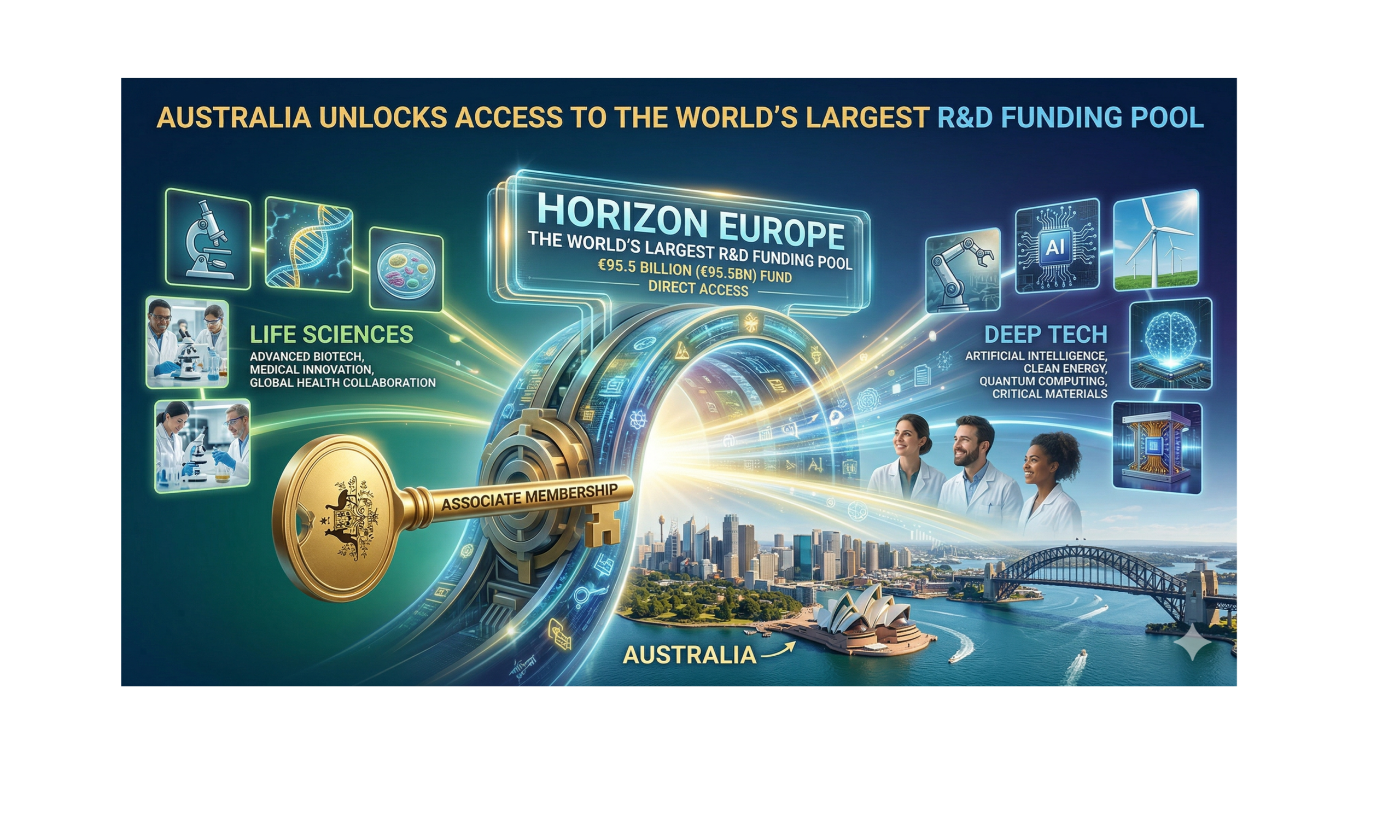
Australia has begun formal treaty negotiations to become an associate member of the EU’s Horizon Europe program. This is the world’s largest single collaborative R&D funding pool. Roughly A$155 billion.
If you are a founder, fund manager, or investor in Australian life sciences, medical devices, deep tech, quantum, clean energy, or critical minerals, this development deserves your full attention.
Here is what is happening, what it means, and why the companies that move early will benefit disproportionately.
What Associate Status Changes
Right now, Australian entities participate in Horizon Europe as a “third country.” That means limited access. Australian researchers and companies cannot lead most projects or access full funding streams. They sit at the edges of the world’s most powerful research collaboration network.
Association changes this fundamentally.
As an associate, Australian universities, research institutions, and companies would be able to lead or fully participate in collaborative projects on equal terms with EU entities. Direct access to funding calls across the agreed pillars of the program.
Negotiations are focused on Pillar II association, which covers Global Challenges, including health, digital, climate, and energy. The exact scope, timing, and specific rules for companies are still being finalised. But the direction is clear.
New Zealand’s early data as an associate already shows strong leverage on its contribution, with the structure designed to deliver significant returns beyond direct grants through network effects, co-investment, and talent flows.
The Group of Eight universities have already committed to help cover Australia’s joining fee. That is not a minor signal. When the country’s top research institutions put capital behind a policy decision before the ink is dry, the sector confidence is real.
Why This Matters for Life Sciences and Medical Devices
Horizon Europe’s Health Cluster is one of the program’s biggest funding areas. It supports disease prevention and treatment, health technologies including medical devices and diagnostics, regenerative medicine, AI-enabled digital health, advanced therapies, regulatory science, and large-scale clinical research.
For Australian life sciences and medtech companies, this opens a door that has been difficult to walk through at scale.
Non-dilutive funding that changes the capital stack. Companies developing therapeutics, devices, or health tech can join or lead multinational consortia and access grants that are extremely difficult to secure domestically at this scale. For a founder raising a $5M round, the ability to point to a multi-million euro Horizon Europe grant as co-funding is a fundamentally different investment proposition. It de-risks the deal. It extends the runway without dilution. And it builds a credibility signal that attracts further private capital.
EU partnerships that accelerate translation. Joint clinical trials. Shared data and infrastructure. Access to more than two million EU researchers. For Australian medtech companies that will eventually need to sell into European markets, being embedded in EU research networks from day one smooths regulatory pathways and builds commercial relationships years before market entry.
Regulatory and scientific alignment with Europe. Stronger coordination on standards, IP and data protection, and policies that incentivise health R&D investment. This matters for medical device companies where regulatory science, manufacturing innovation, and patient-centred technologies are already priority areas within Horizon calls.
A multiplier on domestic funding. The NHMRC already has bridging schemes for Horizon calls. Full association will make direct EU funding significantly more accessible. This does not replace domestic R&D investment. It amplifies it.
The Deep Tech and Critical Minerals Angle
The priority areas announced by the Prime Minister and European Commission President align directly with where Australian innovation is strongest beyond health. Quantum technologies. Critical minerals refining. Advanced computing. Cybersecurity. Climate and clean energy. Supply chain security.
For deep tech founders, the implications are the same. Non-dilutive EU funding extends runway. Consortium participation builds global credibility. And the research partnerships create competitive moats that are difficult to replicate through private capital alone.
Australia’s strength in critical minerals is particularly relevant. The EU has made supply chain diversification a strategic priority. Australian companies with capabilities in minerals refining, processing, and the technologies that support the critical minerals value chain are positioned to become high-value consortium partners.
What This Means for Investors
For sophisticated investors allocating to Australian life sciences and deep tech, this creates a new lens worth applying to deal evaluation.
Companies positioned to access Horizon Europe funding are likely to become lower-risk, higher-upside propositions. The non-dilutive capital extends the runway. The EU partnerships signal global validation. And the network effects from consortium participation compound over time.
The diligence question is straightforward. Is this company positioned to access Horizon Europe? If the answer is yes, the investment case strengthens. If the answer is not yet, the question becomes how quickly they can get there.
This is also a sector-level signal. Life sciences and deep tech deal flow from Australia becomes more attractive as an asset class when there is a A$155 billion funding ecosystem amplifying the companies within it.
The Bigger Picture
This announcement did not happen in isolation. It sits alongside the concluded Australia-EU Free Trade Agreement and a new Security and Defence Partnership. The convergence of trade, research, and security alignment between Australia and the EU is structural. It creates an environment where Australian innovation companies have clearer pathways to global markets, deeper research partnerships, and stronger institutional support than at any point in the last two decades.
For founders, this means the funding landscape just expanded significantly. For investors, the companies they back now have access to a scale of collaborative R&D that was previously difficult to attain. For advisors working with life sciences and deep tech clients, this is a conversation worth having now, not after the details are finalised.
The companies that move early and position themselves for Horizon Europe association will benefit disproportionately. The infrastructure is being built. The question is whether your company or your portfolio is ready to use it.
Steve Torso is the Founder of Wholesale Investor and CapitalHQ, operating Australia’s largest sophisticated investor network of 45,000+ verified subscribers. For more insights on capital markets, investment opportunities, and the companies shaping Australia’s innovation economy, visit wholesaleinvestor.com.au.
Trending
The asset class where the market has no vote
Litigation funding returns are decided in a courtroom, not a cycle. Knightsbridge’s Head of Capital is careful to call that a different risk rather than a lower one, and his answer to it is spread, not concentration. Most alternative assets still answer to something. Property answers to rates. Private credit answers to defaults. Even the […]

The listing fee vendors pay whether the house sells or not
Australia’s property portals collect more than $2 billion a year while national listings sit flat. An Australian-built AI platform is targeting the economics, not just the interface. An Australian vendor listing a home pays a vendor-paid advertising fee on top of agency commission. Rama Dwarapudi, Founder and Chief Executive Officer of RealSearch, puts a typical […]
Reinventing the Condom: How an Australian Deep-Tech Startup Plans to Disrupt a $12 Billion Market
For more than half a century, the global condom industry has remained fundamentally unchanged, constrained by standard materials like latex and solid synthetic polymers. Despite widespread consumer demand for better alternatives, product design has treated the device strictly as a mechanical barrier, sacrificing feel for function. Sydney-based Eudaemon Technologies is setting out to upend that […]
Backed By Leading Investment Groups and Family Offices