
News and Announcements
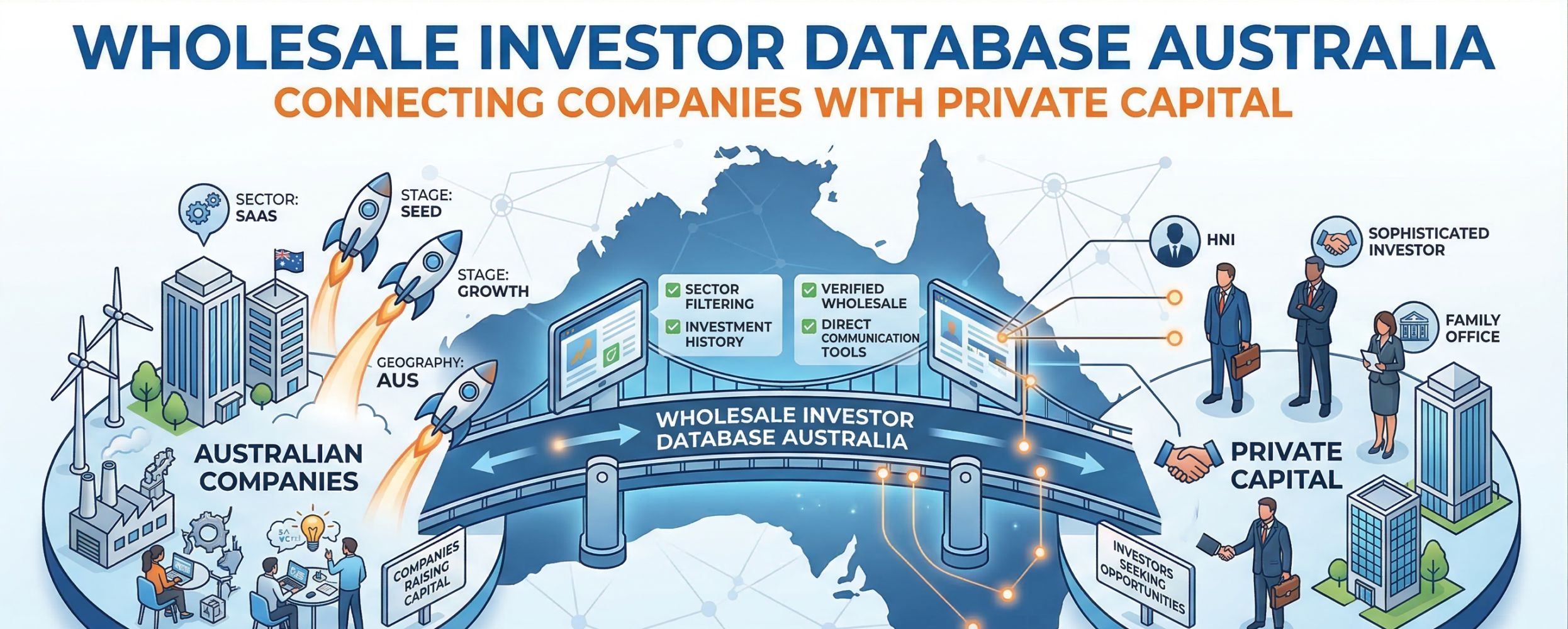
Wholesale Investor Database Australia: Connecting Companies with Private Capital
- Published March 23, 2026 5:40AM UTC
- Publisher Wholesale Investor
- Categories Capital Insights, Capital Raising Tips, Trending
Finding wholesale investors in Australia has historically relied on personal networks, advisors, and word of mouth. For companies raising capital under Section 708 of the Corporations Act, the challenge is not just identifying investors who meet the legal thresholds, but finding investors whose mandate, sector focus, and ticket size actually align with the opportunity.
A wholesale investor database solves this by aggregating verified investors into a searchable, segmented marketplace where companies can connect with capital that matches their raise.
Why a Dedicated Database Matters
Australia’s private capital market is growing, but it remains fragmented. Sophisticated and professional investors are spread across family offices, self-managed super funds, advisory networks, and independent portfolios. Without a centralised platform, founders spend disproportionate time on outreach that yields poor conversion rates, often pitching to investors whose mandates do not align.
A structured database provides three critical advantages. First, investor qualification: every participant has been verified against the Corporations Act thresholds, removing compliance risk from the outreach process. Second, mandate alignment: investors are profiled by sector preference, stage appetite, ticket size, and geographic focus. Third, efficiency: instead of cold outreach to uncontacts, companies can target investors actively looking to deploy capital into their specific category.
The Australian Wholesale Investor Landscape
According to the 2026 Wholesale Investor Survey, the Australian wholesale investor community is diverse and active. Approximately 44% classify themselves as sophisticated or wholesale individual investors, while 24% are founder-investors who both build and back companies. Fund managers account for 12% of the market, and advisors or intermediaries represent 14%.
The geographic investment focus is heavily weighted toward Australia at 71%, but there is meaningful international appetite: 27% are interested in the United States and North America, 20% in Singapore and Southeast Asia, and 21% have no geographic restriction at all.
Sector preferences are broad but cluster around technology in general (39%), deep tech including AI, robotics, quantum, and space (37%), private equity in established businesses (35%), and healthtech and medtech (32%). Renewables, energy, and sustainability also attract strong interest at 32%.
The majority of investors hold between one and five active private investments (45%), with 20% holding six to fifteen positions. This suggests a market of active but selective deployers who are building concentrated, high-conviction portfolios rather than spray-and-pray approaches.
What Investors in the Database Are Looking For
Understanding investor preferences is essential for companies seeking capital. The 2026 survey data reveal several clear patterns.
Management track record dominates decision-making at 75%. Investors want evidence of prior exits, industry depth, and leadership capability before they will take a meeting.
For fund manager evaluation, the hierarchy is similar: track record and performance (DPI, net returns, history of returning capital) is cited by 73% of investors, followed by investment team pedigree at 64%.
On deal structure, priced equity rounds are preferred by 64% of respondents, making them the clear default for most raises. Convertible notes (36%) and private credit with equity upside (33%) are the next most popular structures.
The typical first ticket is $25,000 to $100,000 (43%), with a 3-to-5-year target liquidity horizon preferred by 46% of investors.
How Wholesale Investor’s Database Works
Wholesale Investor operates Australia’s largest private capital marketplace, connecting over 45,000 investors with high-growth companies and fund managers raising capital.
The platform allows companies to present their opportunity to a verified audience through structured profiles, information sessions, and direct investor engagement. Investors receive curated deal flow matched to their stated preferences, including sector, stage, ticket size, and geographic focus.
For companies, the database is not just a list of names. It is an active marketplace where investors have opted in to receive opportunities, have been profiled against their investment thesis, and are engaging with deal flow on an ongoing basis. This is fundamentally different from purchasing a cold list of high-net-worth individuals and hoping for responses.
Building Your Investor Pipeline
Access to a database is the starting point, not the finish line. Companies that convert effectively do several things consistently.
They build a compelling investment narrative anchored in management track record and commercial traction, the two factors investors weigh most heavily.
They communicate regularly and professionally, recognising that 62% of investors prefer an advisor or mentor engagement style, while 42% are comfortable with passive monthly updates. Matching your communication cadence to investor preference is a retention advantage.
They address liquidity proactively, acknowledging the primary frustration in the market (51% cite lack of liquidity) and presenting a clear path to exit.
They leverage events, information sessions, and platform tools to create multiple touchpoints with investors, recognising that private market investing is relationship-driven and rarely converts on a single interaction.
Trending

Forget Startups: Why Magnetic Alliance is Betting on “Boring” Mid-Market Turnarounds
While Australia’s venture capital scene spent years chasing unprofitable tech startups and speculative high-growth plays, Mark Lim was quietly taking a radically different path. The Managing Partner of Magnetic Alliance Capital sees the nation’s richest investment opportunities hiding in plain sight: inside thousands of unglamorous, profitable, but operationally sluggish mid-market businesses. Speaking on Wholesale Investor’s […]

The asset class where the market has no vote
Litigation funding returns are decided in a courtroom, not a cycle. Knightsbridge’s Head of Capital is careful to call that a different risk rather than a lower one, and his answer to it is spread, not concentration. Most alternative assets still answer to something. Property answers to rates. Private credit answers to defaults. Even the […]
The listing fee vendors pay whether the house sells or not
Australia’s property portals collect more than $2 billion a year while national listings sit flat. An Australian-built AI platform is targeting the economics, not just the interface. An Australian vendor listing a home pays a vendor-paid advertising fee on top of agency commission. Rama Dwarapudi, Founder and Chief Executive Officer of RealSearch, puts a typical […]
Backed By Leading Investment Groups and Family Offices