
News and Announcements
The Private Capital Infrastructure Is Failing High-Growth Companies
- Published February 13, 2026 10:00AM UTC
- Publisher Bella Battsengel
- Categories Capital Insights, Capital Raising Tips, Trending
The Broken Reality of Capital Raising Infrastructure
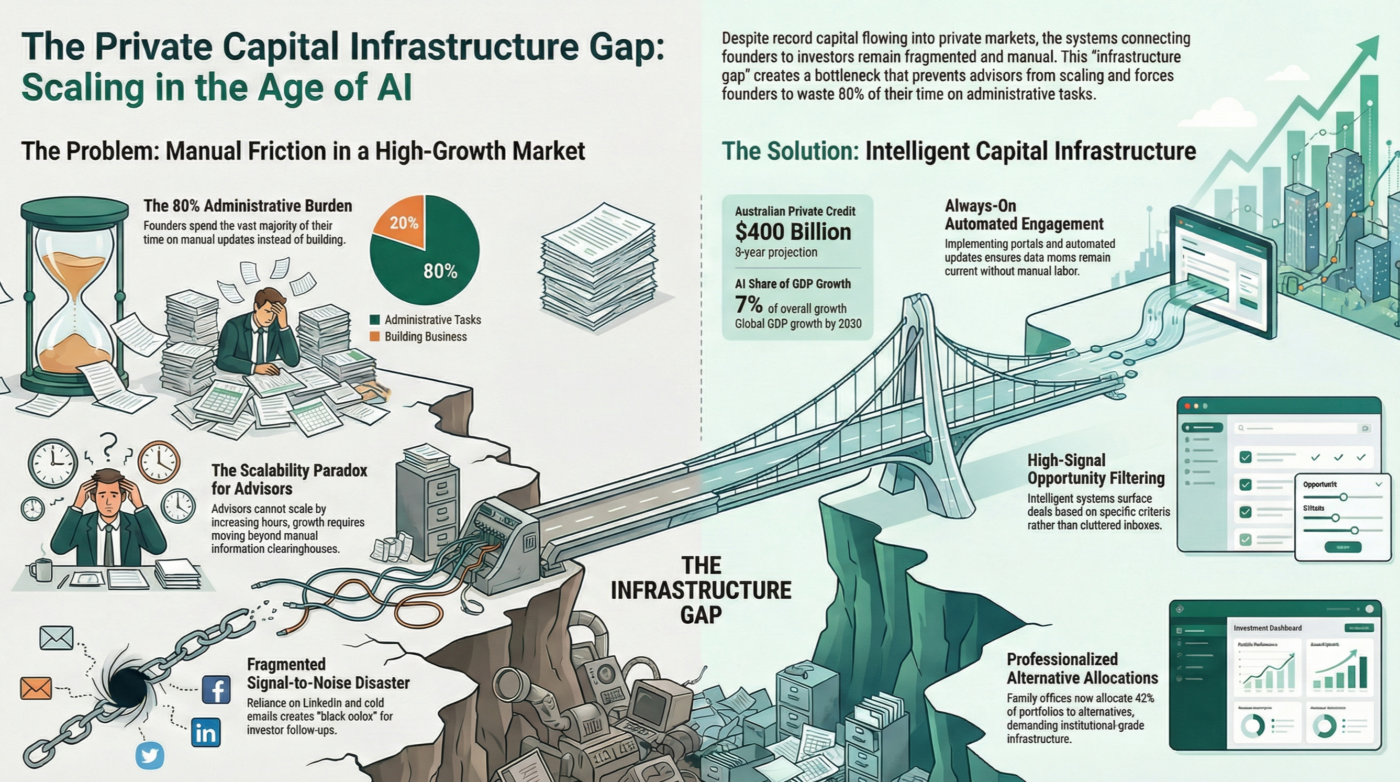
Venture capital poured 55% of global funding into AI companies in 2025. Seed and Series A rounds saw 70% of capital flow to AI-related opportunities. The capital is available. The demand is clear.
But the infrastructure connecting founders to investors remains unchanged. Deal flow arrives through LinkedIn messages, cold emails, and advisor introductions. Investor updates are manual. Follow-ups disappear into silence.
The result is a signal-to-noise disaster. Investors receive hundreds of opportunities with no filtering mechanism. Founders spend 80% of their time on administrative tasks instead of building. Advisors cannot scale because their value is tied to manual introductions.
Why the Rolodex Model Has a Hard Ceiling
Most advisors operate as human clearinghouses for information. They spend their time hand-holding founders through updates and chasing data that should be automated. This creates a paradox. The more successful an advisor becomes, the less time they have to actually advise.
The traditional advisory model does not scale. Growth requires adding headcount for every new client. You cannot build a practice by scaling hours. You can only build it by scaling infrastructure.
The same limitation applies to investor networks. Over 60% of private capital investors are open to strategic calls with founders. They have backgrounds in banking, finance, and go-to-market strategy. But there is no system to activate this network intelligently. LinkedIn has become unusable. Introductions are inconsistent. Deal flow is either a flood or a drought.
The Shift to Always-On Intelligent Infrastructure
The private market is professionalising. Family offices now allocate 42% of portfolios to alternatives. Private credit has grown to $224 billion in Australia with expectations to reach $400 billion. The democratisation of private assets is moving from institutions to high net worth individuals to retail investors.
This professionalisation requires infrastructure that matches institutional standards. Always-on systems that filter signal from noise. Automated investor relations that free founders to focus on execution. Networks that activate rather than sit idle.
The companies winning capital in 2026 are not the ones with the best pitch decks. They are the ones with the infrastructure to maintain consistent engagement. The investors finding alpha are not scrolling through cluttered inboxes. They are using systems that surface high-signal opportunities.
The advisors scaling their practices are not adding headcount. They are implementing infrastructure that allows them to scale expertise without scaling hours.
The Macro Context Behind This Shift
The convergence of platform technologies is creating unprecedented growth opportunities. AI, robotics, energy storage, blockchain, and multi-omics are all moving through S-curve adoption simultaneously. This has not happened since the second industrial revolution.
Global GDP growth is projected to reach 7% by the end of the decade. The largest companies are expected to reach valuations between $20 trillion and $40 trillion within 10 years. There is $2.5 trillion in potential IPOs queued for 2026.
This is the greatest window to build and invest in 30 years. But only for those with the infrastructure to capitalise on it.
The $3.5 trillion succession wave is creating massive liquidity events. Founders are looking to transition. Investors are seeking double-digit yields. Private equity firms are deploying dry powder. All of this requires efficient capital engagement infrastructure.
The old model relied on personal networks and manual processes because the deal volume was manageable. That era is over.
The Implication for Those Who Ignore This
Capital will flow to the path of least resistance. Investors will allocate to opportunities that require minimal friction. Founders will work with advisors who provide scalable value. Advisors will lose clients to platforms that offer better infrastructure.
The rolodex is no longer the moat. The system is.
Those still operating on fragmented emails and manual updates are not competing with other advisors or investors. They are competing with intelligent infrastructure that operates 24/7. The gap will widen. The winners will be decided by those who professionalise their capital engagement before the market forces them to.
The private market is moving toward efficiency. Toward systems that save time and money. Toward infrastructure that activates networks instead of letting them decay.
The question is not whether this shift will happen. It is whether you will adapt before you become irrelevant.
#PrivateCapital #VentureCapital #InvestorRelations #PrivateEquity #CapitalEngagement
Trending

The prefab company that deliberately leaves part of the house unbuilt
BuiltQuik prefabricates the floor and roof structure and stops there. Co-founder Ryan Mullaney argues the omission is the product. Prefabricated housing usually means a factory. A large central facility, identical modules, limited room to move on design, and a logistics problem getting the finished box to site. BuiltQuik builds the opposite, and the design decision […]

Dogs First to Reduce Risk: QBiotics’ Smarter Path to Oncology Markets
QBiotics took a compound derived from a north Queensland rainforest tree all the way to veterinary registration before pursuing human oncology to de-risk its human cancer programme. Interim CEO Ebru Davidson argues that sequence – now backed by early responses across several human cancers – is the company’s real asset. The story that pulled Wholesale […]

Built on discipline, not complexity: inside an ASX equities income strategy
Haydn Froggatt and Zac Brabin have decades of derivatives experience between them and access to almost any strategy in the market. They use two of the simplest structures available, and wrote 202 positions with them last year. Published by Fairway Capital Management. Based on an interview with co-founders Haydn Froggatt and Zac Brabin. Two traders, […]
Backed By Leading Investment Groups and Family Offices