
News and Announcements
The GPS for Oncology: Ending the era of ‘blind’ cancer removal
- Published January 16, 2026 1:22AM UTC
- Publisher Jade Miguel
- Categories Capital Insights, Executive Interviews, Landing, Trending
For decades, cancer surgery has relied on a high-stakes version of “educated guessing.” A surgeon opens a patient, removes the primary tumor they can see on a scan, and then faces an agonising choice: how many of the surrounding lymph nodes—the body’s “hidden highways” for disease—should they cut out just to be safe?
Stewart Bartlett, CEO of Ferronova, believes we are finally moving past this era of surgical guesswork. For Bartlett, the problem isn’t the skill of the surgeons, but the limits of human sight. “You can’t see the cancer in the lymph nodes with any current medical imaging,” he says. “If there’s a few cells left in a node somewhere, they’re going to continue to grow and come back. You’re essentially operating blind.”
The human cost of this “blindness” is staggering. In gastric and esophageal cancers, nearly 60% of patients see their cancer return after surgery. Bartlett, a former electronic engineer who traded consumer tech for the high-stakes world of oncology, saw this as a classic navigation problem. If a GPS can find a car in a city, why can’t we find a microscopic cell in a human body?
The solution, developed at Ferronova, is effectively a “GPS for the tumor.” Rather than relying on blurry CT scans, surgeons inject magnetic nanoparticles into the tumor. These particles are engineered to follow the exact same pathway the cancer takes. They don’t get lost in the bloodstream; they stay in the lymph fluid, marking the precise nodes that need to be removed with a “magnetic breadcrumb” trail.
It is a shift from “search and destroy” to “trace and target.” While traditional tracers disappear within hours, Ferronova’s magnetic map lasts for months. This allows clinicians to inject a patient before they even start chemotherapy, ensuring that by the time they reach the operating table, the surgeon has a high-definition roadmap waiting for them.
By ending the era of “blind” removal, Ferronova isn’t just trying to improve a surgery; they’re trying to eliminate the devastating news that a cancer has returned. It’s an elegant, engineering-led fix for a biological mystery—one that is now being put to the test in world-leading cancer centers from Adelaide to the US.
Mapping the clinical reality
In the current medical landscape, the “standard of care” is a blunt instrument. Surgeons often perform aggressive removals of healthy tissue to minimise the risk of recurrence, removing an entire stomach or oesophagus, leading to permanent complications.
Ferronova’s FerroTrace represents a new guard of Australian medtech: companies moving away from systemic drugs and toward precision engineering.
The $2 million final stretch
Ferronova is currently closing a $8 million capital raise to fund a 140-patient registration study across Australia and Europe. With $6 million already committed by internal investors who have seen the preliminary data, Bartlett is looking for the final $2 million to finalise the bridge to commercial reality.
“Well over 95% of oncology investment goes into drugs for end-stage disease,” Bartlett notes. “We are focusing on the 1% to 4% of investment that actually helps the majority of patients: those sitting in a surgical theatre today.”
With completion of its gastric trial imminent and 84 patients already successfully treated, Ferronova is moving toward a future where “clear margins” aren’t just a hope, but a calculated certainty.
Trending

The A$20.4 Million Inertia Trap: How Kepa Software Is Unlocking Value in Enterprise Capital Allocation
A government agency renewed the same maintenance decision nine years running, because auditing the original choice was deemed too expensive. When the portfolio was finally tested, A$20.4 million of low value spend was identified in a single year. Kepa Software’s capital governance platform was built to expose and eliminate precisely these boardroom blind spots. For […]
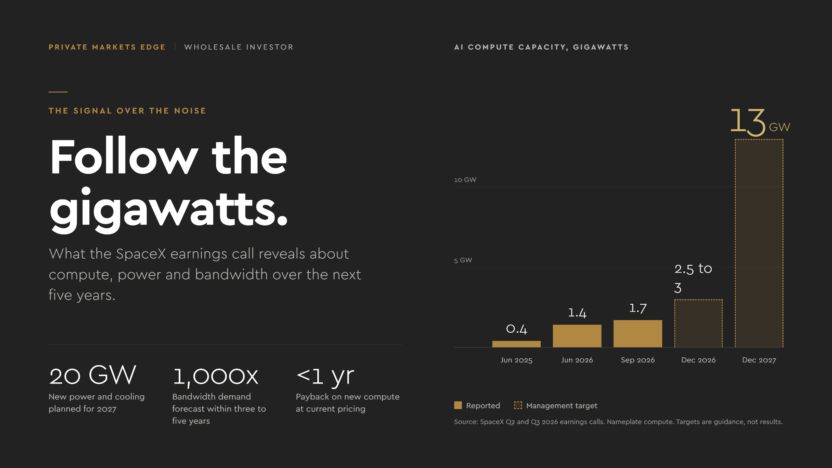
Forget the share price. SpaceX just published a map of the next five years.
Most coverage of SpaceX’s result focused on a 9.1% share price fall. That is noise. The signal is in the transcript: compute, power, bandwidth and demand over the next five years.

The prefab company that deliberately leaves part of the house unbuilt
BuiltQuik prefabricates the floor and roof structure and stops there. Co-founder Ryan Mullaney argues the omission is the product. Prefabricated housing usually means a factory. A large central facility, identical modules, limited room to move on design, and a logistics problem getting the finished box to site. BuiltQuik builds the opposite, and the design decision […]
Backed By Leading Investment Groups and Family Offices