
News and Announcements

Forging a $100M Future: Why Prime Financial Puts People First in its Acquisition Strategy
- Published October 08, 2025 4:52AM UTC
- Publisher Jade Miguel
- Categories Capital Insights, Executive Interviews, Landing, Trending
In a market awash with consolidation plays, ASX-listedPrime Financial Group is charting an ambitious course to nearly double its revenue to $100 million. But while its war chest is primed for acquisitions, Chairman and Managing Director Simon Madder is adamant that the firm’s most valuable asset isn’t capital, but culture.
The group is betting that its founder-focused, people-first ethos will be the key differentiator in executing its aggressive growth strategy, which aims to hit the nine-figure revenue target between FY28 and FY30.
Prime, an integrated advice, capital, and asset management firm with approximately $1.9 billion in funds under management, is not starting from a standstill. The firm currently turns over $55 million in continuous revenue and has a proven strategic playbook.
Madder is quick to point out that this is not uncharted territory. “History is helpful when you’re thinking about what the future might look like,” he says.
“Three years ago, we set ourselves a goal to increase our revenue from $26 million to $50 million. We were able to achieve that, arguably it was probably a little bit more difficult in the past because there’s a lot more infrastructure that you needed to build.”
That confidence is underpinned by strong recent performance. The company posted 21% revenue growth and a 17% lift in underlying EBITDA over the last 12 months, with two-thirds of that top-line growth coming from acquisitions.

The Cultural Litmus Test
While inorganic growth is central to hitting the $100 million target, Prime’s approach to acquisitions deliberately eschews a traditional corporate roll-up model. For Madder, the real litmus test for any deal is cultural alignment.
“It is very much led by the people piece and the service stack,” he says, adding there is a “huge amount of consideration around that founder mindset and continuing that on for the future.”
This philosophy is more than just talk; it’s hard-wired into the deal structure. Prime’s acquisition approach combines immediate value with long-term upside through an equity-based component, designed to align founders’ interests post-transaction. This strategy effectively turns acquired entrepreneurs into partners, vested in the group’s collective success.
“We want to make sure that we keep that business owner mindset going into the future,” Madder notes. He believes this is the key to navigating the complexities of integration. “If you get the people piece right and there’s alignment around that, then you encounter fewer challenges.”
A Business of Owners
Prime’s ability to attract and integrate founder-led businesses is a direct reflection of its own 27-year history and internal structure. The firm has cultivated a deeply embedded “business owner mindset,” underscored by the fact that its 225 team members collectively own half of the company.
It’s this internal dynamic, Madder argues, that gives Prime its edge. “When you own part of the business that you’re helping to co-create, you can drive better outcomes,” he says.
As Prime stands at what Madder describes as an “exciting inflection point,” the strategy is clear: leverage a resilient, ownership-driven culture to attract and empower like-minded businesses. It’s a people-led push for growth in a numbers-driven industry.
“If you empower your people, you can achieve some pretty amazing outcomes,” he concludes. “That’s what we’re excited about.”
Trending

The A$20.4 Million Inertia Trap: How Kepa Software Is Unlocking Value in Enterprise Capital Allocation
A government agency renewed the same maintenance decision nine years running, because auditing the original choice was deemed too expensive. When the portfolio was finally tested, A$20.4 million of low value spend was identified in a single year. Kepa Software’s capital governance platform was built to expose and eliminate precisely these boardroom blind spots. For […]
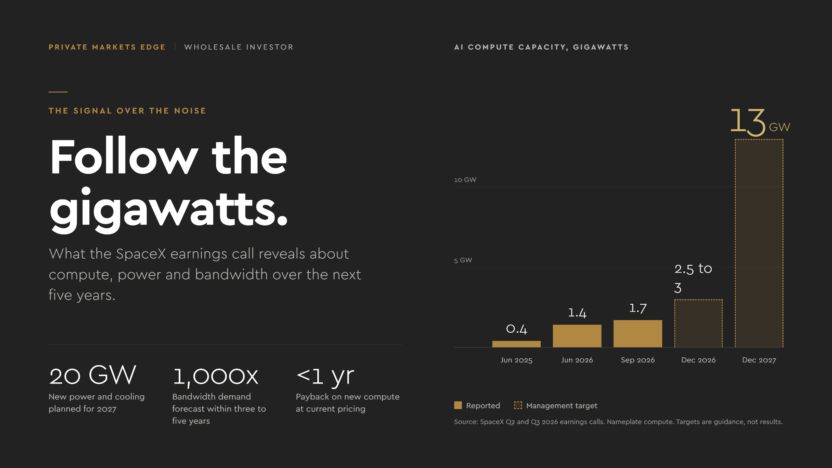
Forget the share price. SpaceX just published a map of the next five years.
Most coverage of SpaceX’s result focused on a 9.1% share price fall. That is noise. The signal is in the transcript: compute, power, bandwidth and demand over the next five years.

The prefab company that deliberately leaves part of the house unbuilt
BuiltQuik prefabricates the floor and roof structure and stops there. Co-founder Ryan Mullaney argues the omission is the product. Prefabricated housing usually means a factory. A large central facility, identical modules, limited room to move on design, and a logistics problem getting the finished box to site. BuiltQuik builds the opposite, and the design decision […]
Backed By Leading Investment Groups and Family Offices