
News and Announcements
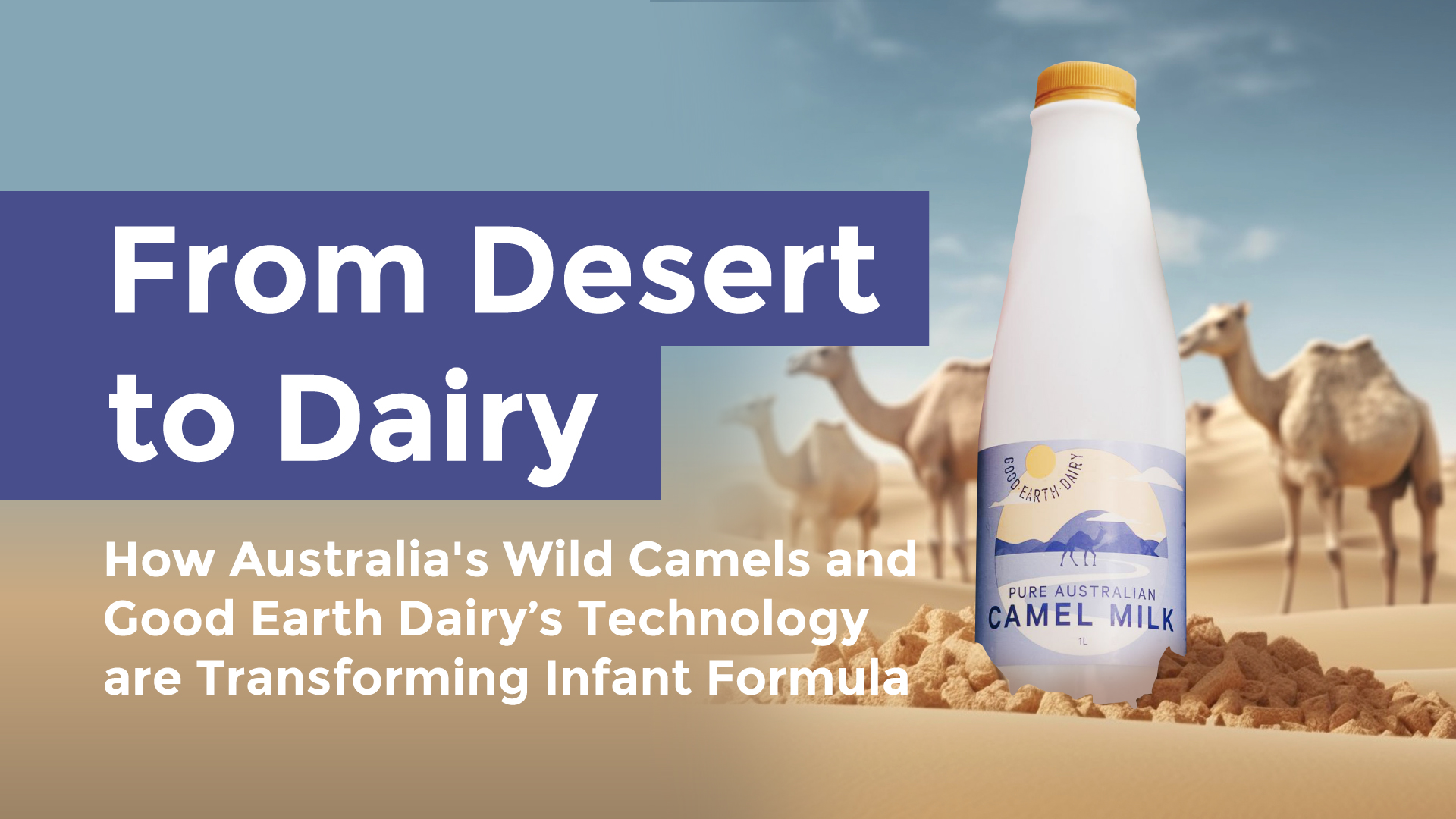
From Desert to Dairy: How Australia’s Wild Camels and Good Earth Dairy’s Technology are Transforming Infant Formula
- Published April 23, 2025 11:02PM UTC
- Publisher Wholesale Investor
- Categories Capital Insights, Landing, Trending
In the vast expanse of the Australian outback, an unexpected revolution in infant nutrition is taking shape. The global dairy Infant Formula market is AUD $127 billion in 2025 and is projected to surge to AUD $278 billion by 2032, and one company has developed new technology to harness Australia’s unique natural advantage: the world’s largest population of wild camels.

At the heart of this transformation is Marcel Steingiesser, Managing Director of Good Earth Dairy, who sees beyond the conventional dairy landscape. “Camel milk does not contain the key allergen that other animal milk has,” he explains, pointing to a critical advantage in a market where “cow and goat milk protein is the most prevalent allergen in Infant Formula.”
This is why Good Earth Dairy invested heavily into its technology to be able to produce high quality camel milk powder at a low cost; a technology that has been awarded with a AUD $4.4m Australian government grant.
The timing couldn’t be better as the specialty baby milk segment is expected to grow at an impressive 9.6% CAGR from 2024 to 2032, outpacing the overall infant formula market growth. What sets Good Earth Dairy’s solution apart is its natural alignment with infant digestive systems.
As Steingiesser notes, “Camel milk is the only animal milk not to hard coagulate in the gut,” making it remarkably similar to human breast milk in terms of digestibility.
Australia’s unique position in this emerging market extends beyond its camel population. “We now have a country full of not just camels, but the healthiest camels,” Steingiesser emphasises, referencing the disease-free introduction of these animals to the continent.
This clean slate, combined with Australia’s reputation for high-quality agricultural products, creates a compelling value proposition for global markets, particularly in the Asia-Pacific region, which holds a 34.1% market volume share, with China, Japan, and South Korea collectively accounting for 79.77% of the region’s total consumption.
But the vision extends far beyond infant formula. Good Earth Dairy has successfully developed delicious cheese, yogurts, ice cream, and gelato, which have the same flavour profile as ordinary cow milk demonstrating the versatility of camel milk.
The nutritional profile is impressive: “It’s very high in lactoferrin, as well as being much richer in minerals such as iodine, copper and zinc, positioning these products for health-conscious consumers across all age groups.
While consumer education remains a priority – Steingiesser acknowledges the need for “market education” – the company’s trajectory suggests a transformation in how we think about dairy alternatives. Their focus on the premium infant formula market indicates a strategic approach to market entry, with potential for broader market disruption.
Looking ahead, Good Earth Dairy’s innovative approach could redefine dairy industry standards. By combining Australia’s natural resources with cutting-edge production techniques, they’re not just creating alternative dairy products – they’re pioneering a new category in global nutrition. For investors and industry observers, this represents more than a market opportunity; it’s a glimpse into the future of sustainable, health-conscious food production.
The global dairy landscape is witnessing a remarkable shift, and Australia’s wild camels, once considered a liability, may well become one of its most valuable assets in the quest for better nutrition. As Steingiesser puts it, “the world has a great respect for the high quality standards that come out of Australia and Good Earth Dairy has developed new technology to be price competitive,” – a foundation upon which Good Earth Dairy is building its vision for the future of dairy.
Sources:
Trending

The asset class where the market has no vote
Litigation funding returns are decided in a courtroom, not a cycle. Knightsbridge’s Head of Capital is careful to call that a different risk rather than a lower one, and his answer to it is spread, not concentration. Most alternative assets still answer to something. Property answers to rates. Private credit answers to defaults. Even the […]

The listing fee vendors pay whether the house sells or not
Australia’s property portals collect more than $2 billion a year while national listings sit flat. An Australian-built AI platform is targeting the economics, not just the interface. An Australian vendor listing a home pays a vendor-paid advertising fee on top of agency commission. Rama Dwarapudi, Founder and Chief Executive Officer of RealSearch, puts a typical […]

Reinventing the Condom: How an Australian Deep-Tech Startup Plans to Disrupt a $12 Billion Market
For more than half a century, the global condom industry has remained fundamentally unchanged, constrained by standard materials like latex and solid synthetic polymers. Despite widespread consumer demand for better alternatives, product design has treated the device strictly as a mechanical barrier, sacrificing feel for function. Sydney-based Eudaemon Technologies is setting out to upend that […]
Backed By Leading Investment Groups and Family Offices