
News and Announcements
Forget the share price. SpaceX just published a map of the next five years.
- Published October 24, 2026 9:17PM UTC
- Publisher Steve Torso
- Categories Capital Insights
The signal over the noise
The share price moved more than the business did this week.
SpaceX jumped around 8% after its results, then fell 9.1% on Thursday as the market fretted over the cost of the AI buildout and talk of a Tesla merger. That is the noise.
The signal sits in the transcript. For an hour, the people building one of the largest infrastructure stacks on the planet set out, in specific numbers, what the next two to five years require.
Compute. Energy. Bandwidth. Demand.
If you want to understand where capital is heading, this is one of the clearest maps published this year. Here is what I took from it.
1. The AI buildout is now measured in gigawatts
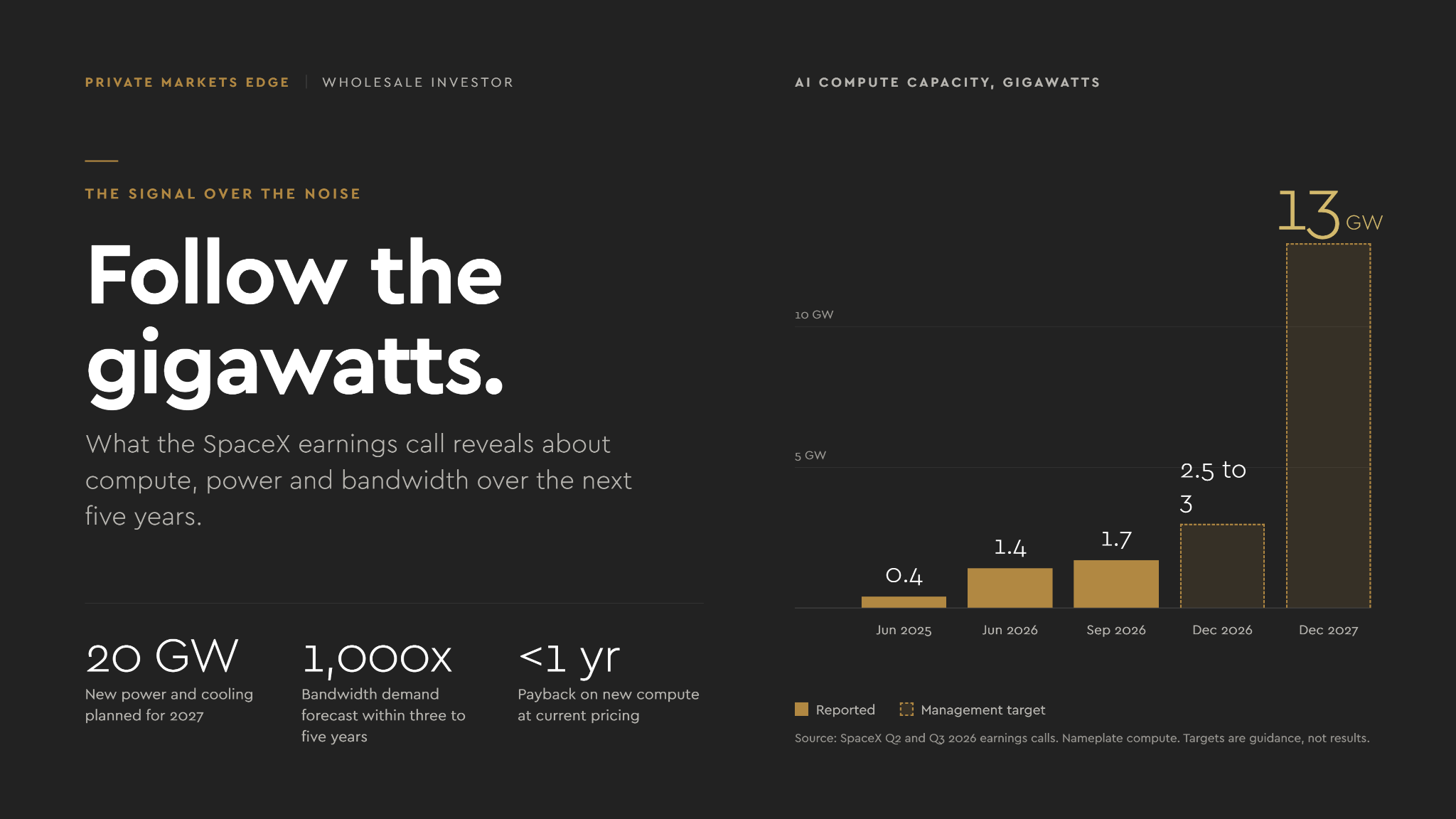
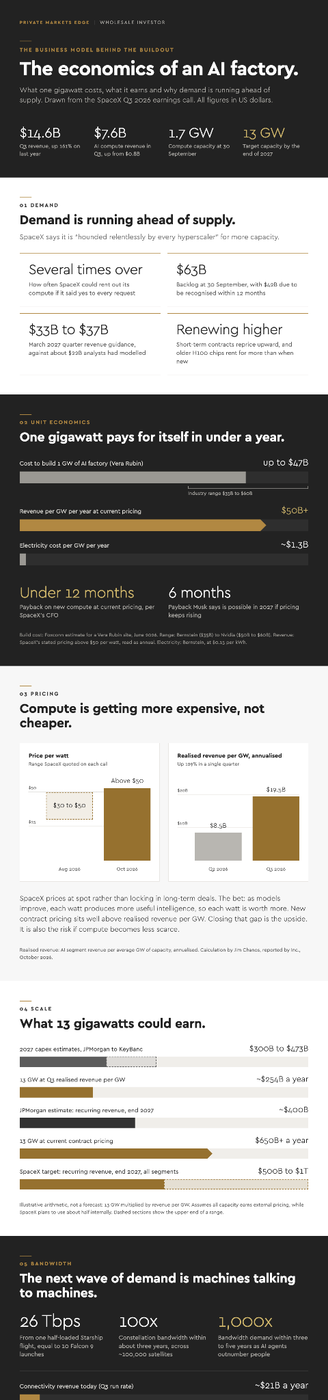
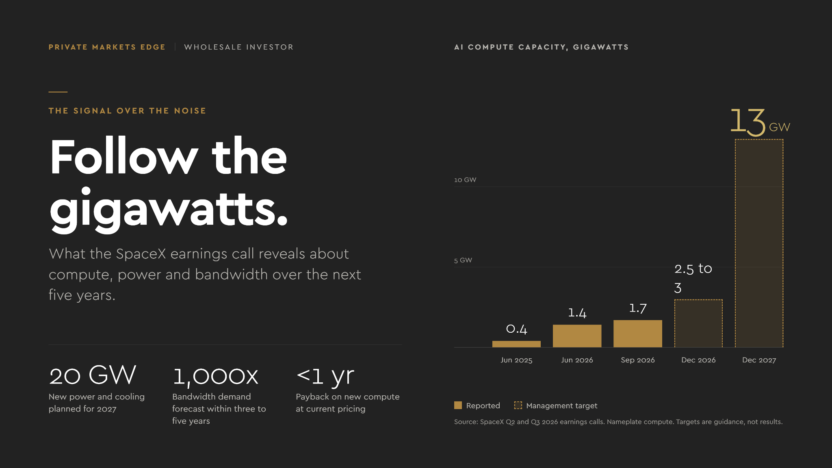
A year before its second-quarter result, SpaceX had about 400 megawatts of compute. It ended September with 1.7 gigawatts. It expects 2.5 to 3 gigawatts by December.
Then the number that matters. Musk said he would be surprised to finish 2027 with less than 13 gigawatts.
In August, the guidance for end-2027 was closer to 10 gigawatts than 5. The target moved up within a single quarter.
The spend matches the ambition. US$19.6 billion of capex in the September quarter. US$35 to 40 billion guided for December. One company. One quarter.
2. Energy is the binding constraint
Nobody on the call spent much time on chips. They spent it on power.
Musk put it plainly: “the constraint on deployment of superintelligence is more in power and cooling” than chips.
SpaceX plans to add 20 gigawatts of power and cooling in 2027, deliberately more than its GPUs need. For context, the average demand record across Australia’s entire east coast grid is about 23.7 gigawatts. One company plans to add close to that in a single year.
The most telling detail I found was turbine blades. Suppliers say blades and vanes run 12 to 18 months behind the rest of the turbine. So SpaceX is casting its own, using the foundry it built for rocket engines.
When a rocket company starts making gas turbine parts to get around a supply chain bottleneck, you know exactly where the real constraint sits.
3. Demand still exceeds supply, and pricing is rising
This is the part most commentary skipped.
- Payback on new compute is under a year. Musk raised the possibility of six months in 2027.
- Pricing is tracking above the top of the US$30 to 50 per watt range discussed only three months earlier. That translates to $30 to $50 billion in revenue per gigawatt.
- Short-term contracts are renewing at higher prices, and older chips are renting for more than they did when new.
- SpaceX says it is “hounded relentlessly by every hyperscaler” and could rent its capacity several times over.
SpaceX prices at spot rather than locking in long-term deals. That is a deliberate bet that compute value rises as the models running on it get smarter.
4. The next bandwidth wave is machines talking to machines
Musk expects demand for 1,000 times more bandwidth within three to five years. The reasoning is simple. Each AI agent uses more bandwidth than a person, and there will be far more agents than people.
Supply is being built to match. A single Starship flight, roughly half-loaded, deployed 26 terabits per second of capacity, equal to ten Falcon 9 launches. The target is 100 times today’s constellation bandwidth within about three years, across something like 100,000 satellites.
The early demand is already visible:
- 13.6 million Starlink consumer subscribers, up 1.6 million in the quarter
- 22 million monthly Starlink Mobile users, up 37% in three months
- 12,000 aircraft contracted, almost a quarter of the available fleet
Connectivity is becoming infrastructure for machines, not just people.
5. Agents are the demand engine underneath everything
Grok Bot, SpaceX’s agentic assistant, launched in August. It reached 800,000 paid weekly users by early October, more than doubling in a month. Business customers are the fastest-growing segment, using it as an always-on teammate across sales, marketing, IT, and engineering. Usage per user rises over time rather than fading.
Musk believes agents may end up consuming most of the company’s compute.
This is the thread that connects every number above. Agents drive compute. Compute drives power. Agents drive bandwidth.
6. Vertical integration is the new moat
SpaceX launches about 90% of all mass sent to orbit. It casts its own turbine parts. It is building its own chip fab, aiming for a test chip by mid-2027 and volume production in the second half of 2028.
Launch, satellites, spectrum, compute, power and models in one stack. Whoever controls the bottleneck captures the margin.
Separate the vision from the guidance
This is where discipline matters.
The aspiration: Musk put annual recurring revenue at US$500 billion to US$1 trillion by the end of 2027.
The guidance: the CFO guided March 2027 quarter revenue to US$33 to 37 billion, against roughly US$22 billion analysts had modeled. Annualised, that is around US$132 to 148 billion.
The independent view: JPMorgan models recurring revenue at around US$400 billion by end-2027.
The cost: 2027 capex estimates run from roughly US$300 billion (JPMorgan) to US$473 billion (KeyBanc). Cash fell about US$10 billion in a single quarter. Only US$42 billion of the US$63 billion backlog converts to revenue within 12 months, so much of the growth isn’t yet contracted. Skeptics also point out that revenue per megawatt sits well below what bulls expected.
Even the conservative read is remarkable. Quarterly revenue was US$4.7 billion at the start of 2026. Guidance for the start of 2027 is seven times that.
What this means for private capital over the next two to five years
- The bottlenecks are the opportunity. Power generation, grid connection, cooling, electrical equipment, and advanced manufacturing. The headline company is rarely where private investors capture the best risk-adjusted return.
- Capital intensity at this scale pulls in debt. SpaceX is already talking to multiple debt capital pools. Private credit and infrastructure funds will finance a meaningful share of this buildout.
- Connectivity becomes machine infrastructure. Every connected car, robot, and agent adds load.
- Australia has the energy, land and capital this cycle needs. The question is whether we position for it or watch it happen elsewhere.
The share price will keep swinging on every headline. The physical requirements will not.
Follow the gigawatts.
Capital Insights
Forget the share price. SpaceX just published a map of the next five years.
Most coverage of SpaceX’s result focused on a 9.1% share price fall. That is noise. The signal is in the transcript: compute, power, bandwidth and demand over the next five years.

The prefab company that deliberately leaves part of the house unbuilt
BuiltQuik prefabricates the floor and roof structure and stops there. Co-founder Ryan Mullaney argues the omission is the product. Prefabricated housing usually means a factory. A large central facility, identical modules, limited room to move on design, and a logistics problem getting the finished box to site. BuiltQuik builds the opposite, and the design decision […]

Dogs First to Reduce Risk: QBiotics’ Smarter Path to Oncology Markets
QBiotics took a compound derived from a north Queensland rainforest tree all the way to veterinary registration before pursuing human oncology to de-risk its human cancer programme. Interim CEO Ebru Davidson argues that sequence – now backed by early responses across several human cancers – is the company’s real asset. The story that pulled Wholesale […]
Backed By Leading Investment Groups and Family Offices