
News and Announcements
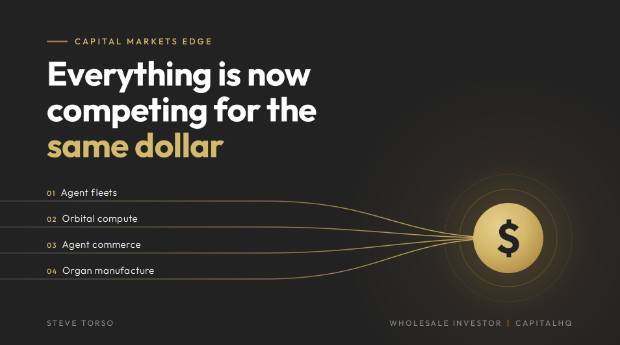
Everything is now competing for the same dollar
- Published September 22, 2026 5:31AM UTC
- Publisher Bella Battsengel
- Categories Company Updates
Key takeaways
- Four frontiers are scaling at the same time: agent fleets, orbital compute, agent commerce and organ manufacture. Each one is capital hungry.
- Goldman Sachs reports that AI now accounts for around 25% of US dollar investment grade bond supply and about 44% of US convertible issuance this year.
- Capital is scarcer and more selective. For founders and fund managers, clear investor communication is now part of the cost of capital.
As recently as 2022, Germany and Japan could borrow for 30 years at close to zero. That world is gone, and AI is now bidding for what is left.
Over the past fortnight, I listened to founders, operators and allocators describe where their industries are heading. They covered four very different frontiers. Each described a capital requirement.
This matters for private markets, because all of those claims land on the same pool of money.
The workforce is becoming a fleet
Operating leverage is moving from headcount to agent fleets.
On the 20VC podcast, Eight Sleep described engineers who each manage hundreds of coding agents. They described their email marketing as a team of zero.
On All-In, Uber and Snowflake were cited as evidence that companies can now grow without adding headcount. Baseten made a quieter point. Agents already choose and deploy models, while production changes stay gated by a human.
That detail matters. Across the new agent products, the rule that the agent drafts and a human hits send has become product positioning. Trust is now a selling point.
Some commentators say this will double GDP. Treat that as a horizon thesis. What the data shows today is narrower. AI investment is already a meaningful contributor to US GDP in Federal Reserve tracking, while aggregate productivity still lags the narrative. Mainstream estimates sit nearer 0.25 to 1 percentage point of annual productivity growth.
The direction is clear. The timing is not. Allocators should price both.
Compute is leaving the ground
Gwynne Shotwell and Elon Musk told All-In that by revenue, SpaceX is now as much an AI business as a space business. Demand for compute rental is not dropping.
The roadmap they named is specific. V3 Starlink satellites arrive in 2026. AI compute satellites are targeted for 2027.
The logic is physical. In orbit, there is no permitting queue and no wait for generators. Solar power is constant, and cooling is simpler. SpaceX also paid $17 billion for EchoStar spectrum to connect satellites directly to mobile phones.
The AI trade is no longer just chips. It is launch, spectrum, watts and orbital real estate. Every layer needs funding.
Agents now have a wallet
On 8 September 2026, Stripe announced that Meta’s personal AI agent, Muse, can shop across the internet using Link, Stripe’s digital wallet.
The design is worth studying. Muse never sees the underlying payment details. At more than 1 million businesses that accept Link, checkout is instant. Everywhere else, Muse receives a single-use virtual card limited to the approved amount. The human approves every total in chat.
This is not two bots settling with each other. It is the first mainstream rail that treats an agent as an economic actor with a supervised budget.
Once agents can pay, distribution changes. Agents will increasingly be the ones your business sells to.
Medicine moves from repair to manufacture
Martine Rothblatt of United Therapeutics told the Moonshots podcast that longevity will not come from a single miracle molecule. It will come from industrial organ manufacture.
She has four thymus programmes running in parallel. A pig thymus-kidney transplant is already on an FDA-cleared clinical path. Trials of a kidney built from the patient’s own cells are slated for 2028, with commercial-scale facilities planned in Minnesota and Texas. Rejuvenated organs are framed for the 2030s, and she says the timing may slip.
The allocation thesis is simple. Spending moves from treating sickness to keeping people well. The diligence filter for any bio platform is whether it has a clinical path and a way to scale to billions of people. A projected year for extending lifespan is not a filter.
One pool, more claims on it
Here is what connects all four. Each of these frontiers is capital hungry, and they are arriving as the cost of capital rises.
Goldman Sachs put a name to it on 17 September 2026. Its report, Competition for Capital, links AI and higher rates through one idea. They draw on the same pool.
- Capex at AA-rated issuers rose 65% year on year in the second quarter. That is the tenth straight quarter above 35%.
- US convertible issuance has reached roughly $135 billion this year. AI accounts for about 44% of it.
- AI now represents around 25% of US dollar investment-grade supply.
- Hyperscaler capex is eating free cash flow, so more of the build is funded by issuance.
Goldman does not call this a classic valuation bubble. US forward PE has fallen from about 22 times to about 19 times since early 2025. Earnings drove returns, not multiples. The bigger risk it names is an earnings boom that proves unsustainable, even while compute demand outstrips supply.
Its stance is neutral on equities over three months and overweight over twelve.
What this means for Australian private markets
This is not a distant Wall Street story. Australian founders and fund managers raise from investors who price risk against the same global pool.
When the world’s largest companies are issuing at a record pace, a tide of cheap money will not carry anyone.
Capital is scarcer and more selective. Investors have more claims on their attention than at any point in my 17 years in this market.
In this cycle, the companies that communicate clearly and stay top of mind will recover capital that would otherwise be left on the table.
The deal does not get better. It just gets understood.
Sources
- Goldman Sachs, Competition for Capital, 17 September 2026
- Stripe newsroom, “Stripe helps Muse, Meta’s new personal AI agent, shop across the internet with Link”, 8 September 2026
- All-In podcast, interview with Elon Musk and Gwynne Shotwell, September 2026
- 20VC podcast, Eight Sleep episode, September 2026
- Moonshots with Peter Diamandis, Martine Rothblatt episode, September 2026
This article is general information only and does not constitute financial advice.
Company Updates
Everything is now competing for the same dollar
Key takeaways As recently as 2022, Germany and Japan could borrow for 30 years at close to zero. That world is gone, and AI is now bidding for what is left. Over the past fortnight, I listened to founders, operators and allocators describe where their industries are heading. They covered four very different frontiers. Each […]
Australia has not held 90 days of fuel since 2012. The fix may start at a sewage plant.
A decommissioned council treatment site in Bundaberg is being built into a $188.9 million biorefinery. Its managing director is candid that the largest revenue line is not yet contracted. Australia has not met its international 90-day fuel reserve obligation since 2012. Around 90 per cent of the country’s liquid fuel is imported. Andy Whitmore, Managing […]
Forget Startups: Why Magnetic Alliance is Betting on “Boring” Mid-Market Turnarounds
While Australia’s venture capital scene spent years chasing unprofitable tech startups and speculative high-growth plays, Mark Lim was quietly taking a radically different path. The Managing Partner of Magnetic Alliance Capital sees the nation’s richest investment opportunities hiding in plain sight: inside thousands of unglamorous, profitable, but operationally sluggish mid-market businesses. Speaking on Wholesale Investor’s […]
Backed By Leading Investment Groups and Family Offices