
News and Announcements

Australia has not held 90 days of fuel since 2012. The fix may start at a sewage plant.
- Published September 22, 2026 4:00AM UTC
- Publisher Bella Battsengel
- Categories Company Updates, Executive Interviews
A decommissioned council treatment site in Bundaberg is being built into a $188.9 million biorefinery. Its managing director is candid that the largest revenue line is not yet contracted.
Australia has not met its international 90-day fuel reserve obligation since 2012. Around 90 per cent of the country’s liquid fuel is imported.
Andy Whitmore, Managing Director of Bio Energy Group, argues the real figure is worse than that.
“The other 10 per cent, we import the feedstock to refine into liquid fuels,” Andy said in the interview. “Effectively 100 per cent of our fuel, we are dependent on the shipping lanes around our continent.”
He points to the recent shock in the Strait of Hormuz, and notes there are other potential disruptions that would matter considerably more to the Australian economy.
His response is being built on a former council sewage treatment plant in Bundaberg, Queensland.

The molecule, not the electron
Andy spent eight years at 3M before running a manufacturing business across the United Kingdom, Eastern Europe and China. He emigrated to Australia, built a wireless broadband network he describes as five times faster than the copper it replaced, then moved into renewable-energy-powered data infrastructure.
That last step is what led him to Bundaberg. He was looking for ways to power decentralised data centres in locations without high-voltage access, and encountered a site with plans for behind-the-meter energy generation.
His assessment was that the plan was inefficient.
“It was inefficient to create biogas and convert it into electrons for behind-the-meter applications,” he said. The value, on his reading, sat in the CH4 molecule itself rather than in the electricity it could produce.
Separate the CO2 from the CH4, and what remains is chemically identical to natural gas. Run that through a gas-to-liquid process using Fischer-Tropsch technology, which Andy notes has existed for a very long time, and the output is a low-carbon liquid fuel.
That, he says, is the most valuable form the molecule can take.
He frames the opportunity as three gaps. Renewable energy for distributed infrastructure without access to high-voltage power. A renewable energy solution that complements agriculture rather than compromising it. And a viable sustainable replacement for fossil gas and fossil liquid fuels.
The second of those is the one he says should sit higher in Australia’s sustainability criteria as a country.
Why a brownfield sewage site
The site selection was a decision about time rather than symbolism.
The location already carried preliminary plans for a data centre and an energy solution, which meant it had been through multiple rounds of approvals and came with established council relationships. Andy describes it as a brownfield site ready for development.
“If you go from a site that has no infrastructure planned or approved, it’s a much longer delivery cycle,” he said.
His view is that the market for sustainable aviation fuel and renewable diesel exists now and is growing quickly, which makes speed to production a competitive variable rather than an operational one. He adds that the council has long wanted to see the site converted to something within the bioenergy sector.
Solving the grower’s problem first
The feedstock strategy runs through an agricultural economy under pressure.
Andy describes the strain on cane growers Australia-wide as incessant, and the contraction in the number of mills along the east coast as terrifying. Two mills remain in the Bundaberg region. He says many forecasters expect room for only one in the near future.
The pricing mechanism compounds it. What a grower receives depends in part on Brazilian decisions about ethanol versus sugar, and the grower does not learn the value of the crop until after processing.
“He has no idea, no certainty of revenue,” Andy said. “No idea whether or not it’s going to be a good year, a bad year, or a terrible year.”
He says this came into focus in conversations with the two cane growers associations in the region, and particularly with one larger grower, Peter, supplying in the region of 200,000 tonnes of cane a year to the sugar mill with no visibility on whether it would deliver a profit or a loss.
The proposal discussed was a 10-year fixed-price feedstock contract. It gives the plant supply security. It gives the grower revenue certainty and the ability to plan.
Sorghum is offered as an alternative crop into that arrangement.
What is contracted, and what is not
On the commercial position, Andy is direct about where the gaps sit.
The CO2 and biofertiliser offtakes are contracted. The sustainable aviation fuel agreement, which accounts for more than half of projected revenue, is not yet fully executed.
He explains that Bundaberg forms the first part of a contract with a global commodity trading group, and represents around 4 per cent of the total contracted volume. Commercial terms have been signed. He expects a fully binding contract to be executed within eight weeks, with the remaining work sitting between the two sets of legal representatives on what he describes as complex logistics structures.
Contracts with the principal installation partners are executed, covering the anaerobic digestion plant, the gas upgrading and the gas-to-liquid plants.
Andy also notes that multiple entities are seeking to acquire the fuel, and that the company has been careful to optimise the value of the offtake rather than accept the first arrangement available.
A model that assumes no subsidy
More than a billion dollars in government initiatives for low-carbon fuels has been announced. The base case financial model assumes none of it.
“A project that is reliant on government subsidies is always subject to scrutiny and policy change,” Andy said.
His position is that the subsidies are coming and will provide additional benefit to the programme and to others in the sector. But a project that depends on them is not investable if they are withdrawn.
Nine million litres, and the argument for scale
Bundaberg is designed to produce nine million litres a year. Andy is the first to say that against national requirements this is a very small amount.
The argument is demonstration rather than volume.
If agricultural residues can be converted into liquid fuels at Bundaberg, the model can be replicated across the arable land and cane-growing regions of the east coast. Andy says the region alone holds something in the order of ten times more available feedstock than the project requires.
He positions this as an alternative to the used cooking oil pathway, and as a route that does not run into the food versus fuel problem. Residues that deliver limited benefit to the soil are processed, and nutrient-available biofertiliser is returned to the land.
The project is forecast to create hundreds of construction jobs and close to 100 full-time roles on a 25-year basis.
“It feels like the beginning of the gas rush 30 years ago,” he said.
The implication
The fuel security argument has been made in Australia for over a decade without producing much construction. What is different here is that the case does not rest on it.
The plant is being built on approvals someone else obtained, with feedstock secured by solving a grower’s revenue problem, and a model that works without a subsidy that has not been legislated.
Executive Interviews
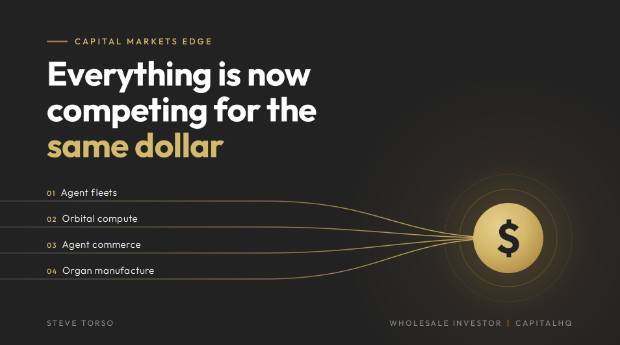
Everything is now competing for the same dollar
Key takeaways As recently as 2022, Germany and Japan could borrow for 30 years at close to zero. That world is gone, and AI is now bidding for what is left. Over the past fortnight, I listened to founders, operators and allocators describe where their industries are heading. They covered four very different frontiers. Each […]

Australia has not held 90 days of fuel since 2012. The fix may start at a sewage plant.
A decommissioned council treatment site in Bundaberg is being built into a $188.9 million biorefinery. Its managing director is candid that the largest revenue line is not yet contracted. Australia has not met its international 90-day fuel reserve obligation since 2012. Around 90 per cent of the country’s liquid fuel is imported. Andy Whitmore, Managing […]

Forget Startups: Why Magnetic Alliance is Betting on “Boring” Mid-Market Turnarounds
While Australia’s venture capital scene spent years chasing unprofitable tech startups and speculative high-growth plays, Mark Lim was quietly taking a radically different path. The Managing Partner of Magnetic Alliance Capital sees the nation’s richest investment opportunities hiding in plain sight: inside thousands of unglamorous, profitable, but operationally sluggish mid-market businesses. Speaking on Wholesale Investor’s […]
Backed By Leading Investment Groups and Family Offices